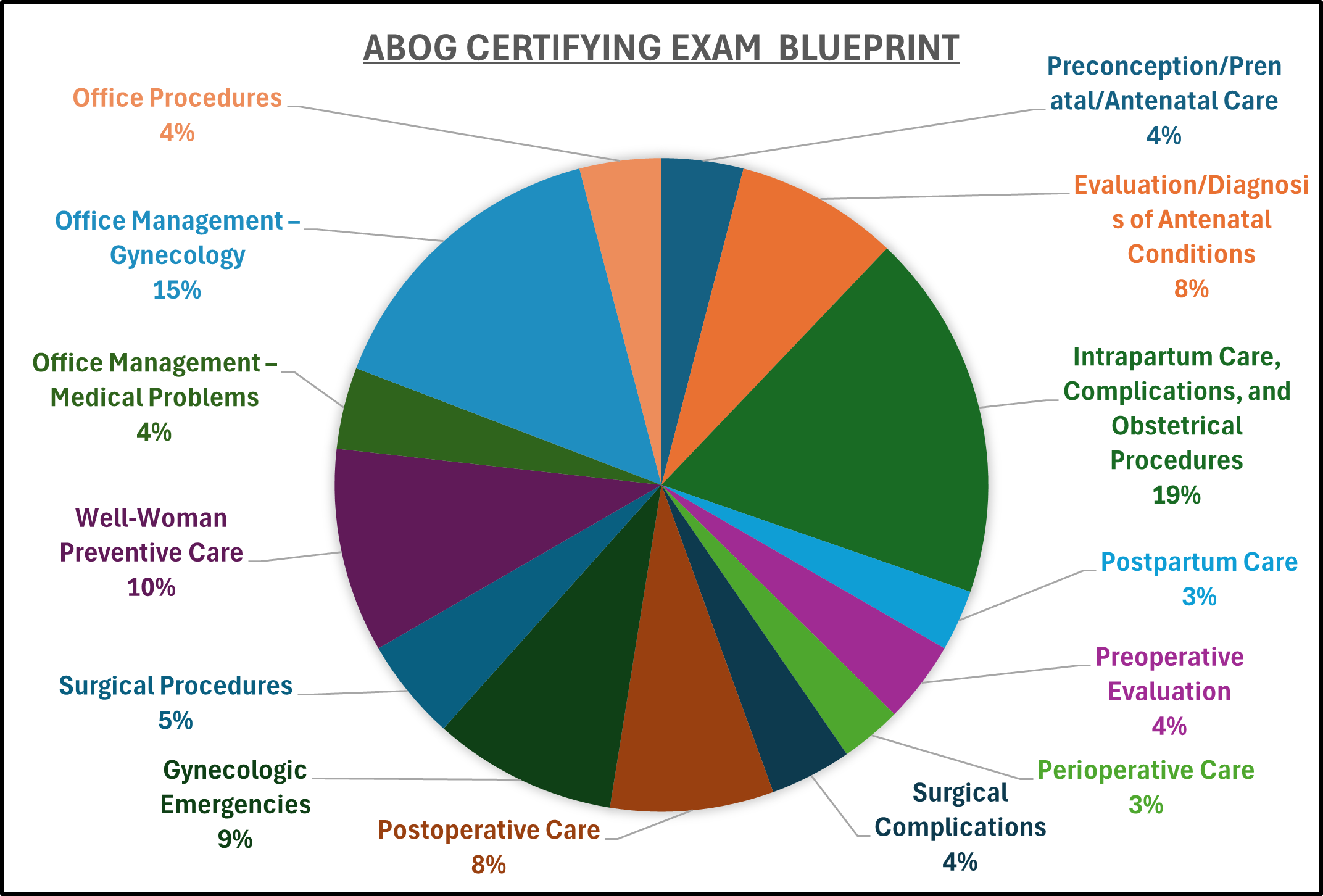
The most reliable way to prepare for the ABOG Qualifying Examination (QE) is to let the Specialty Blueprint dictate how and what you study. The blueprint is not an abstract document or a formality. It is the framework ABOG uses to decide what appears on the exam and how heavily each area is tested.
If you align your preparation to the blueprint, you are studying the exam as it actually exists, not as you imagine it.
What is the Specialty Blueprint and why does it matter?
The ABOG Specialty Blueprint is developed from periodic Job Task Analyses of practicing obstetrician-gynecologists. In plain terms, ABOG surveys what board-certified OB-GYNs actually do in practice and builds the exam to reflect that reality.
For that very reason, the QE does not reward narrow expertise or subspecialty depth. It rewards broad, applied clinical judgment across the full scope of general OB-GYN care.
The blueprint defines both content and weighting, which makes it the single most important study-planning document you have.
Start with the blueprint’s top-level structure
At the highest level, the QE is divided evenly across three domains:
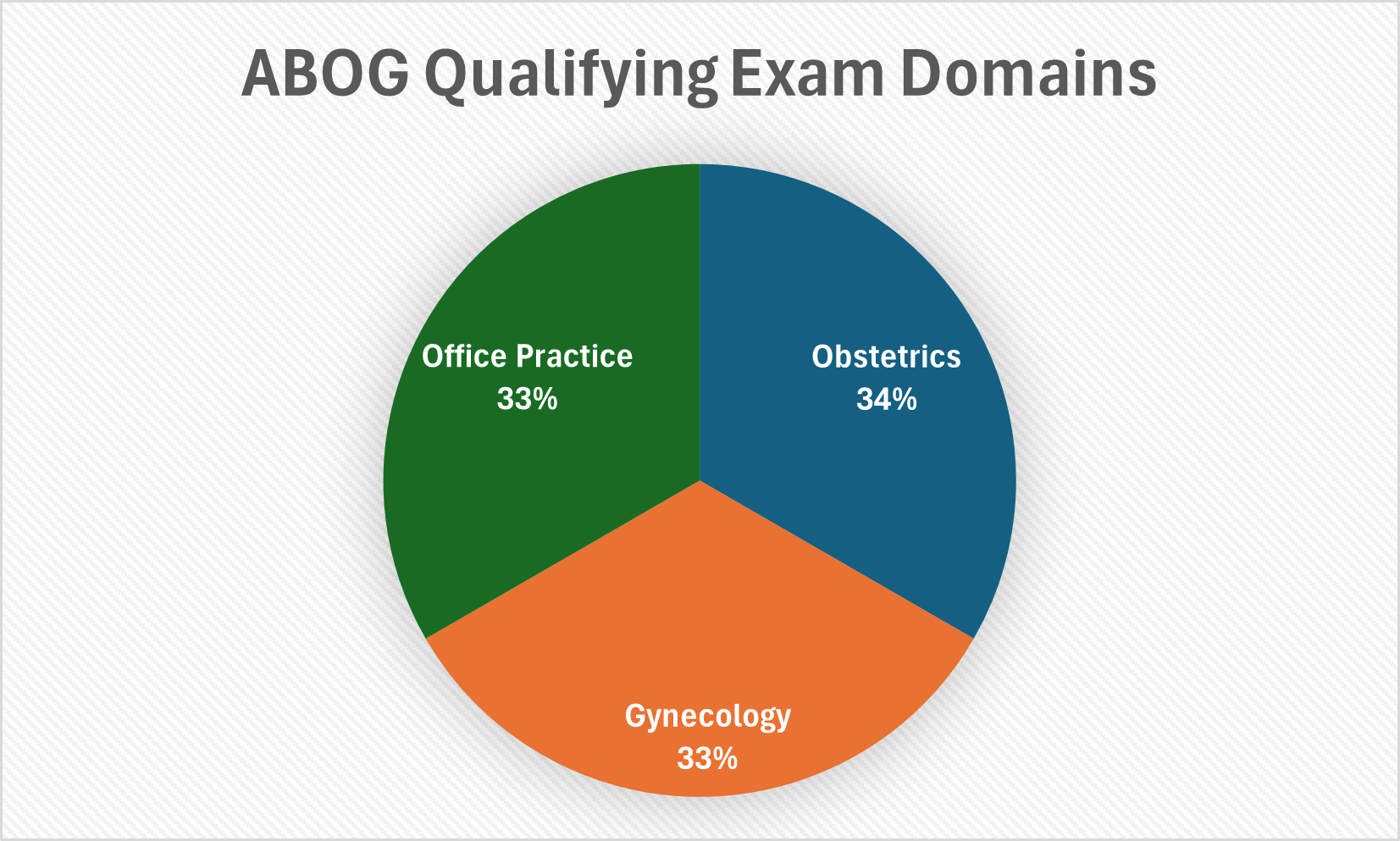
Each domain accounts for approximately one-third of the exam. This balance is fixed.
A common preparation mistake is letting recent rotations, comfort areas, or career plans distort study time. The blueprint makes clear that the exam does not adjust for those factors. Your study plan shouldn’t either.
A simple starting rule is to make sure your weekly studying always includes all three domains, even if the proportions shift slightly from week to week.
Study in the same order the blueprint is organized
The blueprint is intentionally structured. It is not a random topic list.
Within each domain, topics move from routine care to more complex decision-making and complications. That sequencing mirrors how ABOG expects you to reason through clinical problems.
When you study in that same order, concepts tend to stick better and questions feel more familiar on exam day.
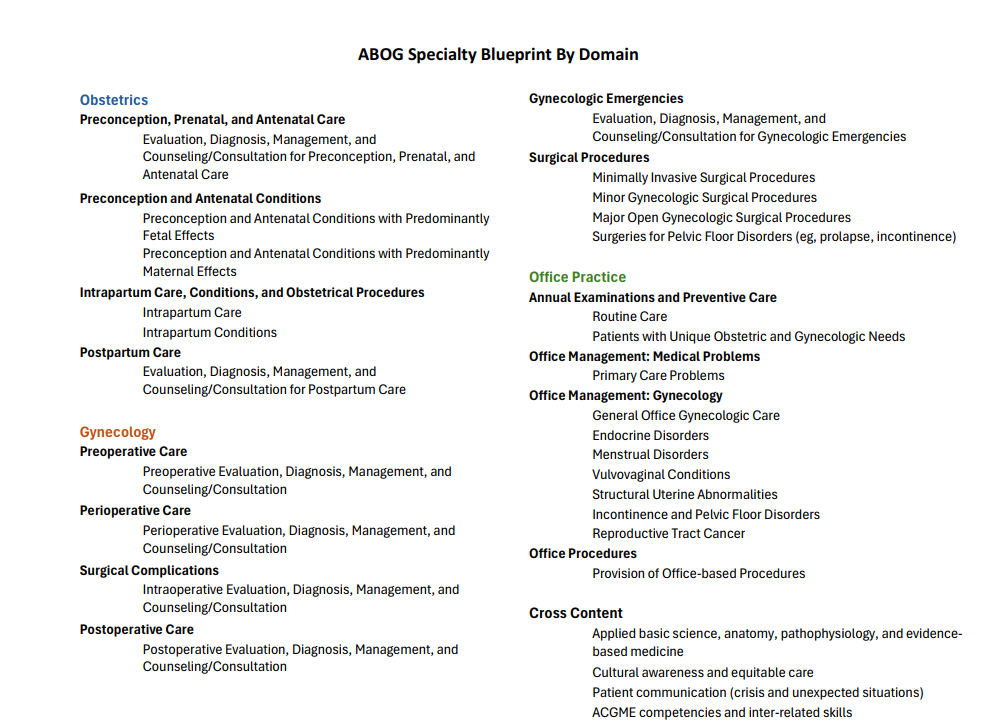
For example, obstetrics content in the blueprint progresses from antenatal care to intrapartum management and postpartum complications. Studying postpartum hemorrhage in isolation, without anchoring it to pregnancy and labor context, makes it harder to apply under time pressure.
The same principle applies to gynecology and office practice. Pair diagnoses with management decisions and complications rather than memorizing topics as standalone facts.
Use questions to apply the blueprint, not just review it
The QE is a scenario-based exam. Reading alone is rarely enough.
The blueprint tells you what to study, but question-based practice teaches you how ABOG asks about it.
When you use practice questions, track them by blueprint category rather than by broad subject alone. Instead of labeling a miss as “OB” or “GYN,” ask which blueprint area it falls under and why.
Patterns matter more than individual misses. If several incorrect answers cluster in the same blueprint area, that signals a structural gap, not a bad test day.
Balance depth and breadth deliberately
The blueprint is broad by design. That can feel uncomfortable, especially for candidates who prefer mastering a smaller set of topics deeply.
The QE does not require subspecialty-level mastery. It requires consistent, safe, generalist-level decisions across many scenarios.
A useful mindset is this: aim for dependable competence everywhere before chasing perfection anywhere. A steady baseline across the blueprint usually produces better results than deep expertise with large gaps elsewhere.
Office Practice deserves dedicated time
Office Practice is the domain most often underestimated and most often responsible for score erosion.
Because office problems feel familiar, candidates may study them casually or late. The blueprint treats Office Practice as a full domain not a filler section.
Build office-based topics into your regular study schedule. Preventive care, contraception, abnormal bleeding, menopausal symptoms, pelvic floor disorders, common infections, and office procedures all appear in applied, management-focused scenarios.
If a problem commonly walks into a general OB-GYN office, it belongs in your study plan.
Practice pacing as a blueprint skill
The QE’s length and mixed content mean pacing is part of preparation, not an afterthought.
Studying with the blueprint helps pacing indirectly. When you recognize where a question fits in the blueprint, you spend less time overanalyzing and more time selecting the best next step.
As exam day approaches, include timed question sets that reflect the exam’s mixed-domain structure rather than isolated topic blocks. This trains you to shift gears smoothly between obstetrics, gynecology, and office practice without losing rhythm.
Review mistakes through the blueprint lens
Post-question review is where much of the learning happens.
Instead of asking only “Why was this answer wrong?” also ask:
- What blueprint area does this question belong to?
- Was the miss due to knowledge, interpretation, or decision-making?
- Did I misidentify what the question was asking me to do?
This approach turns mistakes into targeted study goals rather than vague frustration.
Avoid common blueprint-related pitfalls
Several preparation errors show up repeatedly.
One is over-weighting obstetrics at the expense of office practice. Another is focusing heavily on procedures while neglecting perioperative judgment and complications. A third is studying topics in isolation rather than in the context ABOG uses to test them.
The blueprint helps you avoid these traps by forcing balance and context back into your plan.
How this approach changes late-stage preparation
As you get closer to the exam, the blueprint becomes more diagnostic than prescriptive.
At that stage, think about your preparation and use the blueprint to answer one question about yourself: where are my weakest blueprint areas right now?
Direct your remaining study time toward those gaps. This is usually more effective than repeating content you already handle comfortably.
Frequently Asked Questions
Do I need to memorize the Specialty Blueprint?
No. You need to understand how it organizes content and weighting so your studying matches the exam’s structure.
Should I study one domain at a time or mix them?
Early on, focused blocks can help. As exam day approaches, mixed-domain practice better reflects the actual exam.
Is Office Practice really as important as Obstetrics and Gynecology?
Yes. The blueprint weights Office Practice equally with the other domains.
Does the blueprint change how questions are written?
Indirectly. It determines which scenarios appear and how often, but questions remain scenario-based and management-focused.
What if my practice or training doesn’t include certain blueprint areas?
The QE tests the full scope of general OB-GYN practice regardless of individual exposure. Preparation should fill those gaps.
Next Steps
If you are early in preparation, review the Specialty Blueprint alongside your study resources and map topics to each domain to ensure balanced coverage.
If you are closer to exam day, start tracking missed questions by blueprint category and adjust your remaining study time accordingly.