The Qualifying Examination (QE) is a computer-based exam delivered at a Pearson VUE Testing Center. On exam day, most of what matters is procedural: identification, screening, what you can (and cannot) bring into the testing area, and how breaks work (heads up – there are no scheduled breaks).
If you understand those rules ahead of time, the day feels much more predictable. It may feel like a waste of valuable study time to review these protocols but the cost of not following them is high – you could be turned away and not allowed to test.
👉 ABOG OBGYN Board Exam: How to Prepare and Pass
After You Register: What You Will Receive
After you register on the Pearson VUE website, you will receive a confirmation email. That email includes your exam location and the required arrival time.
Hold onto that confirmation. It is the single best reference for where you are going and when you are expected to be there. And take the time to make a hard copy to have on hand on test day.
👉 ABOG Qualifying Exam and Certifying Exam Dates, Fees, and Deadlines
What to Expect When You Arrive
Pearson VUE uses a formal check-in and security process. You will be asked to complete identity verification and submit to screening before you are allowed into the exam area. Be sure to arrive early – at least 30 minutes before you are required to be there. This is another area where a little advance preparation can save the day. In the week before your exam, go to the test location – if you’re driving, how is the parking? If you’re taking public transportation, are their route change issues that could be an issue?
Candidates who finish the exam before the full time has lapsed may leave the test center early, but if they leave early, they may not return.
Identification: You Must Bring Two IDs
To be admitted to the QE, each candidate must present two forms of identification:
- One document must include both your photograph and signature.
- The second document must include your signature.
If you had a name change between your application and test day, you must bring an official document verifying the name change. Examples include a marriage certificate, divorce decree, or court-ordered name change document.
Middle names are not considered in the identification process.
This is one of the most preventable exam-day problems. The safest approach is to decide on your two IDs in advance and confirm they meet these requirements.
Screening Process: What Pearson VUE May Use
Candidates must submit to a screening process that may include:
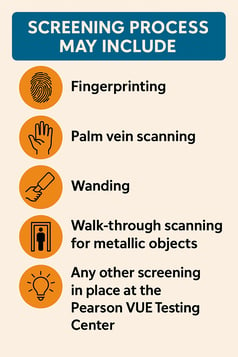
If a candidate refuses to submit to any screening procedure, the candidate will not be allowed to take the exam, and no portion of the fee will be refunded.
This is the key point. Even if a screening step feels unfamiliar, refusing it ends the attempt for the day.
Electronic Devices: The Rule Is Strict
Candidates may not take electronic devices into the exam area.
Candidates are not allowed to possess or access recording devices, cellular phones, paging devices, other electronic communication and/or recording devices, and writing instruments at any time during the written exam or while taking a break.
Candidates may not wear any device that can access the internet, such as an Apple Watch, Fitbit, or similar devices. The one exception is an insulin pump.
If such a device is discovered at any time during the exam, or if the candidate accesses any such device for any reason, the candidate will not receive a grade for any portion of the written examination, and all fees will be forfeited.
The practical takeaway is simple: do not rely on "I will not use it." If it is present or accessed, the consequence is a total loss of the attempt.
Breaks: No Scheduled Break, Only Unscheduled Restroom Breaks
There is no scheduled break during the exam.
Candidates may take unscheduled breaks to use the restroom facilities. Unscheduled breaks should not exceed 10 minutes in length.
During breaks, candidates may not talk with any individual or access any electronic device.
Candidates are not allowed to leave the Pearson VUE Testing Center for any reason before completing the test.
If any candidate violates any of these regulations, the candidate will not receive a grade for any portion of the examination, and all fees will be forfeited.
In real terms, treat breaks as "restroom only." Anything beyond that is a risk you do not need on exam day.
Test Security: What You Agree To
At the time of application and again at the time the test is taken, each candidate must agree to ABOG test security terms. No candidate is allowed to sit for the exam without agreeing.
Those terms include that exam materials are copyrighted, exam content may not be disclosed, and recording or memorizing for the purpose of transmitting content is prohibited. Candidates also agree that de-identified results may be used for research purposes and that QE results will be given to their Program Director.
You’ve prepared for this day for years - you know very well how serious and important this exam is – and so do ACOG and the testing facility. The point is not to make the day feel punitive. The point is that exam security is treated as a condition of eligibility, not a suggestion.
Frequently Asked Questions
How many IDs do I need on exam day?
Two. One must include photo and signature. The second must include your signature.
What screening can Pearson VUE require?
Screening may include fingerprinting, palm vein scanning, wanding, walk-through metal scanning, or other screening at that test center.
Can I access my phone during a break?
No. You may not possess or access electronic devices at any time during the exam or while taking a break.
Are smart watches allowed?
No. Devices that can access the internet are not allowed. The stated exception is an insulin pump.
Are there scheduled breaks?
No. There is no scheduled break. Unscheduled restroom breaks are permitted but should not exceed 10 minutes, and you may not talk to anyone or access devices during breaks.
Next Steps
If your exam day is approaching, do three things early.
First, practice one or two full-length timed sessions to get a feel for pacing and mental stamina. Some study platforms offer timed question sets that help you simulate the experience. Tools such as Med-Challenger support question-based preparation and pacing practice during the final phase of studying.
Second, lay out everything you need the night before your test. Be sure to include the two IDs that meet the exact requirements. Include the hard copy of your Pearson VUE confirmation email. If you have accommodations approved, bring a hard copy of your accommodation confirmation.
Third, set yourself up to comply with the electronics policy without effort. Plan on leaving prohibited devices at home whenever possible. If you bring them to the site, assume they must stay out of reach and never be accessed.
Removing uncertainty about where you are going and when you need to arrive is the easiest way to lower stress before the exam begins.