

abfm board review
What to Expect on ABFM Exam Day
Learn exactly what to expect on ABFM exam day—from check-in and security to timing, breaks, and test flow—so you can arrive prepared and avoid...
Know what to expect on ABIM exam day, from check-in and security to breaks, pacing, and the Pearson VUE testing environment, so you arrive fully prepared.
If you’re preparing for the Pearson VUE-administered ABIM Internal Medicine Certification Exam, knowing what happens on exam day — from arrival to care for yourself to pacing your time — can make a substantial difference. ABIM publishes clear guidance on what to expect, and building your “mental map” of the day helps reduce stress and improve performance.
👉ABIM Board Exam Guide 2025: How to Prepare and Pass
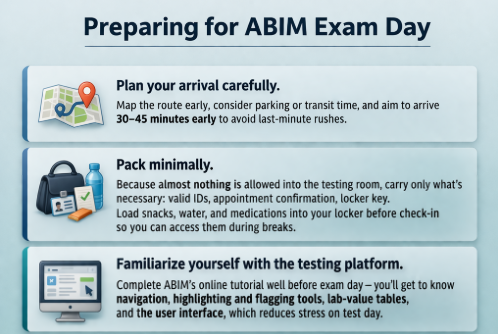
ABIM instructs candidates to arrive at the test center 30 minutes before their scheduled appointment. Checking in takes time — you must verify identification, go through biometric screening, and store personal belongings. If you arrive late, you risk being considered a “no-show,” forfeiting your exam fees, and having to reschedule.
Identification requirements are strict. ABIM requires two valid forms of ID, one being a government-issued photo ID that matches the name on your ABIM registration exactly. Expired IDs are not accepted. Even small name mismatches (e.g., middle name omitted) can lead to denial at the door.
Given how critical the check-in process is, many candidates find it worthwhile to plan their travel carefully — accounting for parking, traffic, or building entry procedures. A “dry run” to the test center a few days before can save major anxiety on the actual exam day.
👉ABIM Registration, Fees, Deadlines, and Scheduling
ABIM uses Pearson VUE centers, which follow firm security protocols designed to preserve exam integrity. When you enter, you’ll be photographed, provide a digital signature, and possibly have a palm-vein biometric scan.
Once inside, you’re assigned a private workstation equipped with a computer, keyboard, mouse — nothing else. All personal items must be stored in a secure locker before you begin. This includes phones, watches, bags, food or drinks, notes, wallets, and any other prohibited items. The only items permitted in the testing room are those provided by Pearson VUE (e.g., on-screen calculator, scratch paper if allowed).
If you leave the testing room during breaks — scheduled or unscheduled — you must re-check in on re-entry: pockets emptied, scanner re-checked, and biometric verification redone.
Because of these constraints, many candidates recommend bringing minimal personal items (just ID and exam confirmation), pre-loading snacks and water into the locker ahead of time, and mentally preparing for a “locked-in” testing day without access to phones or external resources.
The ABIM certification exam is structured as four timed sessions. Each session contains up to 60 single-best-answer multiple-choice questions, for a maximum of 240 questions total.
While ABIM allows up to two hours per block, most examinees finish sooner, depending on their pacing style. Because you cannot return to a block once you leave it, pacing and decision-making under time pressure matter as much as clinical knowledge. To understand how ABIM decides which topics appear in these blocks, see our ABIM Blueprint Guide.
Between blocks, you are allotted 100 total minutes of break time, which you may use flexibly across up to three breaks.
Before the first session, there is an optional 30-minute tutorial. ABIM strongly recommends completing this tutorial before exam day to familiarize yourself with the interface — including highlighting, strikethrough, and navigation tools — as well as with included resources such as normal lab value tables.
👉ABIM Scoring Explained: How to Understand Your Results
Because the exam can stretch over ~10 hours (testing plus breaks), stamina, focus, pacing, and mental discipline are as important as medical knowledge.
👉How Hard Is the ABIM Internal Medicine Certification Exam?
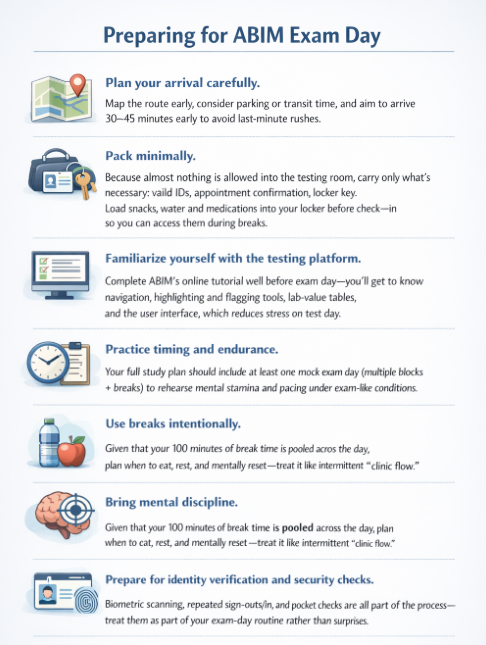
Given how long and intense the day is, success depends as much on logistics and endurance as on content mastery. Here are some practical strategies candidates find helpful:
👉How to Prepare for the ABIM Exam: Study Strategies That Work
It may seem tedious to plan parking, snacks, lab value familiarity, or locker strategy. But these “small” details often matter more in the moment than you expect. The combination of a long day, dense clinical content, media items (ECGs, images, charts), and strict test-center rules means that exam-day comfort and familiarity can significantly influence performance.
Candidates who walk in prepared — knowing exactly where they’re going, what to bring, when and how to take breaks — report less stress, better pacing, and more consistent performance across all blocks.
When should I arrive at the test center?
Plan to arrive at least 30 minutes before your scheduled start time to complete check-in, biometric screening, and locker assignment. Late arrival may result in cancellation of your exam and forfeiture of fees.
What kind of ID is required?
You must present two valid forms of ID, one being a government-issued photo ID that matches the name on your ABIM registration exactly. Expired IDs are not accepted.
Can I bring food, water, or personal items into the testing room?
No. All personal belongings — including phones, watches, bags, and notes — must be stored in a secure locker before entering the test room. Only items provided by the testing center (e.g., on-screen calculator) are allowed. You may access water or snacks only during scheduled breaks.
What if I need a break or leave the room during the exam?
Each time you exit the testing room for a break or re-entry, you will undergo biometric and security re-check (palm-vein scan, pocket check, possible metal detector). You must sign out and back in each time. Your total break time is shared across the entire exam (100 minutes).
Is there a tutorial I can do before exam day?
Yes. ABIM provides a 30-minute online tutorial that lets you tour the exam interface, try highlight/flag tools, and view resources such as normal lab value tables. Completing it before exam day can reduce stress and help you go in familiar with the format.
How long is the total exam day?
Expect about 10 hours total: four timed testing sessions, check-in, optional tutorial, break periods, and a short optional survey at the end.
Learn exactly what to expect on ABFM exam day—from check-in and security to timing, breaks, and test flow—so you can arrive prepared and avoid...
What to expect on the Pediatric Emergency Medicine board exam, including question format, clinical scenarios, tested topics, and exam structure.
What to expect from the NBME Shelf exams, the CCSE exams, and how to prepare for these rotation tests.