Becoming board certified by the American Board of Internal Medicine marks a defining moment in an internist’s early career. It signals that you have met rigorous national standards in medical knowledge, diagnostic reasoning, and the safe, effective management of adult patients. Whether you are completing residency or preparing for your first attempt at certification, understanding exactly what the ABIM Initial Certification Exam measures, how it is structured, and how the certification process works will help you approach this milestone with clarity and confidence.
ABIM’s Internal Medicine Certification Exam determines whether a physician is ready for independent practice. The questions assess how you diagnose, select tests, evaluate risk, and manage common and serious adult medical conditions. Most questions are built around clinical vignettes and often incorporate ECGs, imaging, audio, or lab data. ABIM emphasizes that the exam tests applied reasoning rather than memorization.
The content is shaped by periodic practice analyses that examine what internists encounter most frequently and what decisions matter most for patient safety. Physician committees translate those findings into the blueprint that guides exam construction. Although the blueprint changes slowly, small shifts reflect real updates in practice.
What are the Eligibility Requirements to Take the ABIM Certification Exam?
Eligibility for the ABIM Initial Certification Exam is defined by clear, published standards. The foundation is successful completion of an ACGME-accredited residency or an approved equivalent pathway, but several additional elements determine whether a candidate can sit for the exam.
To qualify, you must meet the following requirements:
Completion of Internal Medicine Residency: You must finish an ACGME-accredited internal medicine residency (or ABIM-approved equivalent) and fulfill all required inpatient, outpatient, continuity clinic, and core subspecialty experiences.
Program Director Attestation: Your program director must verify competence, professionalism, and satisfactory completion of training. This attestation is mandatory for all candidates.
Unrestricted Medical License: You must hold a valid, unrestricted U.S. or Canadian medical license by the time you are certified. A training license alone does not satisfy this requirement. Any restrictions or disciplinary actions must be disclosed and may impact eligibility.
Leave and Training Extensions: If you took extended leave during residency—medical, parental, research, or otherwise—your program director and ABIM may need to determine whether additional training time is required.
Professionalism Standards: ABIM requires candidates to demonstrate professionalism, integrity, and ethical conduct throughout residency. ABIM may review any concerns related to conduct before permitting exam registration.
Early Eligibility Check: ABIM recommends verifying your status through the Physician Portal early in the process. This allows time to resolve licensing issues, training documentation gaps, or pending requirements before registration opens.
What Is the ABIM Eligibility Window, and What Happens If You Delay?
Once you complete training and meet all prerequisites, you become “Board Eligible” for seven years. Within that window, you may apply for and take the exam. If you pass, you are certified. If you do not certify within seven years, your board-eligible status expires and you cannot register again until eligibility is reestablished.
Reestablishing eligibility requires at least one additional year of ACGME-accredited training (or ABIM-approved equivalent) plus a new program director attestation. Because this can significantly disrupt career timelines, many residents take the exam soon after finishing training while clinical exposure is fresh.
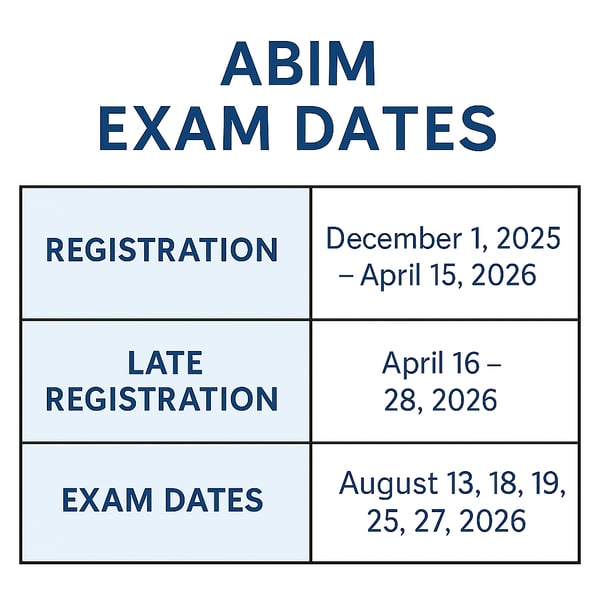
ABIM Registration and Exam Dates
ABIM publishes registration dates annually in the Physician Portal. Candidates who need accommodations should submit documentation well before the window closes, as approval is not guaranteed and requires review.
Pearson VUE administers the exam at secure testing centers across the U.S. Exam scheduling, seating availability, and any rescheduling fees are controlled through Pearson VUE and follow ABIM’s published policies.
The exam contains up to 240 single-best-answer multiple-choice questions delivered in four timed sessions of up to sixty questions.
You cannot return to a session once it is closed, so pacing matters. The total appointment time is approximately ten hours, which includes check-in, an optional tutorial, scheduled breaks, and testing time. The tutorial introduces navigation tools such as highlight and strikeout features.
Questions cover the full breadth of internal medicine: cardiology, pulmonary/critical care, gastroenterology, endocrinology, infectious disease, hematology, oncology, nephrology, neurology, rheumatology, dermatology, and general internal medicine. Multimedia elements emphasize realistic clinical reasoning.
There isno penalty for incorrect answers, so guessing is always preferable to leaving an item blank.
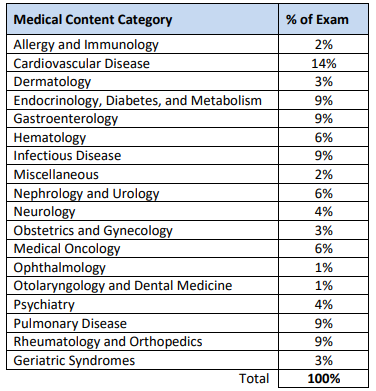
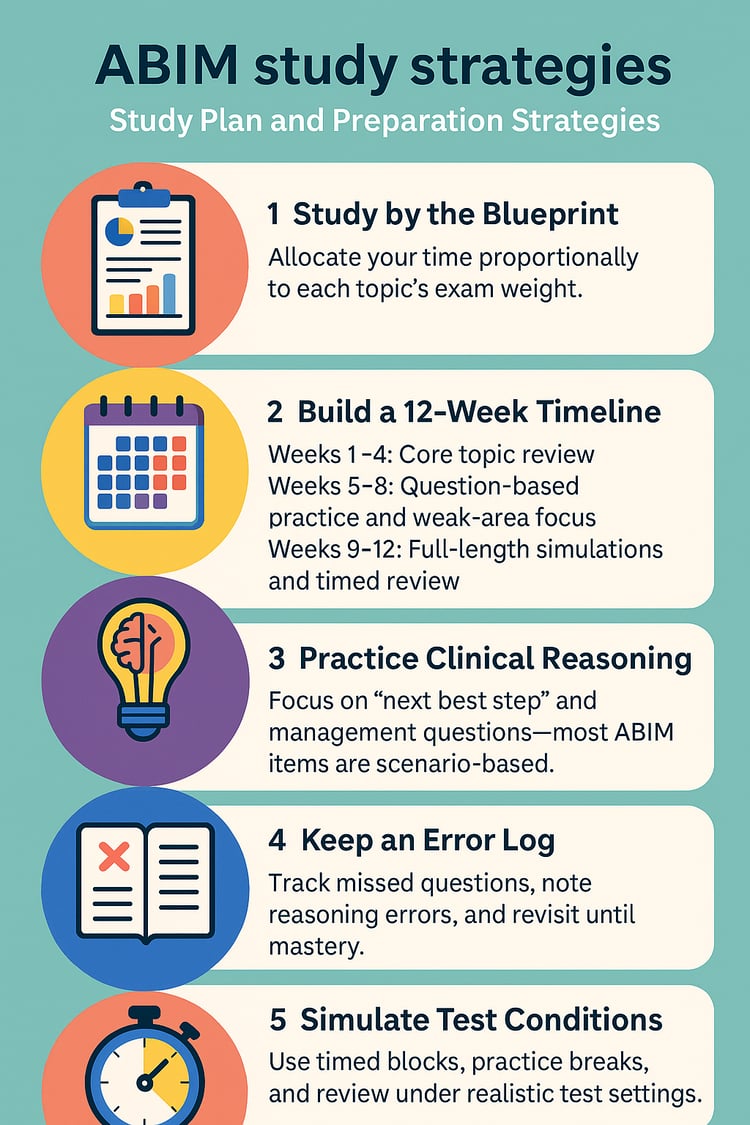
The ABIM blueprint is the cornerstone of your preparation—it defines the weight of each medical category on the exam. Using the blueprint wisely will help you prioritize your study time—focusing on high-weight areas while still covering the full scope.
The blueprint evolves periodically to match current practice. When emerging diseases, new therapies, or shifts in practice patterns occur, ABIM committees evaluate whether adjustments are needed. Because of these updates, reviewing the most recent blueprint before designing your study plan is essential.
ABIM uses a criterion-referenced scoring model, meaning performance is measured against a fixed standard of competence rather than against other candidates. Scores are converted to a 200–800 scale, and the passing standard is 366.
The exam includes unscored pilot questions to evaluate new content, but you cannot identify them. Results are released eight to twelve weeks after the exam and include your overall score and domain performance profile. Although ABIM does not reveal which questions you missed, the domain breakdown helps guide future learning.
Pass rates for first-time examinees are typically between 80% and 90%, though year-to-year variations reflect cohort differences and exam changes rather than a curve.
Exam day at a Pearson VUE center is structured, secure, and designed to maintain standardized testing conditions. Knowing the logistics ahead of time can help reduce anxiety and prevent avoidable complications.
What to bring:
Two valid forms of identification, with one being a government-issued photo ID that matches your ABIM registration name exactly.
Your Pearson VUE appointment confirmation.
Your ABIM registration information for quick verification if needed.
What to expect upon arrival:
Biometric check-in, which may include fingerprinting, a photo, and signature capture.
Secure locker storage for all personal items, including phones, bags, notes, watches, and food. None may enter the testing room.
A controlled testing environment monitored continuously by proctors to ensure exam security.
Scheduled breaks available between exam sections, during which you may access your locker. Unscheduled breaks are allowed but do not pause the exam clock.
A test-station orientation, including the on-screen tutorial that introduces navigation, highlight and strikeout tools, and timing features.
Practical tips for smoother test day:
Arrive 30–45 minutes early to avoid last-minute stress and allow time for check-in.
Consider doing a practice trip to the testing center in advance to confirm parking, traffic, and travel time.
Bring simple, high-yield snacks and water to use during breaks, and think through a break strategy to manage stamina during the long exam day.
Travel light; the fewer personal items you bring, the faster and easier your check-in tends to be.
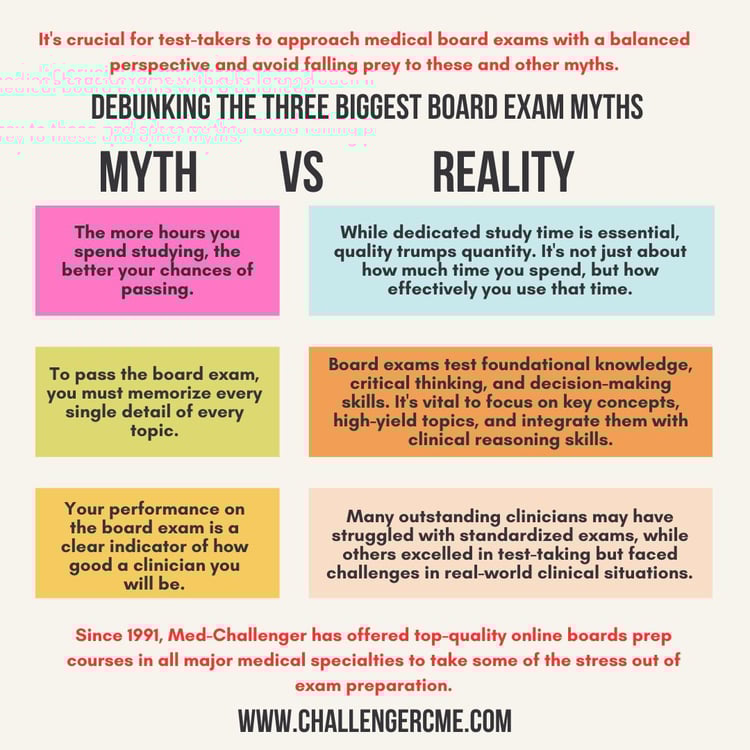
What are common pitfalls and myths about the ABIM exam?
Ignoring the blueprint weights.
Overemphasizing rare diseases.
Neglecting timed practice sessions.
Waiting too long to start structured preparation.
What should I expect after the ABIM exam?
Once the exam is complete, scoring and quality review take several weeks. Your results will appear in the Physician Portal along with your domain performance. Even those who pass benefit from reviewing weak areas as they transition into independent practice.
If you do not pass, ABIM allows retakes for future administrations. A more structured, blueprint-driven study plan — often supported by question banks and assessment tools — tends to benefit repeat examinees. Tools such as Med-Challenger can help organize this remediation by aligning questions and explanations with the blueprint structure.
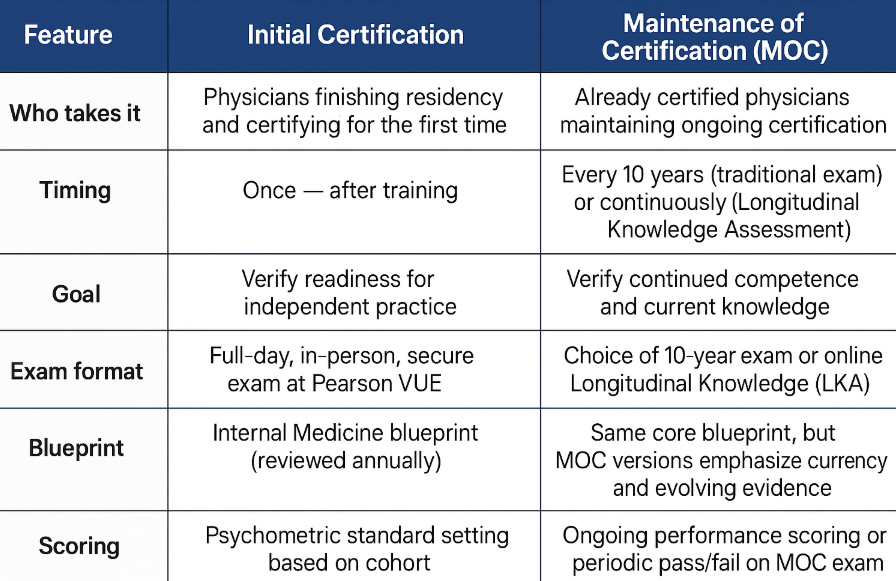
Certification is just the beginning. ABIM’s Maintenance of Certification (MOC) program supports continued learning throughout your career and is distinct from the initial certification exam. Ensure that your preparation aligns with the requirements specific to initial certification.
ABIM Continuing Certification and the MOC Framework
Many physicians are familiar with the MOC process (10-year exam, longitudinal knowledge assessment, etc.). It’s important to note that for initial certification, the format and requirements differ from those of MOC. For example, MOC updates introduced in 2024 affect recertification pathways but do not change the initial certification exam.
Make sure your prep and information are aligned with the initial exam rather than recertification.
✅ Confirm eligibility early. ✅ Register before the April deadline. ✅ Study using the ABIM blueprint. ✅ Practice timed, mixed-topic questions. ✅ Answer every item — no penalty for guessing. ✅ Stay up-to-date via ABIM.org
ABIM Internal Medicine Exam – FAQs
How long is the ABIM exam? Approximately 10 hours total, including tutorial, eight 60-minute test blocks, and scheduled breaks. The test itself contains about 240 multiple-choice questions delivered at Pearson VUE centers. 👉 ABIM Exam Day Information
What is the passing score for the ABIM exam? ABIM uses a scaled score system, not a fixed percentage. The passing standard is 366 on a scale from 200–800, established through psychometric standard-setting. 👉ABIM Scoring & Results
Which ABIM question bank is best? Choose a resource aligned with the official ABIM Internal Medicine blueprint. Reputable choices include those mirroring ABIM’s content outline and clinical reasoning style, like Med-Challenger.
What happens if I fail the ABIM exam? You may re-register for the next available exam window; ABIM allows multiple attempts. However, you must submit a new application and pay the exam fee each time. Many programs encourage structured remediation before retaking.
Where do I take the ABIM exam? At a Pearson VUEtest center, under secure, proctored conditions. Check the Pearson VUE website for locations and availability when scheduling.
How often is the ABIM exam offered? Once a year — typically in August, across several test dates. Registration opens in December of the preceding year. 👉 ABIM Registration Dates
How soon do I get results? Official results are released about 8–12 weeks after the exam. You’ll receive an email when they are available in your ABIM Physician Portal.
Can I take the ABIM exam remotely? No. The Initial Certification Exam must be taken in person at an authorized Pearson VUE test center. Remote testing is not available for initial certification (only certain longitudinal MOC assessments).