Initial ABIM certification marks a major milestone, but it is also the beginning of an ongoing commitment to maintaining current, practice-ready knowledge. ABIM’s Continuing Certification program—historically referred to as Maintenance of Certification (MOC)—is the framework through which internists demonstrate long-term competence in alignment with modern clinical standards. The structure and expectations differ significantly from the initial certification exam, so understanding how the system works early in your career can spare you confusion and last-minute deadlines later on.
How ABIM Continuing Certification works, including MOC requirements, LKA vs. the 10-year exam, CME points, and what to do after initial certification.
ABIM frames continuing certification as part of the same public trust that underpins the initial exam. Patients, employers, and health systems rely on it as evidence of sustained professional development and current expertise. Although the process has evolved in recent years, its core purpose remains the same: to ensure internists remain up-to-date as medical evidence, diagnostic tools, and clinical practice patterns shift.
What Continuing Certification Measures — and How It Differs from the Initial Exam
The Initial Certification Exam evaluates readiness for unsupervised clinical practice. Continuing Certification, in contrast, focuses on ongoing learning, evolving knowledge, and clinical reasoning over time. The content reflects daily practice rather than the broad generalist scope of residency-level training.
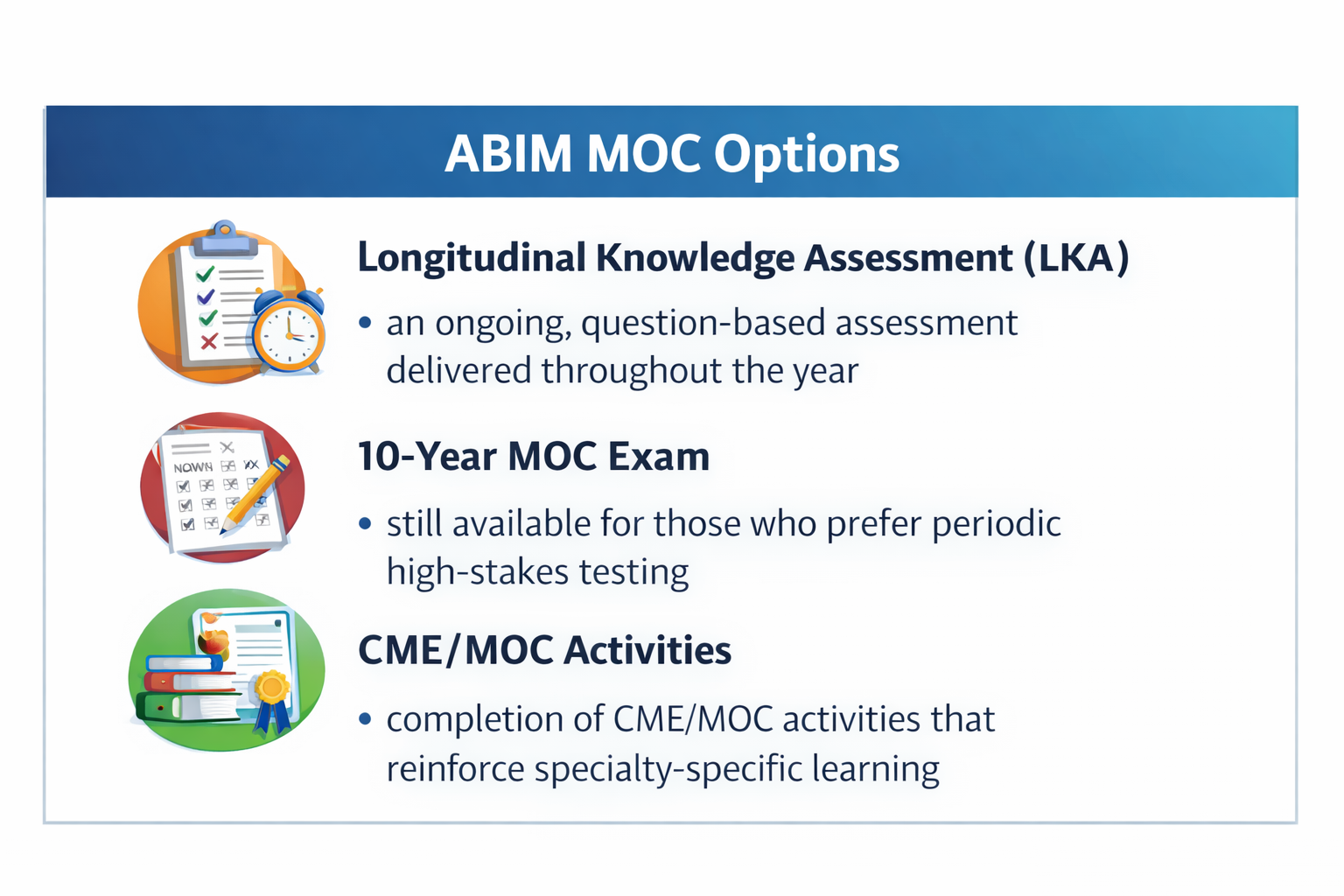
While the initial exam is a one-day, high-stakes event, MOC gives physicians multiple pathways, including:
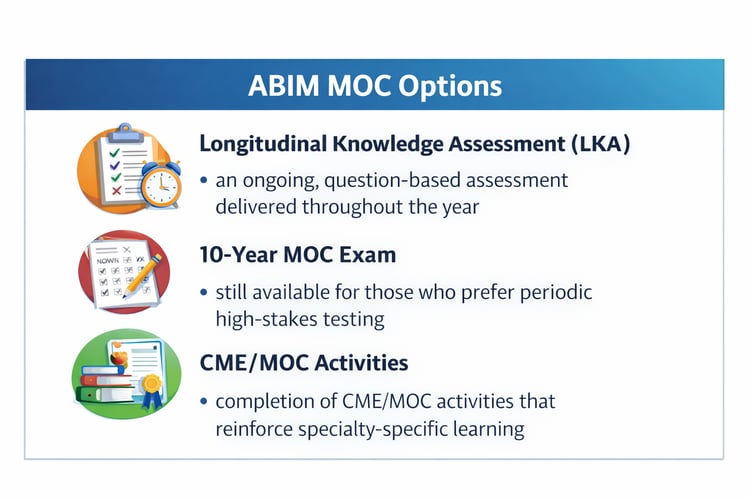
These pathways are distinct from initial certification, which is why we must emphasize the importance of not confusing the two when choosing study resources or reviewing ABIM policies.
For a detailed breakdown of the blueprint used in the initial ABIM exam, see our ABIM Blueprint Guide.
Key Components of ABIM Continuing Certification
ABIM’s MOC framework involves several recurring requirements:
1. Knowledge Assessment (LKA or 10-Year Exam)
The LKA delivers periodic multiple-choice questions that mirror clinical practice rather than residency-level breadth. It emphasizes continuous engagement with evolving literature rather than once-a-decade preparation.
2. CME and Annual MOC Points
Internists must earn a set number of MOC points over a defined interval to demonstrate continuing education. Many professional activities—CME courses, modules, and accredited online programs—qualify for both CME and ABIM MOC credit, allowing physicians to meet requirements efficiently.
Med-Challenger Internal Medicine Review includes MOC Points and LKA prep!
3. Professionalism and Licensure Requirements
Just as in the eligibility process for the initial certification exam, physicians must maintain an unrestricted medical license and uphold ABIM’s professionalism standards throughout their careers.
For comprehensive medical professionalism standards with CME credits Med-Challenger Professionalism
4. Annual Check-ins Through the ABIM Portal
The ABIM Physician Portal becomes the primary tool for tracking progress, deadlines, attestation, and upcoming requirements.
Why Understanding MOC Early Matters
Internists who wait several years before thinking about MOC often find themselves trying to meet point requirements on short notice. The process is more manageable when integrated into ordinary professional development routines.
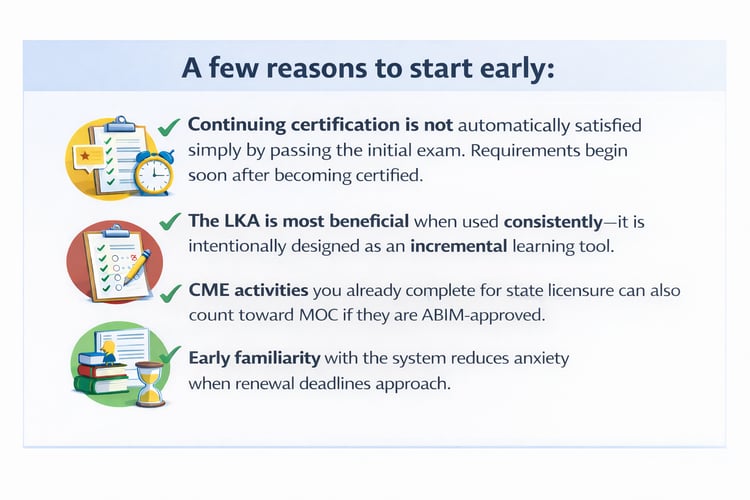
ABIM’s certification process reflects real-world internal medicine practice rather than abstract testing. The MOC system continues this philosophy, ensuring learning remains ongoing as evidence changes.
How the Initial Exam and MOC Fit Together
Although they are part of the same overall framework, ABIM stresses that initial certification and MOC are separate processes with different requirements. Initial certification evaluates preparedness for independent practice; MOC ensures that knowledge keeps pace with evolving clinical science. Understanding this distinction prevents candidates from relying on recertification resources while preparing for the initial exam—or vice versa.
👉ABIM Test-Day Experience: What to Expect
ABIM MOC and Continuing Education: Practical Tips for Staying Current
Staying on track with MOC does not require constant exam preparation. A few simple practices help maintain momentum:
-
Check your ABIM Physician Portal annually to review deadlines and point requirements.
-
Choose CME activities that also carry ABIM MOC credit to avoid duplicated effort.
-
If you prefer steady, incremental learning, enroll in the LKA early to take full advantage of its spaced-question design.
-
Revisit ABIM’s public resources at least yearly—policies evolve just as the blueprint does for the initial exam.
FAQs - ABIM Continuing Certification (MOC)
Do I need to start MOC immediately after passing the ABIM exam?
Yes. Once you are certified, you enter the continuing certification framework and must begin meeting annual requirements.
Can I switch between the LKA and the 10-year exam?
Yes. ABIM allows flexibility, and many physicians choose the LKA for its low-stakes, continuous structure.
Does MOC require a full exam like the initial certification exam?
Only if you choose the 10-year high-stakes option. The LKA offers a more gradual, integrated assessment experience.
Do CME activities count toward MOC?
Many do. Look for ABIM-approved CME to earn both CME hours and MOC points simultaneously.
Is MOC required to keep my initial certification valid?
Yes. Maintaining certification requires ongoing participation in ABIM’s continuing certification program.
Next Steps for Physicians
-
Review your ABIM Physician Portal to understand timelines and point requirements.
-
Identify CME activities that also fulfill MOC credit.
-
Decide whether the Longitudinal Knowledge Assessment or the traditional exam aligns better with your learning style.
-
Build a lightweight, sustainable continuing-education routine that supports long-term growth rather than last-minute scrambling.
If you are still preparing for initial certification, return to our ABIM Board Exam Guide.
How can you prepare for the ABIM Exams? Med-Challenger Internal Medicine Boards Prep