The American Board of Family Medicine (ABFM) certification exam is more than a test of memory—it’s a measure of whether you are prepared to think and act like a practicing family physician. The exam’s design reflects the core purpose of certification: to demonstrate clinical judgment, not just factual recall. The goal of the exam is not to test obscure facts — it is to assess clinical reasoning and real-world decision-making.
👉ABFM One-Day Certification Exam: Format, Flow, and What It’s Like
How ABFM Builds the Blueprint
The ABFM performs a Family Medicine Practice Analysis about every 3–5 years, surveying thousands of physicians on the conditions they manage most frequently. These results feed into both frameworks above.
Longitudinal Assessment Uses the Same Structure
The Longitudinal Assessment uses the same blueprint and content-category weights, distributed across quarterly sessions. Over time, you’ll still see the same proportional emphasis on acute diagnosis and care, management of chronic diseases, urgent and emergent care, preventive care, and core concepts.
👉Which ABFM Maintenance of Certification Path Fits You Best?
Why Does ABFM Publish a Blueprint?
The American Board of Family Medicine (ABFM) structures every exam around a domain-level blueprint that defines the purpose of each question—what kind of clinical thinking it measures. This ensures that that the Family Medicine Certification Examination (FMCE) reflects the real scope of family medicine practice rather than a random sampling of topics.
While the ABFM switched in 2025 from an organ/body system blue print to one based on care domains, it’s reasonable to expect that cardiovascular, respiratory, and musculoskeletal - areas which dominate outpatient encounters—will be well represented across all domains.
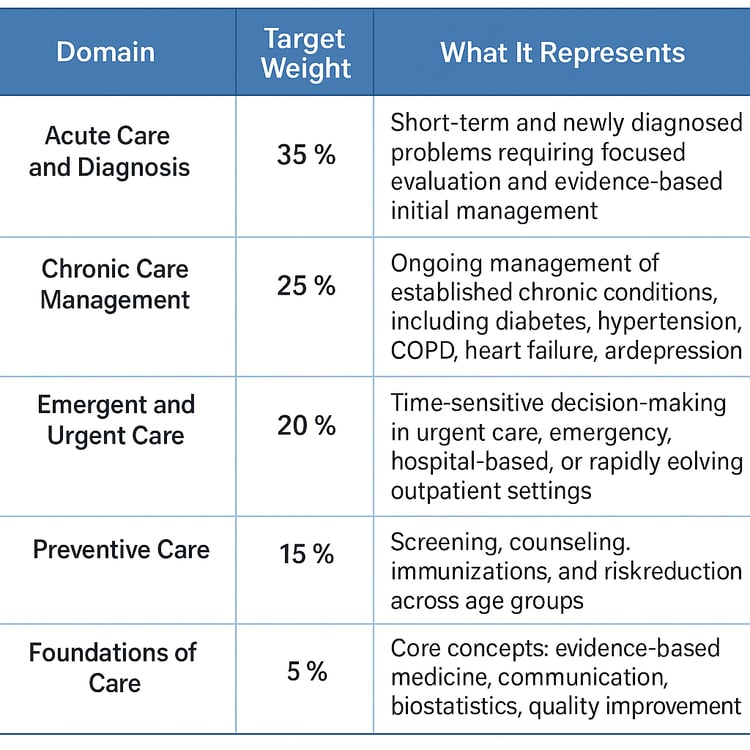
The Five Core ABFM Domains (2025 Blueprint)
👉How to Prepare for the ABFM Exam: Study Strategies That Work
What the Percentages Mean for Preparation
- Prioritize by weight.
The domain rankings reflect their relative proportion in the exam – organize your study with those in mind.
- Respect the small sections.
Low-percentage categories often require high-level conceptual reasoning—statistics interpretation, ethics, or policy.
- Integrate prevention and chronic management.
Many items test both domains simultaneously (e.g., lipid control for secondary prevention of heart disease).
- Use the outline to audit your study plan.
If your question bank underrepresents a major domain (like Acute Care and Diagnosis 35%), adjust your mix.
Practical Tips for Using the Blueprint
- Map your study hours proportionate to the five domains (35-25-20-15-5).
- Cross-train domains. When practicing acute scenarios, weave in preventive and foundational thinking.
- Update yearly. Review ABFM updates annually; while content weights rarely change, blueprint updates occur periodically following practice analyses.
FAQs
Q1: How many domains does the ABFM blueprint include?
Five: Acute Care & Diagnosis, Chronic Care Management, Emergent & Urgent Care, Preventive Care, and Foundations of Care.
Q2: Do the Longitudinal Assessment and the one-day exam use the same blueprint?
Yes. Both use the same domain weights and body-system content distribution.
Q4: Do content weights change every year?
Usually not. ABFM updates the blueprint following large practice analyses (every 3–5 years).
Q5: Should my study plan match the content weights?
Yes. Prioritizing high-frequency domains improves exam readiness. However, you should also factor in your ITE results and adjust accordingly.
Q6: Are low-percentage categories still important?
Yes. Foundations of Care accounts for only 5% but 5% can make a big difference in your final score.
Next Steps
- Download the latest ABFM blueprint.
Base your study plan on these weights.
- Select a reliable Question Bank
Devote some time to assessing high quality ABFM question banks, such as Med-Challenger.
- Build QBank blocks that reflect exam proportions.
Use mixed and blueprint-weighted sets.
- Cross-train domains with clinical vignettes.
Simulate real-world reasoning (e.g., acute + preventive).
- Use ABFM practice analyses for long-term updates.
Check for shifts every cycle.