Updated 10/16/26
Two Pathways, One Standard
Since 2021, the American Board of Family Medicine (ABFM) has offered diplomates two options for maintaining certification:
-
Family Medicine Certification Longitudinal Assessment (FMCLA) — a web-based exam taken in short segments over four years.
- The traditional one-day Family Medicine Certification Examination (FMCE) — the long-standing, in-person, high-stakes exam given at Prometric centers.
Both assess the same knowledge — the differences lie in the format, timing, flexibility, and exam-day experience.
👉ABFM Eligibility Rules and the 7-Year Window Explained
The Traditional One-Day Exam (FMCE)
The Family Medicine Certification Examination (FMCE) remains a rigorous, single-day test of comprehensive clinical knowledge under timed conditions.
- Structure: Four timed sections of 75 multiple-choice questions (300 total)
- Time: 95 minutes per section, plus 100 minutes of pooled break time
- Delivery: In-person at Prometric test centers (U.S. and international)
- Windows: Twice yearly (April and November), with multiple testing dates in each window
- Results: Typically posted 6–8 weeks after the testing window closes
The format is identical for initial certification and for diplomates maintaining certification.
👉 ABFM One-Day Certification Exam: Format, Flow, and What It’s Like
The Family Medicine Certification Longitudinal Assessment (FMCLA)
The Longitudinal Assessment replaces a single test day with a continuous, feedback-driven process. Diplomates answer short, case-based questions online every quarter, reinforcing clinical knowledge throughout the four-year cycle.
- Cycle length: Four years
- Questions: 25 per quarter (100 per year; 300 counted for scoring)
- Platform: Secure, web-based, open-book but timed (approximately five minutes per item)
- Flexibility: Complete questions any time within each quarterly window
- Feedback: Immediate results and explanations with references
- The FMCLA awards up to 10 certification points and 30 CME credits.
Deferred questions and pacing: you do not have to answer all 25 questions in the quarter they become available. Unopened questions are deferred and can be completed later. If you answer questions as they are released, most participants finish the 300-question assessment by the end of year three. If you defer questions (up to 100), completion shifts into year four. This is intentional flexibility—deferring does not remove you from the assessment or count against you.
Blueprint: The Same Foundation
Both exams follow the 2025 ABFM content blueprint:
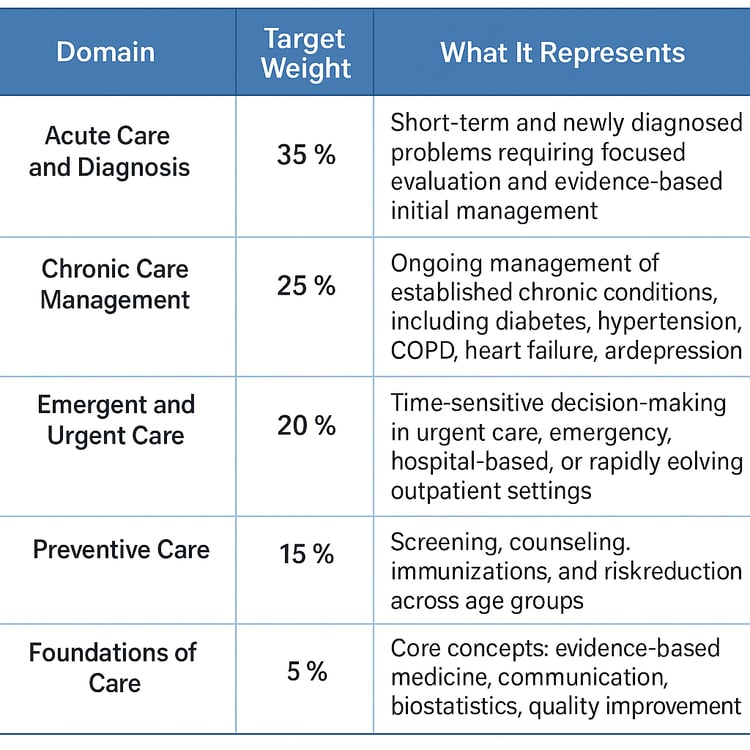
👉What Are ABFM Exam Content Weights and What Do They Mean?
Key Advantages of the Longitudinal Assessment
- Reduced test anxiety: Knowledge is demonstrated over time, not one day.
- Integrated learning: Each question provides feedback and citations.
- Flexibility: Quarterly pacing fits busy practice schedules.
- Adaptability: Pause and resume within the four-year cycle.
- Evidence alignment: Reinforces current guidelines through ongoing, feedback-driven learning
Early ABFM data show high completion and satisfaction rates among participants, with most diplomates meeting the passing standard well before the end of the four-year cycle.
Advantages of the Traditional One-Day Exam
- Familiar format: Mirrors previous board experiences.
- Single commitment: One preparation period, one test day.
- Predictable structure: Twice-yearly schedule simplifies planning.
- No ongoing quarterly requirements: Best for those who prefer one defined preparation period and a single test day.
For diplomates who perform well under exam pressure, this remains a strong option.
👉ABFM One-Day Certification Exam: Format, Flow, and What It’s Like
Participation and Performance Trends
ABFM’s 2024 Annual Report notes that over 80% of eligible diplomates now choose FMCLA. The one-day exam remains available for those preferring it or who need to meet certification after an incomplete FMCLA cycle.
Performance and reliability data show comparable pass rates and psychometric validity between formats.
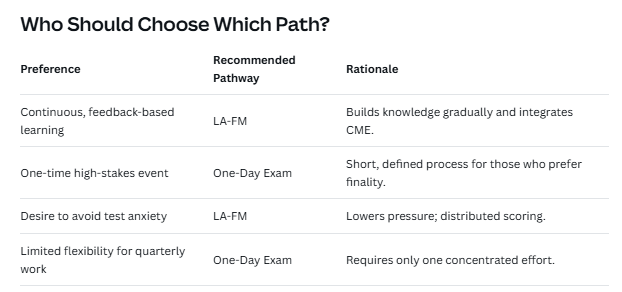
Both satisfy the same certification standard and result in the same ABFM diplomate status.
Common Misconceptions
Myth: FMCLA is easier.
Fact: Both follow the same passing score and blueprint.
Myth: FMCLA replaces CME.
Fact: It complements CME and fulfills part of the ongoing certification activity requirements.
Myth: Failing FMCLA ends certification.
Fact: You can meet the certification requirement by taking the one-day exam if you do not meet the FMCLA passing standard.
FAQs
Q1: Can I switch pathways during the cycle?
Yes. You can switch from FMCLA to the FMCE (or vice versa) at any time. Only the performance in your current pathway counts.
Q2: Is FMCLA truly open book?
Yes, but questions are timed — approximately five minutes per item — so searching for answers is limited and still requires clinical knowledge.
Q3: Does choosing FMCLA affect my credentialing or hiring?
No. Both pathways lead to the exact same ABFM certification.
Q4: Who benefits most from the one-day exam?
Physicians who prefer a single, defined preparation period; those who perform well under timed conditions; or those who need to fulfill certification quickly.
Q5: Who benefits most from FMCLA?
Physicians who prefer paced learning, dislike high-stakes test days, or want continuous reinforcement of guidelines.
Next Steps
- Review your personal learning style and schedule.
Do you prefer steady, quarterly engagement or one concentrated study period?
- Look at your work-life constraints.
If quarterly deadlines are difficult, the one-day exam may be better.
- Check your ABFM Physician Portfolio.
Look at your certification timeline and cycle status before choosing a pathway.
- Review recent performance data.
If you’ve taken ITEs or CKSA items, see whether the FMCLA style works for you.
- Consider your anxiety profile.
High-stakes test environments favor the traditional exam; continuous assessment favors FMCLA.
- If uncertain, start with FMCLA.
You can always switch to the one-day exam later if needed.
- Download the official ABFM FMCLA guide.
Use it to understand mechanics such as quarterly windows, scoring, and requirements.