


board review
NCCPA Board Exam Guide: How to Prepare and Pass
Complete guide to NCCPA certification, including PANCE, PANRE, PANRE-LA, exam structure, scoring, and preparation strategies.
Compare PANRE and PANRE-LA recertification options. Learn differences in format, scoring, structure, and how to choose the right NCCPA pathway.
.png)
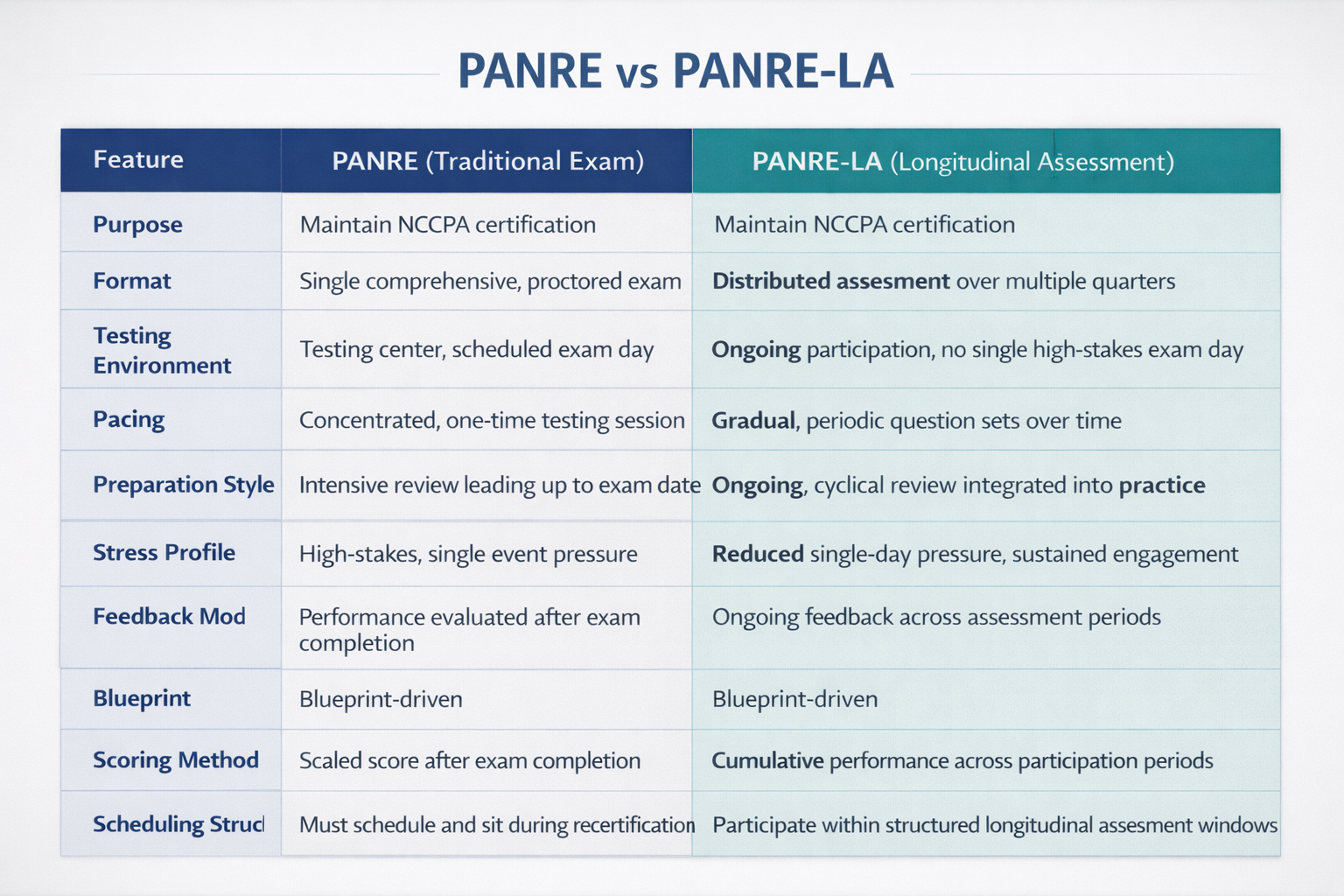
If you are approaching your NCCPA recertification cycle, one of the most important decisions you will make is whether to take the traditional PANRE exam or participate in PANRE-LA (Longitudinal Assessment). Both pathways allow certified physician assistants to maintain the PA-C credential, but they differ significantly in structure, pacing, and testing experience.
The Physician Assistant National Recertifying Exam (PANRE) is a comprehensive, proctored examination taken during a defined recertification window. PANRE-LA, by contrast, distributes assessment questions over time, allowing PAs to complete periodic question sets instead of sitting for a single high-stakes exam.
Understanding the structural and strategic differences between PANRE and PANRE-LA is essential for choosing the option that best fits your schedule, learning style, and professional responsibilities.
For a broader overview of how recertification fits into the full NCCPA certification lifecycle, see our complete NCCPA Certification Guide.
The traditional PANRE is a time-limited, proctored exam designed to assess ongoing medical knowledge across core clinical domains. It follows a blueprint structure similar to the PANCE, covering organ systems and clinical task areas aligned with NCCPA standards.
The exam is taken during a designated recertification window and requires structured preparation similar to initial certification, although expectations reflect a practicing clinician’s experience rather than entry-level competence.
Because PANRE is administered in a single testing session, it carries the familiar characteristics of a high-stakes exam: scheduled testing date, timed blocks, and scaled scoring. Many PAs prefer this format because it allows them to prepare intensively and complete recertification in one sitting.
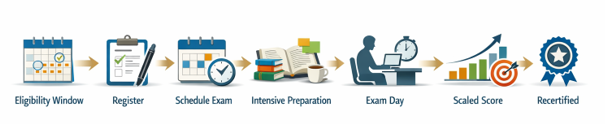
However, the concentrated format can create pressure, especially for clinicians balancing full-time practice with exam preparation.
PANRE-LA is an alternative recertification model that replaces a single exam day with ongoing assessment. Instead of sitting for a comprehensive proctored test, participants answer a defined number of questions released periodically over multiple quarters.
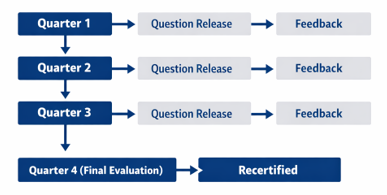
This distributed model allows PAs to engage with recertification gradually. Questions are completed within scheduled windows, and participants receive feedback that supports targeted learning throughout the process.
PANRE-LA reduces the stress associated with a single high-stakes testing event. It also allows clinicians to integrate review into their professional routine rather than stepping away from practice for concentrated exam preparation.
Despite structural differences, PANRE-LA remains blueprint-driven. It evaluates the same core knowledge domains and applies comparable competency standards.
Both PANRE and PANRE-LA:
The core knowledge expectations are not fundamentally different. The primary distinction lies in format and pacing rather than content scope.
The differences between PANRE and PANRE-LA center on structure, scheduling, and psychological profile.
The traditional PANRE requires dedicated preparation followed by completion of a comprehensive exam in a proctored setting. It concentrates evaluation into a defined testing event. Performance is determined after the exam is completed.
PANRE-LA spreads evaluation across multiple assessment periods. Rather than studying intensively for a single date, participants engage in sustained, lower-intensity review over time. The structure allows for reflection and targeted reinforcement of weaker domains.
Another difference lies in exam-day logistics. PANRE involves formal scheduling and testing center procedures. PANRE-LA removes much of the exam-day environment, replacing it with distributed participation windows.
Because of these structural differences, preparation strategies vary significantly.
There is no universally “better” option. The optimal choice depends on professional demands, personal learning style, and tolerance for high-stakes testing environments.
PAs who prefer structured deadlines and concentrated preparation often choose the traditional PANRE. Completing recertification in one sitting provides closure and avoids ongoing quarterly participation.
PAs who prefer steady engagement and reduced exam-day pressure often select PANRE-LA. The longitudinal model may be especially attractive for clinicians with unpredictable schedules or high clinical workloads.
When evaluating your choice, consider the following:
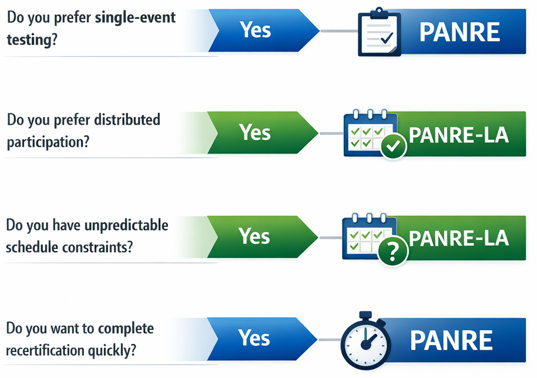
Your decision should reflect both logistical reality and cognitive style.
Preparation for the traditional PANRE resembles scaled-down PANCE preparation. Blueprint-guided review, question banks, and timed practice sessions remain central strategies. Candidates often create structured timelines leading up to their scheduled exam date.
Preparation for PANRE-LA is more cyclical. Because assessment is distributed, review can occur in shorter, more frequent sessions. Participants often focus on reinforcing weaker systems identified through periodic performance feedback.
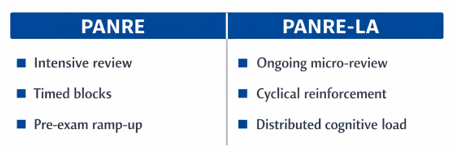
In both pathways, understanding the NCCPA blueprint remains essential. Organ system weighting still influences performance outcomes, and scaled scoring principles still apply.
For a detailed explanation of blueprint structure, see our PANCE and NCCPA Blueprint Breakdown.
Both recertification pathways use scaled scoring systems established by NCCPA. Raw percentages do not directly translate to passing standards.
In the traditional PANRE, performance is evaluated after exam completion. In PANRE-LA, cumulative performance across assessment periods determines outcome eligibility.
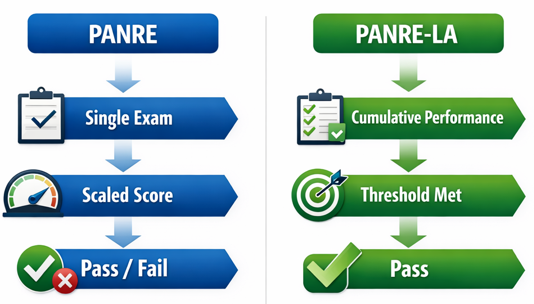
Understanding scaled scoring and performance thresholds is important for interpreting results accurately. Our NCCPA Scoring Guide provides a deeper analysis of how scaled scores are calculated and reported.
One common misconception is that PANRE-LA is “easier” than PANRE. While its format reduces single-day pressure, content standards remain aligned with NCCPA expectations. The difference lies in pacing, not rigor.
Another misconception is that clinical experience alone is sufficient for recertification. Even experienced clinicians can develop knowledge gaps outside their specialty focus. Structured review remains essential for both pathways.
Some PAs also underestimate timeline requirements. Regardless of pathway chosen, recertification windows and participation rules must be followed carefully to maintain certification status.
👉 Common PANCE and PANRE Mistakes — and How to Avoid Them
PANRE-LA serves as an alternative pathway. Both options are available according to NCCPA policy.
The total knowledge expectation is similar. PANRE-LA distributes preparation over time rather than concentrating it before a single exam date.
Eligibility and switching policies are governed by NCCPA guidelines. Candidates should review official policies before making a decision.
Many full-time clinicians prefer PANRE-LA because of its distributed structure, but the best option depends on personal study habits and scheduling flexibility.
PANRE and PANRE-LA are two structured pathways to maintain NCCPA certification. The traditional PANRE is a proctored, comprehensive exam completed in a defined testing session. PANRE-LA distributes assessment over time, reducing single-event pressure while maintaining blueprint-driven standards.
Choosing between them requires thoughtful consideration of scheduling realities, learning preferences, and exam psychology. Both demand structured preparation aligned with the NCCPA content blueprint.
For a full overview of certification stages, return to our NCCPA Certification Guide. If you are ready to plan your recertification strategy, explore our study planning and scoring resources next.
Complete guide to NCCPA certification, including PANCE, PANRE, PANRE-LA, exam structure, scoring, and preparation strategies.
What do physician assistants say about Med-Challenger for PANCE / PANRE exam review and required CME? We surveyed 3000 PA users.
Step-by-step guide to registering for the PANCE or PANRE, including eligibility, authorization to test, scheduling, ID requirements, and retake rules.