Last updated: February 2026
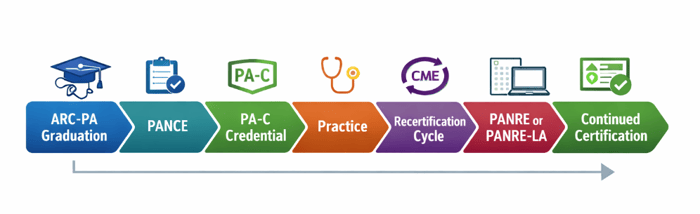
NCCPA certification is the national credential required for physician assistants (PAs) to practice in the United States. Administered by the National Commission on Certification of Physician Assistants (NCCPA), the certification process includes passing the PANCE (Physician Assistant National Certifying Exam) for initial licensure and maintaining credentials through PANRE or PANRE-LA for recertification. Understanding how the PANCE, PANRE, and PANRE-LA fit into the full PA certification pathway is essential for exam preparation, licensure eligibility, and long-term professional maintenance. This guide explains the complete NCCPA certification process, including exam structure, scoring, blueprint organization, registration steps, and strategic preparation considerations for both new graduates and practicing PAs.
If you are preparing for the PANCE or planning for upcoming recertification, this article serves as your high-level roadmap before diving into exam-specific strategy guides.
👉 Start preparing now with Med-Challenger’s Physician Assistant Review Course
PANCE Exam Overview: Initial NCCPA Certification
What Is the PANCE Exam?
The Physician Assistant National Certifying Exam (PANCE) is the initial certification exam required for all physician assistants seeking NCCPA certification. Passing the PANCE grants the PA-C credential and allows candidates to pursue state licensure.
Eligibility requires graduation from an ARC-PA–accredited PA program. After program verification, candidates apply through the NCCPA website and receive an exam authorization window. The PANCE must be scheduled and completed within that designated timeframe.
What Does the PANCE Test?
The PANCE exam follows a structured NCCPA blueprint that organizes content by organ systems and clinical task areas. Rather than focusing on rare subspecialty details, the exam evaluates broad clinical competence expected of an entry-level physician assistant.
Questions are vignette-based and require application of knowledge in areas such as:
- Diagnosis
- Clinical management
- Interpretation of diagnostic studies
- Preventive medicine and health maintenance
Because the PANCE is psychometrically standardized and scaled, preparation should focus on blueprint weighting rather than anecdotal topic emphasis.
A full breakdown of PANCE blueprint percentages and exam strategy is addressed in our dedicated PANCE Blueprint Breakdown.
PANRE and PANRE-LA: Maintaining NCCPA Certification
What Is the PANRE?
The Physician Assistant National Recertifying Exam (PANRE) is the traditional recertification exam required at designated intervals to maintain NCCPA certification. It assesses continued competence across core clinical domains and follows a blueprint similar in structure to the PANCE.
What Is PANRE-LA?
PANRE-LA (Longitudinal Assessment) is an alternative recertification pathway that distributes assessment questions over time rather than requiring a single high-stakes exam session. Certified PAs answer a set number of questions during scheduled quarters, allowing ongoing evaluation without a full testing day.
PANCE vs PANRE: Key Differences
The PANCE exam evaluates readiness for entry into practice. PANRE and PANRE-LA evaluate maintenance of professional knowledge. While blueprint domains overlap, preparation differs significantly.
Entry-level candidates preparing for the PANCE typically focus on comprehensive review across all organ systems. Practicing PAs preparing for PANRE often focus on refreshing broader domains outside their clinical specialty.
Choosing between PANRE and PANRE-LA depends on scheduling preferences, learning style, and long-term planning. A full comparison of PANRE and PANRE-LA structure is covered in our in-depth recertification guide.
👉 Which NCCPA Recertification Option Is Right for You?

NCCPA Blueprint and Content Domains
How Is the NCCPA Exam Blueprint Organized?
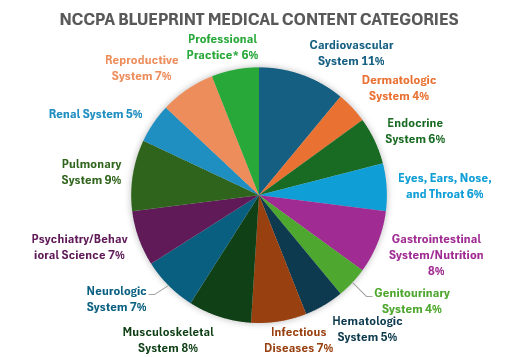
All NCCPA certification exams are built around an official content blueprint. The blueprint organizes exam questions by:
- Organ system categories (e.g., cardiovascular, pulmonary, gastrointestinal, endocrine)
- Clinical task areas (e.g., history and physical examination, diagnostic studies, diagnosis, clinical intervention, health maintenance)
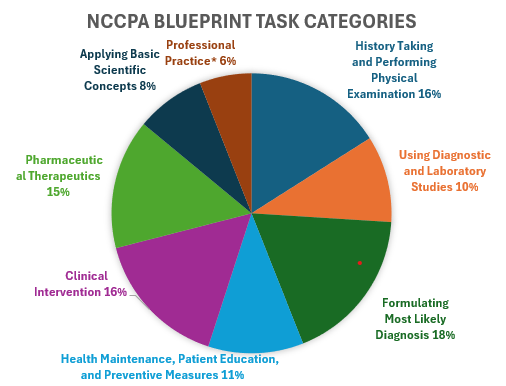
This dual-structure model ensures that candidates are evaluated on both knowledge base and application.
👉 PANCE Blueprint Breakdown: What Is Tested and How the Exam Is Weighted
Why Blueprint Weighting Matters for PANCE and PANRE Preparation
Each organ system is assigned a percentage weight on the exam. High-weight categories require proportionally more preparation time. Candidates who study evenly across all systems often underperform in heavily weighted domains.
Blueprint-driven studying improves efficiency, reduces cognitive overload, and aligns preparation with how the NCCPA exam is actually constructed.
Because the NCCPA periodically updates its blueprint, candidates should always confirm they are using the most current version before beginning exam preparation.
PANCE and PANRE Exam Structure and Scoring
What Is the Format of the NCCPA Exams?
Both PANCE and PANRE use multiple-choice, vignette-based questions administered in timed blocks. Questions simulate real patient encounters and require diagnostic reasoning, management decisions, and interpretation of data.
Exams are administered at secure testing centers under standardized conditions. Candidates must manage endurance and pacing in addition to content mastery.
How Does NCCPA Scoring Work?
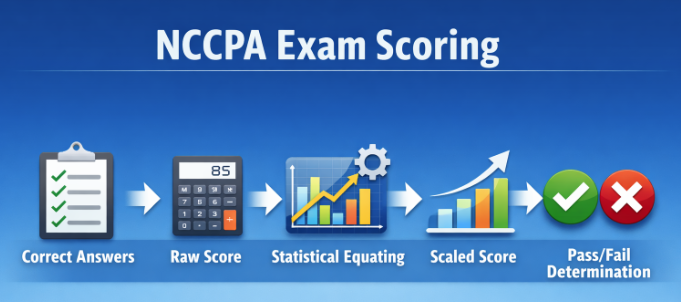
NCCPA exams use scaled scoring rather than raw percentage scoring. This psychometric model accounts for minor variations in exam difficulty across different test forms. As a result, the number of questions answered correctly does not directly translate into a simple percentage.
Understanding scaled scoring is critical. Many candidates misinterpret practice exam results because they equate raw percentages with passing standards.
Score reports are released according to NCCPA timelines, and retake policies include defined waiting periods and attempt limits.
👉 NCCPA Scoring for PANCE and PANRE Explained
NCCPA Registration and Exam Logistics
How Do You Register for the PANCE or PANRE?
Registration begins with creating an NCCPA account and submitting an application. Once eligibility is verified, candidates receive an authorization window for scheduling.
Exams are scheduled through designated testing providers. Candidates must comply with identification requirements, arrival policies, and testing center security procedures.
Missing documentation or failing to follow exam-day protocols can delay certification or result in forfeited attempts. Reviewing official policies well before the exam date is an important but often overlooked step in the certification process.
👉 How to Register for the PANCE or PANRE: Step-by-Step NCCPA Guide
Strategic Preparation for NCCPA Certification
Preparation for NCCPA exams should begin with timeline planning. Graduating students preparing for the PANCE must coordinate study schedules with graduation verification and exam window authorization. Practicing PAs preparing for PANRE or participating in PANRE-LA must align preparation with recertification cycles.
High-performing candidates use blueprint-guided study plans and integrate question-based learning early. Reviewing rationales, tracking weak domains, and simulating exam conditions improve performance more effectively than passive content review alone.
Preparation strategies differ between PANCE and PANRE. The PANCE demands comprehensive breadth. PANRE preparation often requires identifying knowledge gaps created by clinical specialization.
Cognitive endurance, structured review cycles, and burnout prevention are as important as content knowledge.
👉 Creating a PANCE Study Plan: Timeline, Strategy, and Preparation
Common Mistakes When Preparing for the PANCE or PANRE
Several recurring patterns undermine NCCPA exam performance. Candidates frequently underestimate blueprint weighting or delay registration until scheduling becomes compressed. Others rely too heavily on memorization without practicing clinical reasoning through vignette-style questions.
Another common error is assuming that clinical experience eliminates the need for structured review during recertification. While experience provides context, certification exams evaluate comprehensive knowledge across all blueprint domains.
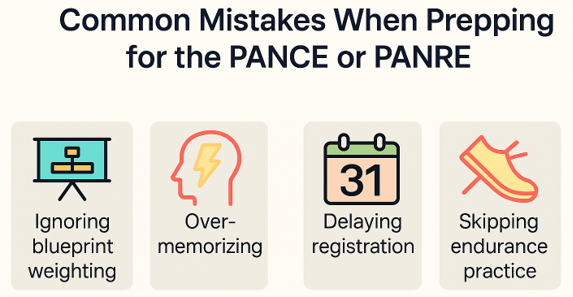
👉 Common PANCE and PANRE Mistakes — and How to Avoid Them
Frequently Asked Questions About NCCPA Certification
What is the difference between the PANCE and PANRE?
The PANCE is the initial certification exam required after graduation from an accredited PA program. PANRE and PANRE-LA are recertification pathways required to maintain the PA-C credential.
How often do physician assistants need to recertify?
NCCPA establishes defined recertification intervals and offers both traditional exam and longitudinal assessment options.
Is PANRE-LA easier than PANRE?
PANRE-LA differs in structure rather than content expectations. It spreads assessment over time, which may reduce single-exam pressure, but blueprint standards remain comparable.
What happens if you fail the PANCE?
Candidates must follow NCCPA retake policies, including waiting periods and attempt limits, before reapplying within an authorized exam window.
Next steps: Choosing the Right NCCPA Certification Strategy
If you are approaching graduation, your next step is reviewing the current PANCE blueprint and building a structured study timeline aligned with your authorization window.
If you are nearing recertification, evaluating whether PANRE or PANRE-LA better fits your schedule and learning style is critical.