


board review
Common PANCE and PANRE Mistakes — and How to Avoid Them
Avoid common PANCE and PANRE mistakes. Learn how blueprint weighting, scoring, and study strategy impact NCCPA exam performance.
Learn how NCCPA scoring works for the PANCE and PANRE, including scaled scores, passing standards, score reports, and retake policies.
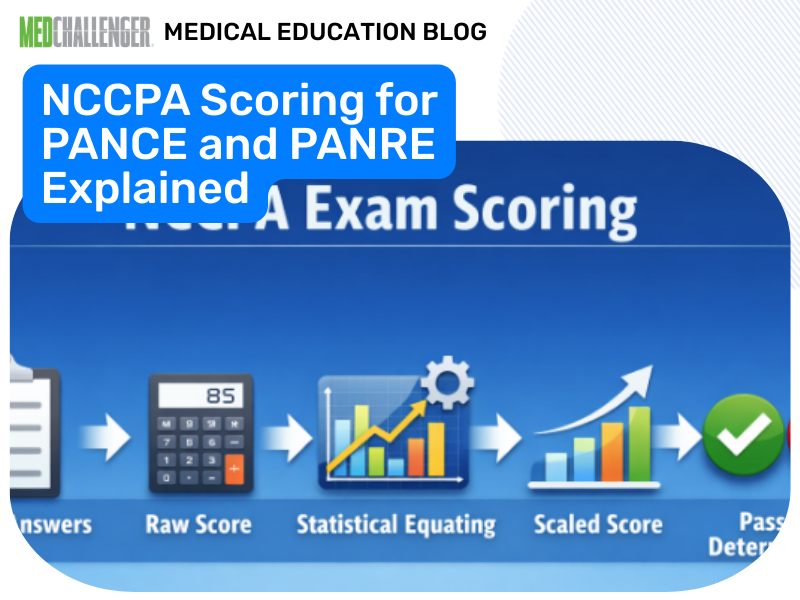
One of the most common sources of confusion for physician assistant candidates is how NCCPA scoring actually works. The PANCE and PANRE do not report simple percentages. Instead, they use a scaled scoring system designed to ensure fairness across different exam versions.
Understanding how scaled scoring works is essential for interpreting practice exam results, managing expectations, and making informed decisions after receiving a score report. Whether you are preparing for the PANCE or approaching PANRE recertification, knowing how your performance is evaluated removes unnecessary uncertainty.
For a broader overview of how scoring fits into the NCCPA certification lifecycle, see our complete NCCPA Certification Guide.
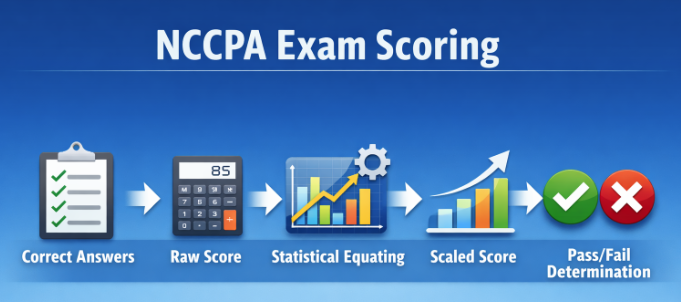
A scaled score is a standardized score that accounts for minor differences in difficulty between exam versions. Because no two test forms are identical, NCCPA uses statistical equating to ensure that passing standards remain consistent regardless of which version a candidate receives.
This means your score is not a raw percentage of correct answers. Two candidates who answer a different number of questions correctly on different versions of the exam may receive comparable scaled scores if the difficulty of their exam forms varies.
Scaled scoring protects exam integrity and fairness. It ensures that passing standards do not fluctuate based on subtle differences in question composition.
The NCCPA establishes a minimum passing standard for the PANCE based on psychometric analysis and competency expectations. The passing threshold is expressed as a scaled score rather than a percentage.
Because scaled scores reflect statistical equating, there is no fixed percentage correct that guarantees passing. Candidates sometimes attempt to reverse-engineer the required percentage, but this approach is unreliable.
The key takeaway is that performance in heavily weighted blueprint domains has a greater influence on your scaled score than performance in low-percentage systems. For a deeper understanding of blueprint weighting, review our PANCE Blueprint Breakdown.
The traditional PANRE also uses scaled scoring. Like the PANCE, it applies statistical equating to maintain consistency across exam forms.
Although the PANRE assesses practicing clinicians rather than entry-level candidates, the scoring model follows the same principles. Raw percentages are converted into scaled scores that determine whether the candidate meets the recertification standard.
Because the PANRE evaluates broad medical knowledge, underperformance in high-weight systems can significantly affect your scaled result.
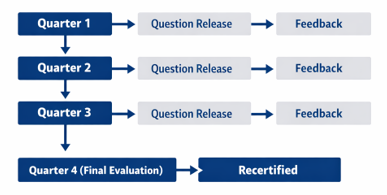
PANRE-LA differs in structure but still relies on NCCPA performance standards. Rather than a single testing session, PANRE-LA evaluates performance across multiple assessment periods.
Cumulative performance determines whether a candidate meets the recertification standard. While the delivery format differs from traditional PANRE, competency expectations remain aligned with the NCCPA blueprint.
Understanding this distinction is important. PANRE-LA is not graded as a casual knowledge check. It remains a formal recertification pathway governed by defined scoring policies.
For a structural comparison of PANRE and PANRE-LA, see our detailed recertification comparison guide.
👉 Which NCCPA Recertification Option Is Right for You?
After completing the PANCE or PANRE, candidates receive a score report that includes:
Performance feedback is typically organized by organ system categories. This breakdown can help candidates identify strengths and weaknesses.
However, domain-level feedback should be interpreted cautiously. It provides directional insight but does not represent a granular percentage breakdown of individual question performance.
Candidates who do not pass should use the content domain feedback to guide targeted remediation aligned with blueprint weighting.
Many candidates track progress using practice question banks and assume that achieving a certain raw percentage guarantees passing. While practice performance is useful for trend analysis, it does not directly predict scaled exam outcomes.
Practice questions vary in difficulty and may not reflect official blueprint weighting precisely. Additionally, scaled scoring adjustments applied to the official exam cannot be replicated in most third-party question banks.
Rather than fixating on a specific percentage threshold, candidates should focus on:
Preparation should be blueprint-driven, not percentage-driven.
👉 Creating a PANCE Study Plan: Timeline, Strategy, and Preparation
If a candidate does not meet the passing standard, NCCPA enforces defined retake policies. These include waiting periods and maximum attempt limits within specific timeframes.
Failure does not permanently end eligibility, but it does impose structural constraints. Candidates should carefully review official retake policies before reapplying.

Remediation after a failed attempt should focus on high-weight domains identified in the score report rather than restarting broad review indiscriminately.
For details on exam registration and retake logistics, review our PANCE and PANRE Registration Guide.
Several misconceptions frequently circulate among candidates.
One is that a specific raw percentage guarantees passing. Because of scaled scoring and equating, this is inaccurate.
Another misconception is that PANRE-LA is scored more leniently than traditional PANRE. While the format differs, competency standards remain defined by NCCPA policy.
Some candidates also misinterpret domain feedback as exact percentage breakdowns. In reality, these categories provide general performance insight rather than precise scoring analytics.
Understanding these distinctions reduces anxiety and prevents misguided study adjustments.
No. The PANCE uses scaled scoring and statistical equating, not relative grading against other candidates.
NCCPA establishes a minimum passing standard expressed as a scaled score. Because exam forms vary, there is no universal percentage correct that guarantees passing.
Both pathways use defined NCCPA performance standards, though PANRE-LA evaluates performance cumulatively across assessment periods.
Score reporting timelines are determined by NCCPA and may vary slightly depending on exam cycle and administrative processing.
NCCPA exams use scaled scoring rather than raw percentages to ensure fairness and consistency across exam forms. Both the PANCE and PANRE apply psychometric equating, and PANRE-LA evaluates cumulative performance across distributed assessments.
Understanding scaled scoring prevents misinterpretation of practice exam percentages and reduces unnecessary anxiety. Performance in heavily weighted blueprint domains has the greatest influence on final outcomes.
For a full overview of certification pathways, return to our NCCPA Certification Guide. To improve performance strategically, review our Blueprint Breakdown and Study Plan resources next.
Avoid common PANCE and PANRE mistakes. Learn how blueprint weighting, scoring, and study strategy impact NCCPA exam performance.
Learn how the Pediatric Emergency Medicine board exam is scored, including criterion-referenced scoring, scaled scores, and how passing standards are...
In Training Exams (ITEs) are a critical part of residency. Ensuring your residents pass with high scores is important. Here are some steps to raise...