Last Update: 10/21/2026
Why eligibility rules matter
ABFM’s eligibility policies set the guardrails for progressing from residency graduation to earning your first certificate. They also determine what happens if you delay, change jobs, move states, or need extra time to meet requirements. The key ideas become straightforward when laid out clearly: a seven-year board-eligibility window, a simplified three-year pathway right after residency, and defined steps if you miss those milestones.
👉ABFM Board Exam Guide 2026-2027: How to Prepare and Pass
The seven-year ABFM board-eligibility window (what it is, when it starts)
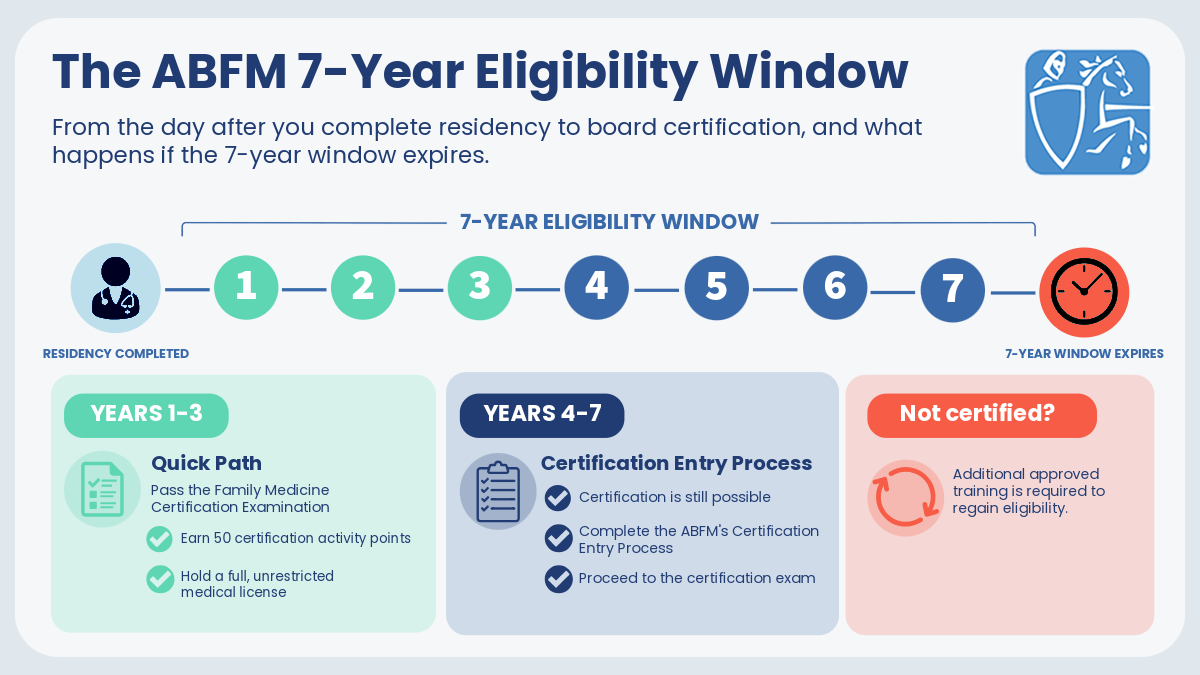
For physicians completing an ACGME-accredited family medicine residency on or after Jan 1, 2012, ABFM defines board eligibility as a seven-year period beginning the day after residency completion. During that seven-year window, you can complete the requirements for initial certification.
In practice, ‘board eligible’ means you may pursue initial certification under ABFM rules, but you are not certified until you meet all requirements and pass the exam.
👉ABFM One-Day Certification Exam: Format, Flow, and What It’s Like
The 3-year “quick path” right after residency (why it’s simpler)
ABFM highlights an important period: the three calendar years immediately following your residency completion year. In that time, the path is the most straightforward—think of it as the “quick path”:
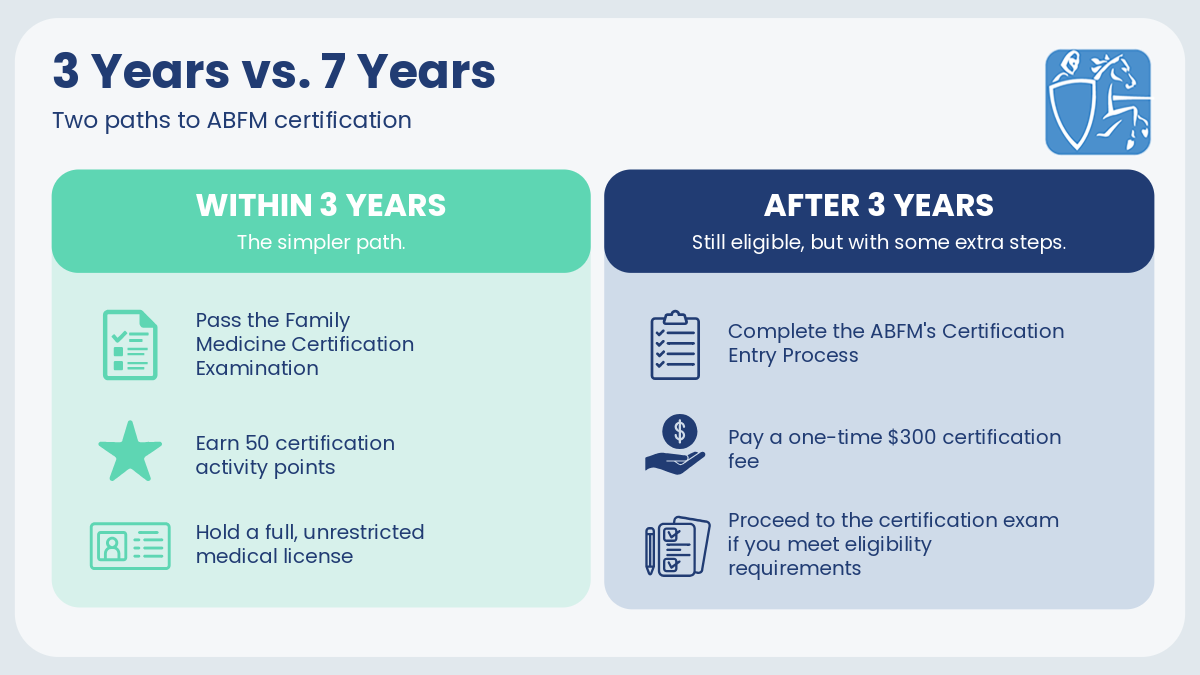
- You must pass the Family Medicine Certification Examination, earn 50 certification activity points, and obtain a full, unrestricted medical license reported in your MyABFM Portfolio
- After those 3 years have elapsed (but before the end of your 7-year window), you can still become certified—but you must complete the formal “Certification Entry Process” requirements first (a defined set of steps ABFM uses to verify readiness).
Takeaway: If you finish everything within three years of residency, your path is simpler. If you’re past three years, you can still become certified (as long as you’re within seven years), but you’ll need to complete ABFM’s Certification Entry Process steps before your exam eligibility is approved.
👉How to Prepare for the ABFM Exam: Study Strategies That Work
What happens if you delay beyond three years (but are still within seven)
If more than three calendar years have passed since you completed residency, you can still pursue initial certification as long as you remain inside your seven-year board-eligibility window. However, ABFM requires you to complete the Certification Entry Process before your exam application can be approved.
The Entry Process has a defined set of requirements and its own three-year clock. Once you start it, you have three years to finish everything and pass the exam. If you do not, the process resets and previously completed activities cannot be carried forward.
Certification Entry Process requirements
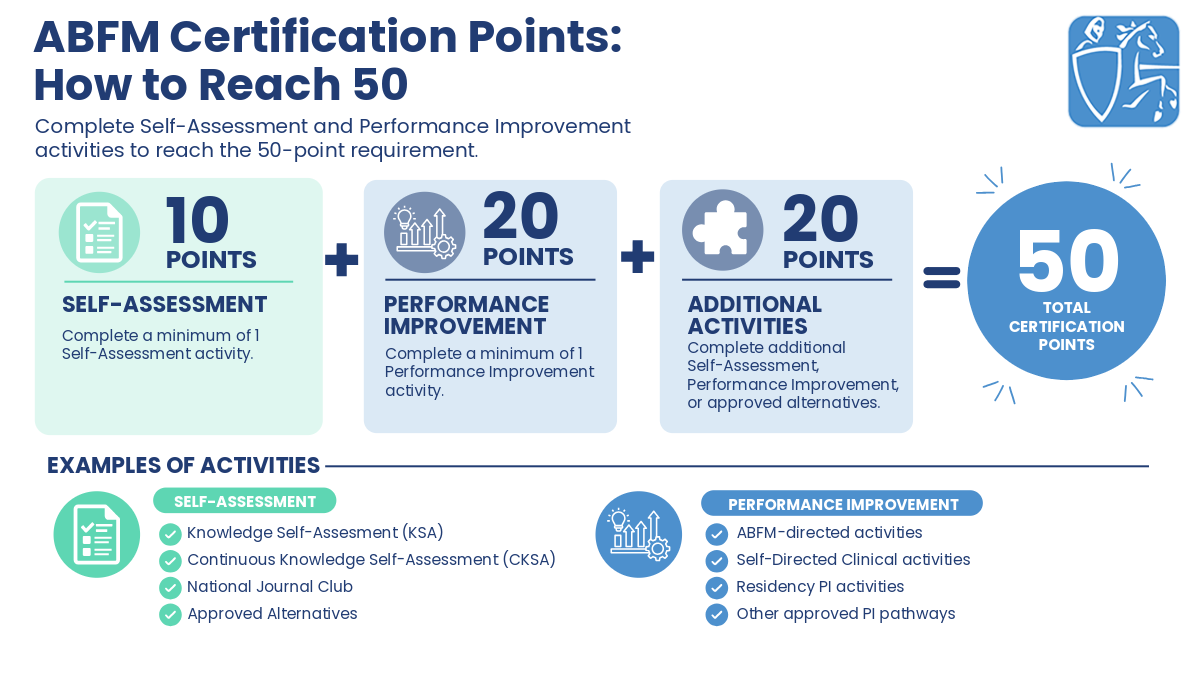
- 50 certification activity points, earned through:
- At least one self-assessment activity (minimum 10 points)
- At least one performance improvement activity (minimum 20 points)
- Additional self-assessment, performance improvement, or approved alternative activities to reach 50 points
- 150 CME credits completed in the three years prior to the exam (at least 50% Division I)
- Continuous compliance with ABFM’s Guidelines for Professionalism, Licensure, and Personal Conduct, including an active, unrestricted medical license reported in your MyABFM Portfolio
- One-time $300 Entry Process fee, plus the full examination fee when you apply
- Successful completion of the one-day Family Medicine Certification Examination
Your MyABFM Portfolio will show the exact requirements that apply to your pathway and timeline. Log in early if you are approaching or past the three-year mark so you have time to complete activities and submit the Entry Process before the next exam window.
Official ABFM Postponed Certification / Certification Entry Process page
What if your seven-year window expires?
If your seven-year board-eligibility window has expired (i.e., you have not achieved initial certification before its end):
- ABFM requires one additional year of training in an ACGME-accredited family medicine residency program (or an ABFM-approved alternative) to regain a new board-eligibility period and qualify again for certification.
- While outside the seven-year window, you may not refer to yourself as ‘board eligible.’
Bottom line: If you reach the end of seven years without certifying, you can still pursue certification—but you’ll need additional accredited training to reset eligibility.
Exam timing, applications, and scheduling
Some logistics to keep you on track:
- The one-day exam is offered April and November each year at Prometric test centers. Applications can be started before all requirements are complete, but approval and scheduling happen after ABFM confirms you’ve met your entry requirements.
- If you need dates and deadlines, use the “Dates and Deadlines” section on the one-day exam page and the year’s Candidate/Registration Information Booklet for exact windows.
Tip: If you’re approaching three years post-residency (or you’ve crossed it), check your MyABFM Portfolio now so you have time to complete any Entry-Process tasks before the next exam window fills.
Licensure and professionalism requirements
To earn initial certification, you must hold a valid, active, full medical license without prohibitive restrictions and meet ABFM professionalism and conduct standards. ABFM asks you to report your license in your MyABFM Portfolio; lapses, restrictions, or professionalism issues can delay approval.
👉For comprehensive medical professionalism standards with CME credits see Med-Challenger Professionalism
What’s changing for 2026 graduates (competency attestation)
Beginning with June 2026 graduates, program directors, with input from the Clinical Competency Committee (CCC), must attest that each resident is competent across ABFM’s full set of core outcomes before the resident can be considered board-eligible. This expands the Competency-Based Board Eligibility (CBBE) attestation that began rolling out in 2024 and 2025.
Procedural competence attestation is not required for board eligibility in 2026. ABFM has postponed that requirement until June 2027. Program directors may optionally attest to procedural competence for 2026 graduates, but it is not mandatory until the following year.
This change does not alter the seven-year board-eligibility window. It clarifies what “ready for board eligibility” means at the time of graduation. Residents still complete the usual requirements (exam, 50 certification activity points, license, and professionalism standards) once the program director’s attestation is in place.
Common scenarios (and what to do)
- I’m 18–24 months out of residency and haven’t taken the exam yet.
You’re still within the 3-year quick path. Make sure your 50 points, full license, and exam application are on track for the next window.
- It’s been >3 years since residency, but <7 years.
You will need to complete ABFM’s Certification Entry Process before your exam application can be approved.
- My 7-year window just ended.
You will need one additional year of approved ACGME family medicine residency (or ABFM-approved alternative) to regain eligibility and restart the clock.
FAQs
Q1: When does my seven-year ABFM board-eligibility window start?
The window begins the day after you complete an ACGME-accredited family medicine residency.
Q2: What must I complete during the three-year “quick path”?
You must:
- Pass the ABFM one-day exam
- Earn 50 certification activity points
- Hold a full, unrestricted medical license
Q3: Can I still certify if I’m past three years but inside seven?
Yes. You must complete ABFM’s Certification Entry Process before your exam application is approved.
Q4: What if my seven-year window expires?
You must complete one additional year of ACGME-accredited family medicine training (or an ABFM-approved alternative) to regain eligibility.
Q5: Can I call myself “board eligible” after my window expires?
No. ABFM prohibits using the term outside an active seven-year eligibility window.
Q6: How do I know which Certification Entry Process steps apply to me?
Your MyABFM Portfolio lists personalized requirements based on your pathway, timeline, and licensure.
Next Steps
- Log into your MyABFM Portfolio.
Confirm your residency completion year, eligibility window, and pending requirements.
- Determine whether you’re in the three-year quick path or the extended pathway.
This affects the steps you need to complete before applying.
- If you’re beyond three years, start the Certification Entry Process early.
Some steps require time to complete and verify.
- Check your medical license status.
Ensure it is active, unrestricted, and correctly reported to ABFM.
- Plan your exam window.
Choose the April or November exam based on your timeline and readiness.
- Schedule activity completion.
Plan when you’ll earn your 50 certification points if you are still within the three-year path.
- If your seven-year window is approaching its end, act immediately.
Missing the deadline triggers a required extra year of training.