Last Updated: 10/16/2026
The ABFM certification exam is a comprehensive assessment of family medicine practice — measuring not only medical knowledge but also stamina, reasoning, pacing, and guideline-based decision-making. Most first-time test takers pass, but success requires intentional, blueprint-aligned preparation.
This guide explains ABFM’s blueprint and provides practical study strategies based on how the exam is actually structured.
In addition to studying the topical material, you are strongly encouraged to take advantage of the online tutorial/exam orientation provided by the ABFM in advance of your exam day. Arriving at the Prometric center with an established comfort level with the testing software is an easy thing to check off your preparation list.
👉What to Expect on ABFM Exam Day
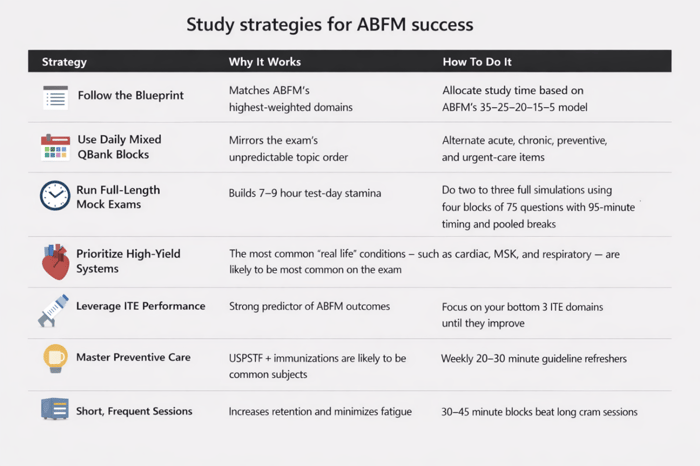
At-a-Glance: 7 Core Study Strategies for ABFM Success
Start With the Blueprint: Know What ABFM Actually Tests
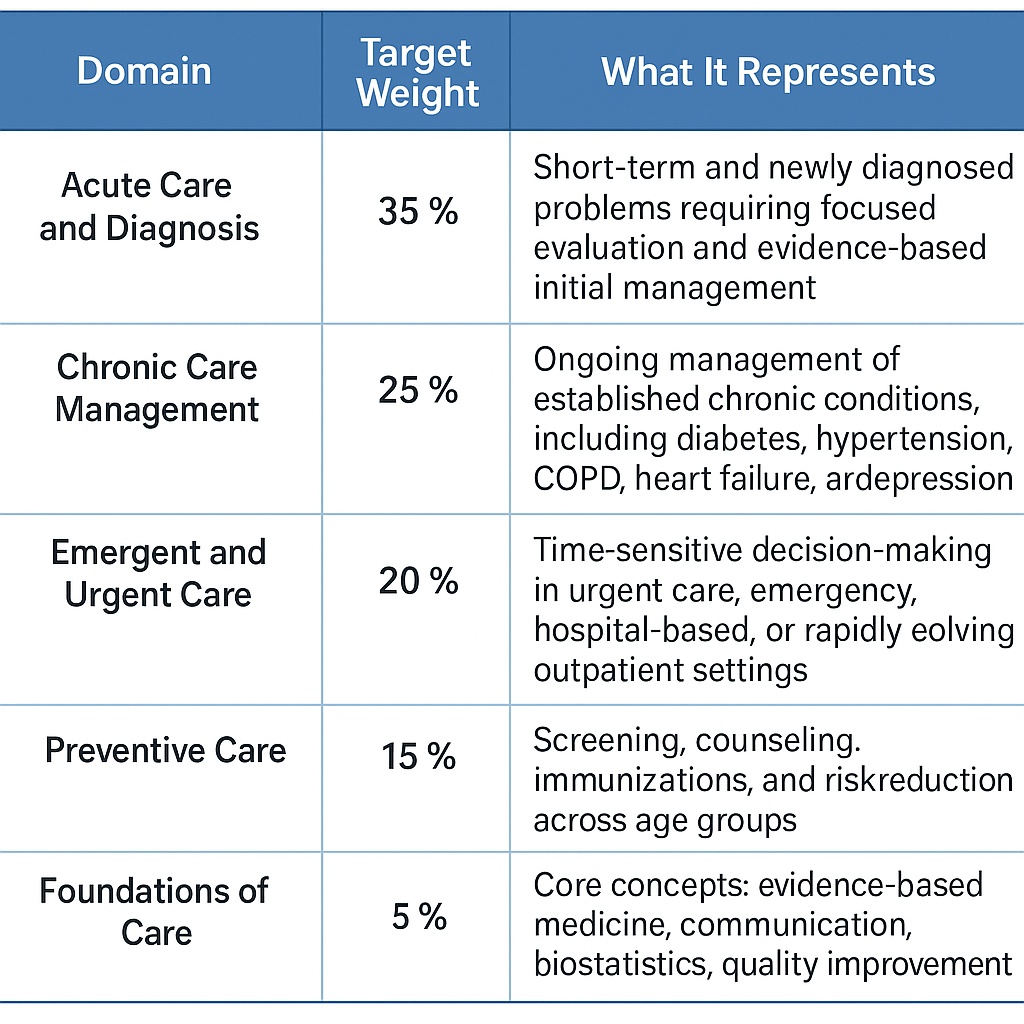
The 2025 ABFM blueprint breaks exam content into five major domains that dictate not just what appears on exam day — but how often. If your study time does not reflect ABFM’s domain weightings, your final performance won’t either.
The Five Core ABFM Domains (2025 Blueprint)
 👉What Are ABFM Exam Content Weights and What Do They Mean?
These percentages are stable year to year and apply to both the one-day exam and Family Medicine Certification Longitudinal Assessment (FMCLA).
👉Which ABFM Maintenance of Certification Path Fits You Best?
ABFM’s One-Day Exam Content Outline lists specific clinical systems and the proportion of total items expected from each.
Allocate the majority of your study time to match these proportions. For example, Acute Care and Diagnosis plus Chronic Care Management together account for 60% of the exam, so they should receive the largest share of your QBank blocks and review time. This approach keeps your preparation focused on the content ABFM actually tests and reduces time spent on lower-yield areas.
Build Daily and Weekly Study Schedules That Actually Work
Cramming doesn’t work for the ABFM exam – it tests retention, application, and stamina — all of which improve with distributed practice, not marathon sessions.
Daily (30–60 minutes)
In daily 30–60 minute sessions, complete 1–2 QBank blocks, review explanations, and include brief preventive-care reinforcement.
Weekly (2–5 hours)
One timed QBank block of 75 questions (95 minutes) to mimic ABFM section pacing.
Monthly
Follow the full 7–9 hour test-day rhythm, including break timing. This recreates the fatigue curve of the real exam.
Use Qbanks the Right Way (Not the Hard Way)
A high-quality QBank aligned with the ABFM blueprint is essential. Med-Challenger, for example, maps directly to the Family Medicine Certification Examination Blueprint (FM Model) and blends “assessment” questions with “teaching” cases. To use a QBank effectively:
- Don’t just mark right/wrong — study explanations.
- Use both mixed-topic and system-specific blocks to simulate exam unpredictability while reinforcing weak areas.
- Build custom quizzes from your weakest categories.
- Stay strict: if it’s a chronic/acute management question, ask yourself:
- “What’s the next best step right now?”
- “What if labs/images change?”
- “What guideline applies?”
👉How to Choose the Right ABFM Question Bank (What Really Matters)
Run Full-Length Mock Exams to Build Endurance
When you factor in check-in, tutorial, testing time, and breaks, the ABFM one-day exam lasts 7–9 hours. Failures occur when candidates lose focus or stamina — not because they lack knowledge.
Do 2–3 full simulations
- 300 questions
- 4 blocks × 75 questions
- 95 minutes per block
- 100 minutes of pooled break time
- Begin your simulation at the same time your scheduled exam will begin
During mocks:
- Use identical food and hydration routines
- Practice “mark and move” instead of agonizing over single items
- Identify your pacing rhythm
- Track your attention dips, especially in the mid-afternoon window.
This prepares you for exam day’s mental and physical load.
Prioritize High-Yield Systems and Common Conditions
Although the ABFM Certification exam no longer follows an organ/system blueprint, you can expect it to represent real life encounters. You will want to focus on common clinical presentations within the domain structure.
Your weekly schedule should include:
- Cardio (HTN, heart failure, arrhythmias, CAD, murmurs)
- Respiratory (asthma, COPD, pneumonia, PE)
- MSK (back pain, joint pain, trauma vs non-trauma)
Also prioritize:
- Diabetes
- Thyroid disorders
- Hypertension and lipid management
- Depression/anxiety
- GI pain syndromes
Use Your ITE Performance as a Roadmap
The ABFM In-Training Examination (ITE) is one of the strongest predictors of certification-exam success. If you took the ITE in residency, use it.
- Pull up your last ITE score report
- Identify your bottom three domains
- Make each one a weekly non-negotiable topic
- Build extra Qbank blocks from those areas
This creates a targeted improvement curve.
👉ABFM Pass Rates and What They Really Mean
Avoid Common ABFM Study Pitfalls
Patterns among those who fail the exam include:
- Spending too much time on rare conditions
- Underestimating preventive care (15% of the blueprint)
- Ignoring Foundational topics (stats, ethics, communication)
- Not practicing full-length blocks early enough
- Doing passive reading instead of active recall
- Not spacing repetitions
ABFM rewards clinical bread-and-butter management, not zebra hunting.
👉Myth Versus Reality - Debunking the Three Biggest Board Exam Myths
Build Endurance and Exam-Day Readiness
Treat exam day like a clinic day — long, steady, and mentally demanding.
Two Weeks Before
- Stabilize your sleep schedule and daily routine
- Practice your breakfast/hydration routine
One Week Before
- Take the online exam software tutorial
- Re-review your “most-missed” topics
- Run at least one final simulation
- Do only light review in the last 48 hours
Day Before
- Do not cram — keep your brain fresh for exam day.
- Light Qbank only (<15 questions)
- Pack everything you need
- Confirm your Prometric location and arrival time
On Exam Day
- Stay within your pacing plan
- Use breaks intelligently
- Mark questionable items and move on
- Trust your preparation
👉What to Expect on ABFM Exam Day
FAQs
Q1: How long should I study for ABFM?
Most candidates need 8–16 weeks, depending on schedule and baseline knowledge.
Q2: How many questions should I complete?
Aim for 700–1,500 questions, reviewing all explanations, especially missed items.
Q3: Do I need full-length practice exams?
Yes. Complete at least two, ideally three, full simulations to build pacing and stamina.
Q4: Should I use multiple Qbanks?
One high-quality bank such as Med-Challenger is enough if used well.
Q5: Is reading enough to pass?
No. The ABFM exam rewards active recall and applied reasoning, so QBank-based study is essential.
Next Steps
Passing ABFM isn’t about grinding for hours — it’s about aligned preparation. If you follow a plan built around strategic, blueprint-driven study, you’ll place yourself firmly in the group of physicians who pass confidently — on time, with a stronger foundation for practice.
- Download the latest ABFM blueprint and content outline.
Align study hours and QBank time to those percentages.
👉What Are ABFM Exam Content Weights and What Do They Mean?
- Build a 12-week study plan.
Include mixed QBank blocks, blueprint-focused sessions, and preventive-care refreshers.
- Start with untimed practice.
Learn reasoning and explanations before pushing speed.
- Add weekly 95-minute timed blocks at Week 3–4.
Train pacing early.
- Schedule two to three full-length simulations.
Use identical timing, breaks, and a start time matching your actual exam.
- Review missed questions weekly.
This is the single highest-value study habit.
- Reinforce high-yield topics weekly.
Cardio, respiratory, musculoskeletal, diabetes, thyroid, depression, preventive care.
- Taper the final 48 hours.
Light review only, with stable routines and early sleep.