Updated 10/19/2026
A Test Built to Reflect Real Practice
The American Board of Family Medicine (ABFM) certification exam is more than a test of memory — it evaluates whether you are prepared to think and act like a practicing family physician. The exam’s design reflects the core purpose of certification: to demonstrate clinical judgment, not just factual recall.
👉ABFM Board Exam Guide 2026: How to Prepare and Pass
Exam Structure and Timing
The one-day computer-based exam consists of 300 multiple-choice questions, divided into four sections of 75 questions each. You have 95 minutes for each section and a shared pool of 100 minutes of break time to use between sections as needed.
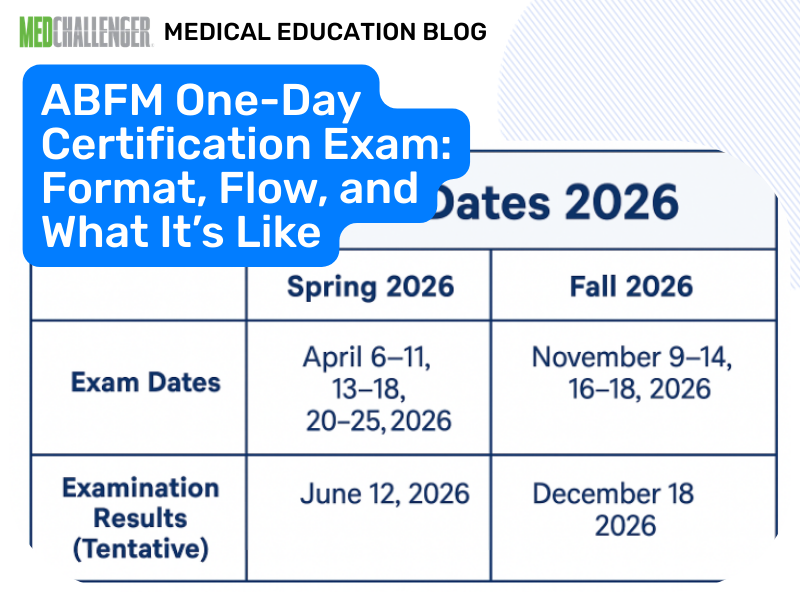
The Exam is offered each Spring (April) and Fall (November) with multiple testing dates available for each season. For 2026 and 2027, the testing dates are:
| ABFM Exam Dates 2026 |
| |
Spring 2026 |
Fall 2026 |
| Exam Dates |
April 6-11, 13-18, 20-25, 2026 |
November 9-14, 16-18, 2026 |
Examination Results (Tentative)
|
June 12, 2026 |
December 18, 2026 |
| ABFM Exam Dates 2027 |
| |
Spring 2027 |
Fall 2027 |
| Exam Dates |
April 5-10, 12-17, 19-24, and 26, 2027
|
November 1-10, 2027 |
Examination Results (Tentative)
|
June 11, 2027 |
December 17, 2027 |
You’ll notice that more testing dates are offered in the spring, reflecting higher candidate volume during that window.
When you include check-in, the tutorial, testing time, and breaks, the full exam day typically lasts seven to nine hours. The ABFM certification examination is delivered at Prometric test centers, which have roughly 350 locations in the United States and 180 international locations. Prometric serves as the site for many types of exams so when you look around the room, you’ll see many others taking tests – but they won’t all be taking the ABFM certification exam.
👉What to Expect on ABFM Exam Day
Pacing and Endurance Strategies
Because the testing is computer-based, you can easily move forwards and backwards, marking items to return to and double-checking those you’ve answered. Within each block’s scheduled time, you can review and change answers. However, once the time allowed for that section is complete, no more changes are allowed – your answers are locked in. You will see a countdown clock at the top of your screen to help you keep an eye on your time. If you hit a troublesome question, your best strategy will be to flag it and move on. The good news is that there is no penalty for incorrect answers. When moving through each section, you should allow about one minute per question. Give yourself time to return to any questions you skipped and be sure to reserve the final five minutes of each block for a review.
What Does the ABFM One-Day Exam Really Test?
Understanding what the American Board of Family Medicine (ABFM) exam actually covers can help you focus your study time where it matters most. Put simply, the test reflects the full range of family medicine practice — from acute diagnosis to chronic disease management and preventive care — all grounded in real patient scenarios. Bottom line: the exam is designed to mirror real-life outpatient and inpatient family medicine.
The one-day certification exam is made up of multiple-choice questions, each having a single best answer. This approach evaluates clinical reasoning, decision-making, and guideline-based care, rather than memorization. The material is organized and weighted to follow the 2025 ABFM Family Medicine Exam Blueprint. The five main topical areas you’ll see on exam day are:
Acute Care and Diagnosis: 35%
This portion focuses on the fast-paced, problem-solving side of family medicine. You’ll see short clinical vignettes similar to those in outpatient and urgent-care visits and be asked to decide the next diagnostic step, identify the correct diagnosis, or choose the right initial treatment. The goal is to test your ability to think through new or evolving problems in real time — not just recall textbook facts.
Chronic Care Management: 25%
These questions reflect the ongoing care of patients with long-term conditions like diabetes, heart failure, or COPD. Scenarios are drawn from routine ambulatory practice and long-term care settings. You can expect to be asked about medication adjustments, follow-up schedules, lifestyle interventions, and coordination of care — all of which are at the core of managing chronic disease in family medicine. These questions frequently emphasize guideline-based management and medication adjustments.
Emergent and Urgent Care: 20%
This section tests how you respond when time matters. Cases are modeled after urgent or emergent clinical situations which family physicians may encounter in hospitals, emergency departments, urgent care centers, or rapidly evolving outpatient situations. You’ll need to identify immediate next steps, determine how to stabilize patients, or recognize conditions requiring rapid escalation or transfer. Questions focus on quick, safe, and evidence-based decision-making.
Preventive Care: 15%
Preventive medicine is a cornerstone of family practice, and this section reflects that. You’ll encounter questions about immunizations, screening recommendations, counseling for lifestyle risk factors, and early detection of disease. Most questions are framed around common outpatient visits where you’re providing proactive, rather than reactive, care.
Foundations of Care: 5%
Finally, the ABFM exam includes questions that assess your broader understanding of what it means to practice medicine responsibly. You can expect questions covering evidence-based medicine, ethics, communication, biostatistics, health policy, and health equity. These topics ensure you can interpret data, navigate system-level issues, and deliver care that is clinically sound, ethical, and patient-centered.
👉What Are ABFM Exam Content Weights and What Do They Mean?
In Short
The ABFM certification exam mirrors real-world family medicine practice and emphasizes clinical reasoning, not obscure fact recall. By organizing your study around these domains and by focusing on clinical reasoning, preventive medicine, and professional foundations, you’ll be better prepared for both the test and your daily work as a family physician.
👉How to Prepare for the ABFM Exam: Study Strategies That Work
FAQs
Q1: How many questions are on the ABFM one-day exam?
There are 300 questions divided into four sections of 75 questions, each with 95 minutes.
Q2: Is the exam all outpatient medicine?
No. While outpatient scenarios dominate, you will also see urgent, emergency, and hospital-based situations.
Q3: Can I go back and change answers within a section?
Yes — as long as you are still within the time limit for that section.
Q4: Can I return to a section after it closes?
No. Once a section ends or times out, you cannot return to it.
Q5: How long is the full test day?
Including check-in, tutorial, testing, and breaks, the day typically lasts 7–9 hours.
Q6: How often is the exam offered?
Twice yearly: April (Spring) and November (Fall) windows, each with multiple testing dates.
Q7: Are the exam questions similar to QBank questions?
The best QBanks, like Med-Challenger, mimic ABFM style: short vignettes, next-best-step decisions, guideline-based management.
Next Steps
- Download the ABFM Candidate/Registration Information Booklet.
Review testing policies, break rules, and check-in requirements.
- Practice with 75-question timed blocks.
Match the 95-minute pacing used on the exam.
- Build a strategy for section timing.
Aim for ~1 minute per question, with time reserved for review.
- Use two to three full exam simulations.
Practice the full-length day to build endurance.
- Plan your exam window early.
Choose Spring or Fall based on readiness and schedule constraints.