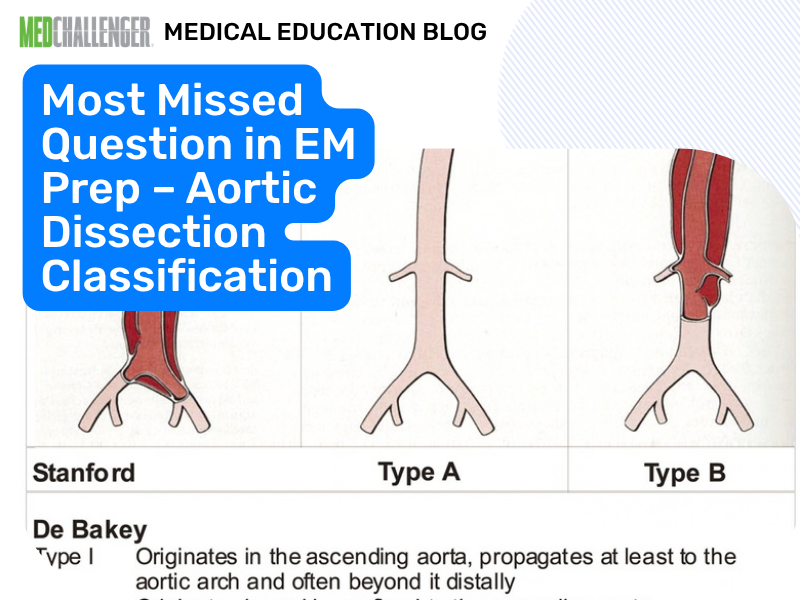
Key takeaway: If the ascending aorta is involved, it is Stanford Type A (and if it originates in the ascending and extends beyond the arch, it is DeBakey Type I).
Question - Dissection type
A chest CT scan with contrast of a 73-year-old male with acute onset of hypotension and chest pain identifies an aortic dissection that originates in the ascending aorta and extends beyond the aortic arch.
According to the DeBakey and Stanford classifications, this lesion is classified as:
Answer Options:
A. Type I
B. Type II
C. Type III
D. Type A
E. Type B
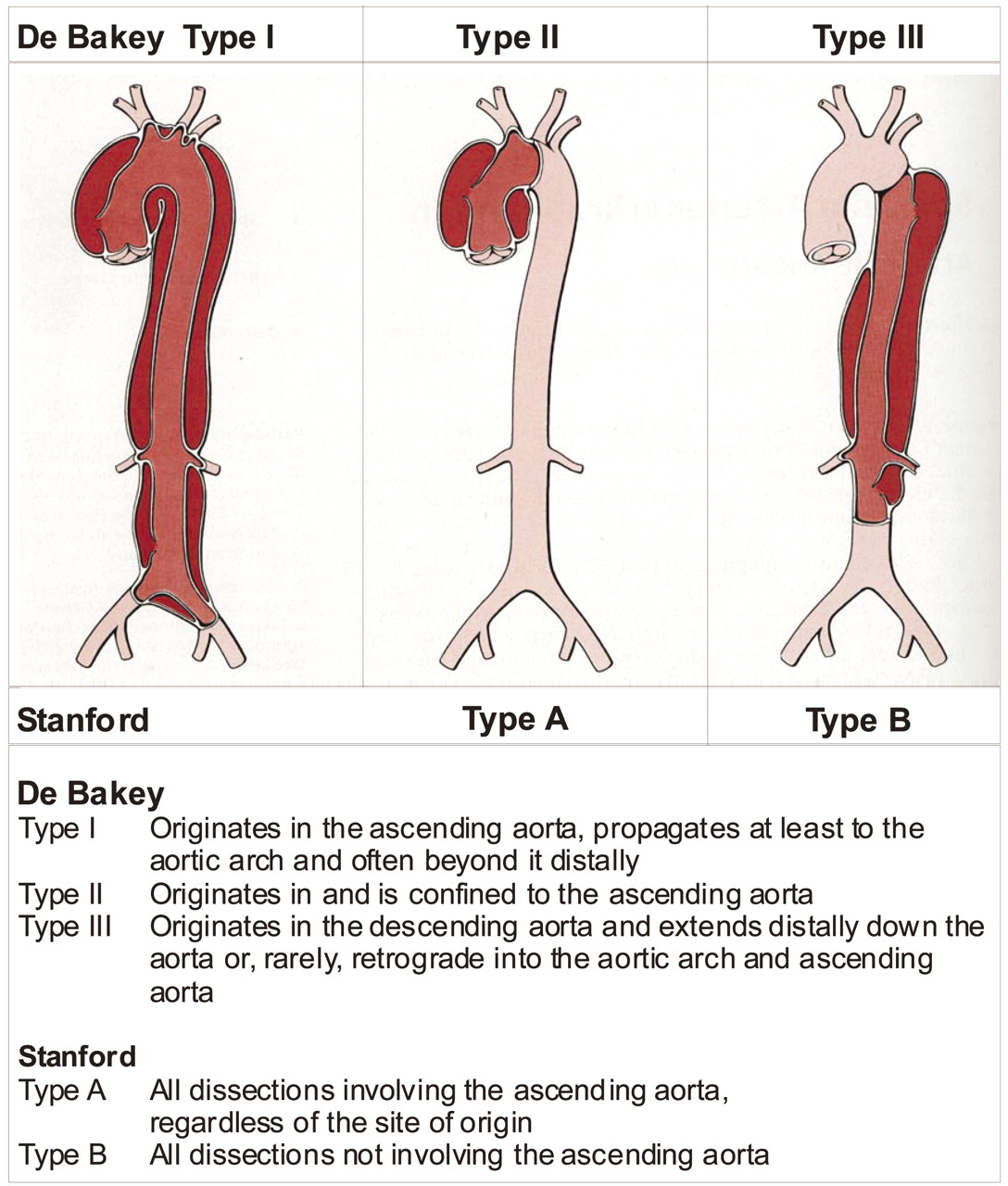
This is frequently missed because the stem name-drops both systems, but the answer list forces you to pick one label. Per ACC/AHA 2022 and long-standing exam convention, any dissection involving the ascending aorta is Stanford Type A, even when it extends beyond the arch.
At the same time, the imaging description (“originates in the ascending aorta and extends beyond the aortic arch”) is the classic definition of DeBakey Type I (Type II is confined to ascending; Type III originates distal to the left subclavian). On boards, when forced into a single best answer with mixed-system options, choose Stanford Type A when ascending aorta involvement is explicit.
Why This Emergency Medicine Question Is Often Missed
- It mixes DeBakey (I/II/III) and Stanford (A/B) in one answer set, pushing test-takers into an “either/or” choice.
- Learners over-focus on “extends beyond the arch” and forget the overriding rule: ascending involvement = Stanford A.
- Confusion between origin (DeBakey) vs involvement (Stanford).
What the Distractors Indicate
| Option |
What It Tests / Implies |
Why It’s Wrong Here |
| Type I |
DeBakey: originates in ascending and extends beyond arch |
Actually true for DeBakey, but the item’s single-best-answer structure makes Stanford Type A the exam-preferred label when ascending involvement is explicit. |
| Type II |
DeBakey: confined to ascending aorta |
Wrong because the dissection extends beyond the arch. |
| Type III |
DeBakey: originates in descending aorta (distal to L subclavian) |
Wrong because this dissection originates in the ascending aorta. |
| Type A |
Stanford: any dissection involving ascending aorta |
Correct: ascending aorta is involved (and origin is ascending). |
| Type B |
Stanford: dissections not involving ascending aorta |
Wrong because ascending aorta involvement is stated. |
High-Yield Pearl for ABEM Exam Prep
If the ascending aorta is involved → Stanford Type A, regardless of how far it extends.
Core Learning Objectives
- Differentiate Stanford Type A vs Type B dissections based on ascending aorta involvement.
- Differentiate DeBakey Types I–III based on site of origin and extent.
The Exam Trick at Play
The trick is system-mixing: the stem describes a lesion that is simultaneously DeBakey I and Stanford A, but the answer choices don’t let you select both. On EM/IM-style exams, when ascending involvement is explicit, Stanford Type A is the most actionable classification (it maps to immediate surgical consultation/management pathways per contemporary guidance).
Additional Practice Questions & Remediation for Aortic Dissection Classification
Emergency Medicine Practice Question 1 — Ascending-only
CTA shows an intimal flap confined to the ascending aorta, not extending beyond the brachiocephalic vessels. Classification?
- A. DeBakey Type II
- B. DeBakey Type I
- C. DeBakey Type III
- D. Stanford Type B
- E. Intramural hematoma only (not dissection)
Emergency Medicine Practice Question 2 — Descending distal to L subclavian
Dissection begins just distal to the left subclavian artery and extends to the abdominal aorta; no ascending involvement. Best Stanford class?
- A. Stanford Type A
- B. Stanford Type B
- C. DeBakey Type II
- D. DeBakey Type I
- E. Cannot be classified without TEE
Emergency Medicine Practice Question 3 — Origin vs involvement
A dissection involves the ascending aorta but imaging suggests the tear may be near the arch. Under Stanford classification, it is:
- A. Stanford Type B
- B. Stanford Type A
- C. DeBakey Type III
- D. DeBakey Type II
- E. Penetrating atherosclerotic ulcer by definition
Emergency Medicine Practice Question 4 — DeBakey mapping
Which pairing is correct?
- A. DeBakey I = Stanford B
- B. DeBakey II = Stanford B
- C. DeBakey III = Stanford B
- D. DeBakey III = Stanford A
- E. DeBakey I = confined to ascending aorta
Emergency Medicine Practice Question 5 — Mixed-system single-best
CTA: dissection originates in ascending aorta and extends to descending thoracic aorta. If forced to choose one label for immediate risk stratification, best answer is:
- A. DeBakey Type III
- B. DeBakey Type II
- C. DeBakey Type I
- D. Stanford Type A
- E. Stanford Type B
Mini Case Discussion Prompt
How would your classification and next-step disposition differ for (1) DeBakey III / Stanford B with end-organ malperfusion vs (2) Stanford A with pericardial effusion and hypotension?
Mini-FAQ
Q1: On boards, what is the fastest rule for Stanford classification?
A: The ABIM/ABEM expect you to recognize that any ascending aorta involvement = Stanford Type A; everything else is Type B.
Q2: What DeBakey type is “ascending origin + beyond arch”?
A: DeBakey Type I—it originates in the ascending aorta and extends into the arch/descending aorta.
Q3: Can one dissection be both DeBakey I and Stanford A?
A: Yes. The systems are overlapping; many dissections have two correct labels, which is why mixed-option questions can be tricky.
Q4: Why do exams emphasize Stanford A so heavily?
A: Because it maps to high-risk complications and escalation pathways (often surgical consultation), so rapid recognition is test-relevant.
Find this and other Emergency Medicine exam prep questions in Med-Challenger Emergency Medicine Review with CME
Try for free and save. Ace your exams and meet your CME/MOC requirements for just $35 a month!