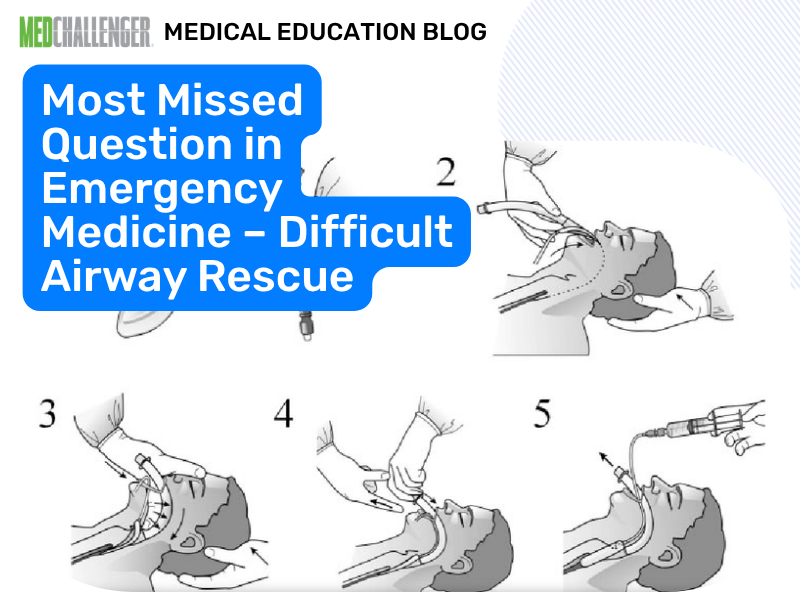
Restoring oxygenation quickly is the priority in a failing BVM scenario, and a supraglottic/extraglottic airway is a high-success, low-time rescue step in predicted difficult airways.
Question - Difficult BVM
A 55-year-old man who is morbidly obese and has a short neck and full beard is found unresponsive. There is no sign of trauma, he moans with a sternal rub, bag-mask ventilation is proving to be difficult, and the patient’s saturation levels are dropping despite repositioning him and adjusting the bag seal.
Which of the following is the preferred next step in this particular patient?
Answer Options:
- A. Extraglottic airway
- B. Immediate direct laryngoscopy
- C. Rapid sequence intubation
- D. Needle cricothyroidotomy
- E. Surgical cricothyroidotomy
In this stem, you are being told (1) oxygenation is worsening, (2) BVM is difficult despite optimization, and (3) anatomy predicts both difficult mask seal (beard) and difficult laryngoscopy/front-of-neck access (short neck, morbid obesity). On boards, this combination pushes you toward the most reliable rapid oxygenation rescue option with high first-pass success and minimal setup time: a supraglottic/extraglottic airway.
This aligns with modern difficult-airway frameworks (e.g., DAS 2015 and ASA 2022) that emphasize: when ventilation is inadequate and intubation is anticipated to be difficult, place a supraglottic airway early to restore oxygenation and buy time, rather than “digging the hole deeper” with repeated laryngoscopy attempts or jumping prematurely to cricothyrotomy unless you are truly in “can’t oxygenate” (CICO) extremis.
Why This Emergency Medicine Question Is Often Missed
- Test-takers overvalue “definitive airway” (ETT) and under-recognize that oxygenation rescue outranks intubation in priority when BVM is failing.
- The presence of a beard/obesity biases people toward “cric now,” but front-of-neck access is also harder in morbid obesity/short neck.
- Many interpret “dropping saturation” as RSI-indicated, but the stem’s key is difficult BVM + predicted difficult intubation, where SGA is the exam-safe rescue move.
What the Distractors Indicate
| Option |
What It Tests / Implies |
Why It’s Wrong Here |
| Extraglottic airway |
Rescue oxygenation/ventilation step in difficult airway algorithms |
Correct: fastest high-success rescue when BVM is difficult and intubation predicted difficult (DAS 2015; ASA 2022). |
| Immediate direct laryngoscopy |
“Just tube him now” reflex |
High risk of failed attempts and rapid desaturation; doesn’t address immediate ventilation failure priority. |
| Rapid sequence intubation |
Paralysis to facilitate intubation |
If you paralyze a patient you can’t ventilate well, you may precipitate a “can’t oxygenate” scenario; SGA first is more reliable in this setup. |
| Needle cricothyroidotomy |
Temporizing front-of-neck access |
Reserved for true CICO rescue; also less reliable ventilation in adults vs surgical techniques and can be technically difficult in obesity. |
| Surgical cricothyroidotomy |
Definitive CICO airway |
Indicated when you cannot oxygenate by noninvasive means; the stem implies deterioration but not yet “failed airway/CICO” after SGA attempt. |
High-Yield Pearl for ABEM Exam Prep
In a deteriorating patient with difficult BVM and predicted difficult intubation, place a supraglottic/extraglottic airway early to restore oxygenation before escalating to CICO airway.
Core Learning Objectives
- Apply difficult-airway algorithm priorities to select the next best step when BVM is inadequate and desaturation is evolving.
- Distinguish when to use supraglottic rescue versus when to proceed to front-of-neck access (CICO).
The Exam Trick at Play
The stem is engineered to make you chase a “definitive airway” (RSI/direct laryngoscopy) while quietly telling you the real emergency is oxygenation failure with a difficult mask seal (beard) in a patient likely to be hard to intubate (short neck, obesity). Boards reward selecting the maneuver with the highest probability of restoring oxygenation immediately: SGA/extraglottic airway—not the most “definitive” procedure.
Additional Practice Questions & Remediation for Difficult Airway Rescue
Emergency Medicine Practice Question 1 — Beard seal failure
A 48-year-old man is obtunded from suspected overdose. He has a large beard. Two-person BVM with OPA and repositioning still yields poor chest rise and falling SpO₂. Next best step?
- A. Direct laryngoscopy without medications
- B. Supraglottic airway placement
- C. RSI with etomidate/succinylcholine
- D. Needle cricothyrotomy
- E. Hyperventilate with BVM at higher pressure
Emergency Medicine Practice Question 2 — When to cut (CICO)
After failed BVM optimization, failed supraglottic airway placement, and failed intubation attempts, an adult patient becomes profoundly hypoxic. Best next step?
- A. Reattempt direct laryngoscopy with same blade
- B. Administer additional paralytic
- C. Reposition and continue BVM only
- D. Needle cricothyrotomy as definitive airway
- E. Surgical cricothyrotomy (front-of-neck access)
Emergency Medicine Practice Question 3 — RSI vs SGA first
A 30-year-old trauma patient (no facial hair, normal BMI) is apneic with easy BVM and stable SpO₂ on preoxygenation. Best next step to secure airway?
- A. Supraglottic airway and observe
- B. Rapid sequence intubation
- C. Needle cricothyrotomy
- D. Awake fiberoptic intubation
- E. No airway intervention needed
Emergency Medicine Practice Question 4 — Predicted difficult intubation, still oxygenating
A 62-year-old with severe ankylosing spondylitis is awake, breathing spontaneously, and oxygenating well but needs emergent operative airway control. Best initial approach?
- A. RSI with paralytic
- B. Direct laryngoscopy first pass attempt
- C. Awake intubation strategy (e.g., flexible scope/video with topicalization)
- D. Supraglottic airway as definitive plan
- E. Immediate surgical cricothyrotomy
Emergency Medicine Practice Question 5 — Obese, short neck, initial rescue
A 59-year-old morbidly obese patient becomes obtunded during sedation; jaw thrust and OPA help minimally, and BVM is increasingly difficult. SpO₂ trending down. Next best step?
- A. Repeat BVM attempts only
- B. Place a supraglottic airway
- C. Immediate needle cricothyrotomy
- D. RSI immediately
- E. Wait for anesthesia without intervening
Mini Case Discussion Prompt
Compare two scenarios: (1) difficult BVM with beard/obesity and falling SpO₂ versus (2) easy BVM but predicted difficult laryngoscopy—how does your “next best step” differ, and when does the algorithm push you to front-of-neck access?
Mini-FAQ
Q1: Why do guidelines emphasize oxygenation over intubation?
A1: EM and anesthesia difficult-airway algorithms (e.g., DAS 2015; ASA 2022) prioritize preventing hypoxic injury; the boards expect you to choose the step that restores oxygenation fastest.
Q2: When should I go straight to cricothyrotomy?
A2: When you are in a true “can’t intubate, can’t oxygenate” situation after noninvasive rescue attempts; ABEM-style questions look for FONA once oxygenation cannot be maintained.
Q3: Why is RSI risky when BVM is difficult?
A3: Paralysis removes spontaneous respirations and may turn “difficult to ventilate” into “impossible to oxygenate”; exams expect SGA rescue before committing to RSI when ventilation is failing.
Q4: Are supraglottic/extraglottic airways definitive?
A4: Usually no—they’re typically bridging/rescue devices; the exam point is that they can rapidly restore oxygenation and buy time for definitive airway planning.
Find this and other Emergency Medicine exam prep questions in Med-Challenger Emergency Medicine Review with CME
Try for free and save. Ace your exams and meet your CME/MOC requirements for just $35 a month!