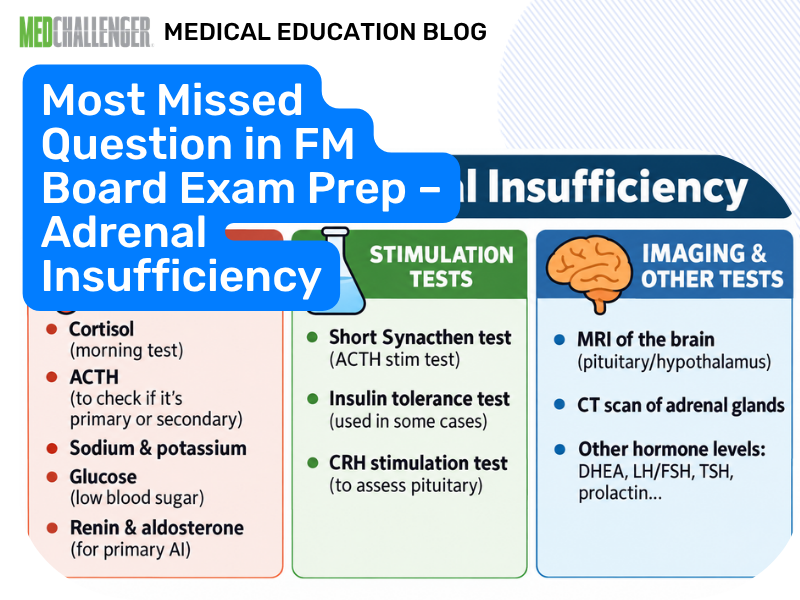
When adrenal insufficiency is suspected—especially primary Addison disease—confirm with an ACTH (cosyntropin) stimulation test and interpret the cortisol response.
Question – Next-step test
A 35-year-old man presents with fatigue, loss of libido, and lethargy for the last 3 years. He has no medical history. He takes a multivitamin but no other medications. He smokes 1 pack of cigarettes every week and drinks 1 glass of wine each night. He does not use drugs. He is the manager at a retail clothing store.
His review of symptoms is notable for a 15-pound weight loss since his last visit 3 years ago. Vital signs are: temperature 37.4 °C, heart rate 95 beats/minute, blood pressure 110/65 mm Hg, respiratory rate 14 breaths/minute, and oxygen saturation 99% on room air. Findings on his head, ears, eyes, nose, and throat examination, as well as examinations of his neck, heart, lungs, abdomen, and neurologic status are all normal. His skin appears tanned, even under his clothes.
You order laboratory studies that show a normal complete blood count, sodium level of 130, potassium level of 5.1, chloride level of 110, bicarbonate level of 25, blood urea nitrogen level of 13, creatinine level of 0.8, and glucose level of 90. You suspect adrenal insufficiency.
What is the next test to order to confirm this suspected diagnosis?
Answer Options:
- A. random serum cortisol and adrenocorticotropic hormone (ACTH) levels
- B. 24-hour urine cortisol excretion
- C. Plasma cortisol level after infusion of adrenocorticotropic hormone (ACTH)
- D. antiadrenal antibodies
- E. low-dose corticotropin stimulation test
This is a high-miss item because learners confuse (1) confirming adrenal insufficiency with (2) localizing whether it is primary vs secondary. The Endocrine Society (2016) supports the standard-dose (250 µg) ACTH/cosyntropin stimulation test as the key confirmatory test for suspected primary adrenal insufficiency. In practice and on exams, you typically draw a baseline ACTH at the same time (before administering cosyntropin) to establish whether ACTH is elevated (primary) or low/inappropriately normal (secondary/tertiary)—but baseline ACTH alone does not “confirm” adrenal insufficiency.
The stem strongly suggests primary adrenal insufficiency: hyperpigmentation (high ACTH → melanocortin receptor stimulation), hyponatremia, and borderline hyperkalemia (aldosterone deficiency), plus weight loss and chronic constitutional symptoms. The next confirmatory step is therefore an ACTH stimulation test with cortisol response measurement (Option C).
Why This Family Medicine Question Is Frequently Missed
- Test-takers pick “random cortisol + ACTH” because they remember ACTH helps differentiate primary vs secondary, but forget it doesn’t reliably confirm adrenal failure by itself.
- Confusion between Cushing testing (24-hour urine cortisol) vs Addison testing (ACTH stimulation).
- Overthinking “low-dose” vs “standard-dose” cosyntropin: most board-style algorithms default to the standard 250 µg test.
What the Distractors Indicate
| Option |
What It Tests / Implies |
Why It’s Wrong Here |
| A |
Baseline cortisol + ACTH to help localize primary vs secondary |
Helpful adjunct (baseline ACTH should be obtained), but random cortisol is hard to interpret and not confirmatory; stimulation testing confirms. |
| B |
Hypercortisolism screening (Cushing syndrome) |
Wrong disease direction; suspected adrenal insufficiency, not excess. |
| C |
Standard ACTH (cosyntropin) stimulation test |
Correct confirmatory test for suspected primary adrenal insufficiency (Endocrine Society 2016). |
| D |
Autoimmune etiology workup (21-hydroxylase antibodies) |
Etiology testing is after confirming adrenal insufficiency; does not confirm functional cortisol deficiency. |
| E |
Low-dose cosyntropin stimulation |
Sometimes used, but guidelines/exam convention typically favor standard-dose cosyntropin for primary AI confirmation; low-dose is not clearly superior and is less “default board answer.” |
High-Yield Pearl for Family Medicine Exam Prep
Primary adrenal insufficiency suspicion (hyperpigmentation + hyponatremia ± hyperkalemia) → confirm with standard-dose cosyntropin (ACTH) stimulation test and draw baseline ACTH to localize.
Core Learning Objectives
- Differentiate confirmatory testing for adrenal insufficiency from tests used to localize etiology (primary vs secondary/tertiary).
- Identify clinical and laboratory clues most consistent with primary adrenal insufficiency and select the guideline-supported next diagnostic step.
The “Test Trick” at Play
The trick is the word “confirm”: boards often want the ACTH stimulation test as confirmation, while ACTH level is framed as localization. In real workflows, you draw baseline ACTH before cosyntropin (same encounter), but among these choices, the best “confirmatory” test is the stimulation test in Option C.
Additional FM Practice Questions and Remediation for Adrenal Insufficiency Testing
Family Medicine Practice Question 1 - Hyperpigmentation + hypotension
A 42-year-old woman has progressive fatigue, salt craving, orthostatic hypotension, and diffuse hyperpigmentation. Na 128, K 5.6. Best test to confirm adrenal insufficiency?
- A. Midnight salivary cortisol
- B. Cosyntropin (ACTH) stimulation test with serum cortisol response
- C. 24-hour urine cortisol
- D. Dexamethasone suppression test
- E. Plasma renin activity only
Family Medicine Practice Question 2 - Localizing primary vs secondary
A patient fails cosyntropin stimulation (low cortisol response). Which additional lab best distinguishes primary from secondary adrenal insufficiency?
- A. Baseline plasma ACTH
- B. 24-hour urine cortisol
- C. Aldosterone level after saline infusion
- D. Metanephrines
- E. TSH only
Family Medicine Practice Question 3 - Exogenous steroids
A 55-year-old man on chronic prednisone stops abruptly and develops weakness and nausea. Testing for suspected secondary adrenal insufficiency should start with:
- A. Morning serum cortisol (with consideration of ACTH stimulation if indeterminate)
- B. 21-hydroxylase antibodies
- C. CT adrenal glands
- D. 24-hour urine cortisol
- E. Plasma aldosterone-to-renin ratio
Family Medicine Practice Question 4 - Interpreting electrolytes
Which electrolyte pattern best supports primary adrenal insufficiency over secondary?
- A. Hypernatremia and hypokalemia
- B. Normal sodium and normal potassium
- C. Hyponatremia and hyperkalemia
- D. Hypernatremia and hyperkalemia
- E. Hypocalcemia and hypophosphatemia
Family Medicine Practice Question 5 - Etiology after confirmation
A patient is confirmed to have primary adrenal insufficiency by cosyntropin testing. Next best test to evaluate for autoimmune Addison disease?
- A. 24-hour urine cortisol
- B. MRI pituitary
- C. 21-hydroxylase (adrenal) autoantibodies
- D. Dexamethasone suppression test
- E. IGF-1 level
Mini Case Discussion Prompt
How would your diagnostic approach differ between (a) suspected primary adrenal insufficiency with hyperpigmentation and hyperkalemia vs (b) suspected secondary adrenal insufficiency in a patient tapering chronic glucocorticoids?
Mini-FAQ
Q1: What single test most commonly confirms adrenal insufficiency on boards?
A: The ABFM/ABIM-style expectation is the standard-dose (250 µg) cosyntropin (ACTH) stimulation test assessing cortisol response (Endocrine Society, 2016).
Q2: Should ACTH be measured too?
A: Yes—baseline plasma ACTH should be drawn before cosyntropin to distinguish primary from secondary/tertiary, but ACTH alone is not usually considered confirmatory.
Q3: Why is 24-hour urine cortisol the wrong direction?
A: Boards use 24-hour urine cortisol to evaluate hypercortisolism (Cushing syndrome), not adrenal insufficiency.
Q4: When do adrenal antibodies matter?
A: After confirming primary adrenal insufficiency, antibodies (e.g., 21-hydroxylase) help determine autoimmune etiology and anticipate polyglandular autoimmunity.
Find this and other Family Medicine exam prep questions in Med-Challenger Family Medicine Review with CME
Try for free and save. Ace your exams and meet your CME/MOC requirements for just $35 a month!
No matter your program, no matter the size, Med-Challenger for Groups and Institutions can better prepare your program or group, fulfill industry requirements, and increase test scores.
For personal medical education that includes board's prep, MOC, and CME requirements, Med-Challenger has you covered in Family Medicine, Emergency Medicine, Internal Medicine, Pediatrics, Pediatric Emergency Medicine, OBGYN, Physician Assistants, and Nurse Practitioners.
Never miss a thing. Subscribe to our blog and save!