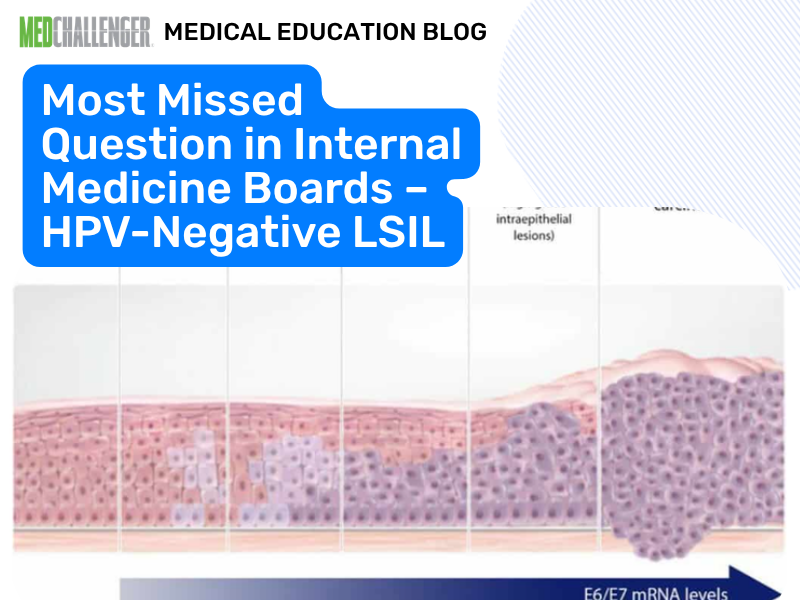
HPV-negative LSIL in a patient ≥30 years old is generally managed with 1-year repeat HPV-based testing (cotest) under ASCCP risk-based guidelines.
Question - LSIL follow-up
A 32-year-old woman, G1P1, who is otherwise healthy, had a screening Pap smear that showed LSIL (low grade squamous intraepithelial lesion). Her HPV testing, done at the same time as cytologic testing, is negative for high-risk HPV.
According to current guidelines from American Society for Colposcopy and Cervical Pathology (ASCCP), what is the preferred management/evaluation strategy for this situation?
Answer Options:
A. Repeat cytology every six months until resolution
B. Immediate repetition of cytology
C. Repeat cytology and HPV testing in one year
D. Repeat cytology and HPV testing in six months
In ASCCP’s 2019 risk-based management consensus guidelines (published 2020), management is determined by estimated CIN3+ risk rather than rigid result-to-action pairs. For most patients ≥30 with LSIL cytology and negative high-risk HPV, the immediate risk of CIN3+ is low enough that the preferred approach is surveillance with repeat HPV-based testing in 1 year (often performed as cotesting in settings where cotesting is used).
This item is commonly missed because learners over-apply older algorithms (e.g., “any LSIL → colposcopy”) or confuse follow-up intervals used for different combinations (e.g., HPV-positive results, higher-grade cytology, or specific prior-history scenarios). Boards tend to reward recognition that HPV negativity meaningfully lowers near-term CIN3+ risk, prompting 1-year follow-up rather than 6-month cytology “chasing” or immediate repeat sampling.
Why This Internal Medicine Question Is Often Missed
- Test-takers memorize “LSIL → colposcopy” without incorporating HPV status or the ASCCP move to risk-based thresholds (2019).
- Confusion between 6-month cytology (older practices/special situations) vs 1-year HPV-based surveillance (current standard for low-risk results).
- The stem omits prior screening history, and learners don’t know the exam-default approach when history is not provided.
What the Distractors Indicate
| Option |
What It Tests / Implies |
Why It’s Wrong Here |
| Repeat cytology every six months until resolution |
Older, more intensive surveillance mindset |
ASCCP 2019 generally uses HPV-based testing and annual surveillance for low-risk abnormalities; 6-month serial cytology is not the preferred strategy here. |
| Immediate repetition of cytology |
Concern for specimen adequacy/false result |
“Immediate repeat” is more consistent with unsatisfactory cytology or certain technical issues—not a standard response to HPV-negative LSIL. |
| Repeat cytology and HPV testing in one year |
Risk-based surveillance for low immediate CIN3+ risk |
Correct: aligns with ASCCP 2019/2020 low-risk management pathway for HPV-negative LSIL in most ≥30-year-olds. |
| Repeat cytology and HPV testing in six months |
Over-management / shortened interval |
Six-month cotesting is not the preferred routine interval for this low-risk combination under contemporary ASCCP guidance. |
Internal Medicine High-Yield Pearl for Exam Prep
HPV status is the “risk lever”: HPV-negative LSIL (≥30) → repeat HPV-based testing/cotest in 1 year, not immediate colposcopy or 6‑month testing.
Core Learning Objectives
- Apply ASCCP risk-based principles to triage LSIL with HPV-negative results in patients age ≥30.
- Distinguish follow-up intervals for low-risk abnormalities versus situations needing colposcopy (e.g., HPV-positive LSIL or higher-grade cytology).
The Exam “Test Trick” at Play
The question tests whether you’ll anchor on the word LSIL and reflexively escalate, or whether you’ll correctly incorporate negative high-risk HPV (lower immediate CIN3+ risk) and choose 1-year surveillance in keeping with ASCCP’s risk-threshold approach.
Additional Internal Medicine Practice Questions and Remediation for HPV-Negative LSIL / ASCCP Risk-Based Follow-Up
Internal Medicine Practice Question 1 — “HPV-negative LSIL default”
A 35-year-old has LSIL on cytology with negative high-risk HPV on cotest. No prior screening history is provided. Best next step?
- A. Immediate colposcopy
- B. Repeat HPV-based testing (cotest) in 1 year
- C. Repeat cytology in 6 months
- D. Repeat cotest in 3 years
- E. Excisional procedure
Internal Medicine Practice Question 2 — “LSIL with HPV-positive”
A 33-year-old has LSIL on cytology and is positive for high-risk HPV. Best next step?
- A. Repeat cotest in 1 year
- B. Colposcopy
- C. Repeat cytology in 6 months
- D. Endometrial biopsy
- E. HPV vaccination only
Internal Medicine Practice Question 3 — “Higher-grade cytology”
A 31-year-old has HSIL cytology. HPV is negative. Next step?
- A. Repeat cotest in 1 year
- B. Repeat cytology in 6 months
- C. Colposcopy (or expedited treatment depending on risk context)
- D. Repeat cotest in 3 years
- E. No further evaluation if asymptomatic
Internal Medicine Practice Question 4 — “Unsatisfactory cytology”
A 34-year-old’s Pap is reported as unsatisfactory; HPV test returns negative. Best next step?
- A. Repeat age-based screening (cytology/HPV-based) in 2–4 months
- B. Repeat cotest in 1 year
- C. Immediate colposcopy
- D. Repeat in 3 years
- E. Treat with antibiotics and repeat in 6 months
Internal Medicine Practice Question 5 — “ASC-US with HPV-negative”
A 37-year-old has ASC-US cytology with negative high-risk HPV. Next step?
- A. Colposcopy
- B. Repeat cotest in 1 year
- C. Return to routine screening interval (typically 3 years, depending on screening modality/history)
- D. Repeat cytology in 6 months
- E. Immediate repeat cytology
Mini Case Discussion Prompt
How would your management change (if at all) for LSIL with HPV-negative results if the patient had a prior history of abnormal screening or was recently post-colposcopy with negative histology?
Mini-FAQ
Q1: Why doesn’t LSIL automatically mean colposcopy anymore?
A: ASCCP 2019/2020 shifted to risk-based thresholds; HPV negativity lowers immediate CIN3+ risk enough that many LSIL results are managed with 1-year surveillance. Boards expect this nuance.
Q2: Why is “repeat in 6 months” usually wrong for this scenario?
A: Six-month intervals are not the preferred pathway for HPV-negative LSIL in current ASCCP paradigms; exam items typically reserve shorter intervals for specimen issues (e.g., unsatisfactory cytology) or specific high-risk contexts.
Q3: What follow-up is expected after the 1-year repeat test is negative?
A: Many pathways step back toward longer intervals (often 3 years) after reassuring follow-up; ABIM-style questions usually test the initial 1-year step first.
Q4: What’s the single highest-yield discriminator in the stem?
A: High-risk HPV test result—it drives the risk estimate and therefore whether you choose surveillance vs colposcopy.
This question appears in Med-Challenger Internal Medicine Review with CME
Try for free and save. Ace your exams and meet your CME/MOC requirements for just $35 a month!