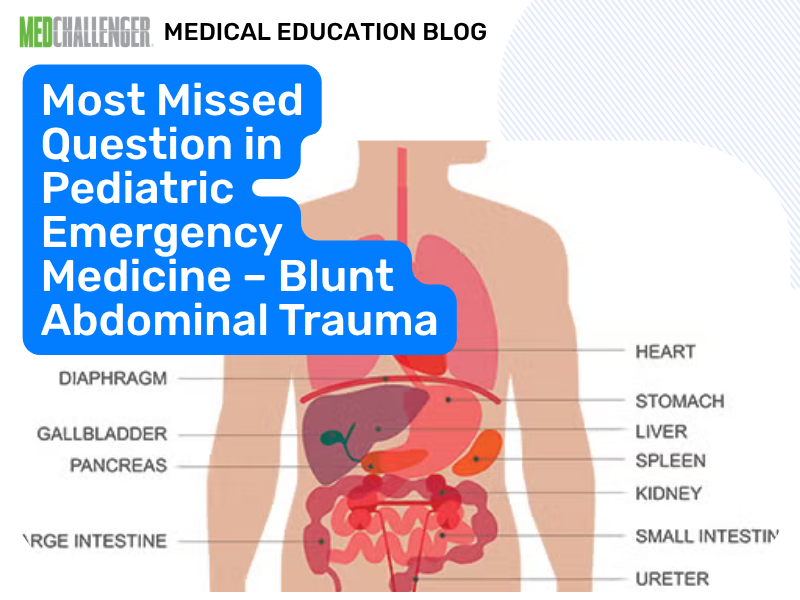
Worsening abdominal pain plus anemia after a bicycle crash should make you think solid-organ injury—most commonly the spleen in children.
Question – Blunt trauma
A 10-year-old boy was brought to the ED by his parents after a bike accident causing a left forearm injury. The patient lost control of his bike, flipped over his handlebars, and fell onto his left arm. On exam, he has a deformity to the left forearm with no open wounds and no neurovascular deficits. He has mild tenderness to palpation of the periumbilical area and epigastrium without guarding. No other injuries are appreciated on exam. X-rays confirm left distal radius and ulna fractures with angulation and mild displacement. His fractures are reduced and splinted. However, prior to discharge, the patient begins complaining of worsening abdominal pain. You decide to obtain trauma labs which result as follows: WBC 14, hemoglobin 9.9, hematocrit 31, platelets 310, AST 40, ALT 33, amylase 65, lipase 100.
What organ is most likely to be injured in this patient?
Answer Options:
A. Kidney
B. Pancreas
C. Small bowel
D. Spleen
This is a classic “distracting obvious injury” scenario: the forearm fracture pulls attention away from subtle but evolving intraabdominal trauma. The key board clue is worsening abdominal pain with anemia after blunt abdominal trauma—this pattern is most consistent with splenic (or hepatic) injury, and among the listed options, spleen is the most likely.
Current pediatric blunt abdominal trauma principles (as reflected across ATOMAC/APSA-era guidance and major imaging/trauma consensus approaches within the last decade) emphasize that splenic injury is common and typically managed nonoperatively if the child remains hemodynamically stable; diagnosis is commonly confirmed with contrast-enhanced CT when clinical concern for intraabdominal injury persists or increases.
Why This Pediatric Emergency Medicine Question Is Often Missed
- The extremity fracture creates anchoring bias, delaying recognition of intraabdominal injury.
- Test-takers over-weight “handlebar trauma = pancreas,” but here lipase/amylase are not elevated and anemia points to bleeding.
- “Normal-ish” transaminases can falsely reassure; hemoglobin trend and evolving symptoms matter more.
What the Distractors Indicate
| Option |
What It Tests / Implies |
Why It’s Wrong Here |
| Kidney |
Flank trauma, hematuria, retroperitoneal injury |
No flank findings/hematuria provided; the vignette instead points to intraperitoneal bleeding (anemia + worsening pain). |
| Pancreas |
Handlebar/epigastric blow; amylase/lipase may rise (often delayed) |
Mechanism can suggest pancreas, but the question’s best discriminator is anemia and the provided enzymes are not supportive. |
| Small bowel |
Hollow viscus injury; peritonitis, free air, seatbelt/handlebar sign |
Would expect more peritoneal signs, leukocytosis is nonspecific, and anemia favors solid-organ bleeding over isolated bowel injury. |
| Spleen |
Most common pediatric solid-organ injury in blunt trauma |
Fits epidemiology and the scenario of evolving pain with low Hgb/Hct; classically diagnosed by CT and often managed nonoperatively if stable. |
High-Yield Pearl for Exam Prep
In a child with blunt abdominal trauma and falling hemoglobin, presume solid-organ injury (spleen/liver) until proven otherwise.
Core Learning Objectives
- Recognize clinical patterns that prioritize splenic injury in pediatric blunt abdominal trauma (worsening pain, anemia).
- Differentiate solid-organ injury from pancreatic or hollow viscus injury using mechanism + labs + evolving exam.
The Exam “Test Trick” at Play
The stem leverages a “two-injury” trap: an obvious orthopedic injury diverts attention while subtle abdominal trauma evolves. Boards reward reassessing the whole patient and re-triaging when symptoms worsen—especially when labs suggest blood loss.
Additional Peds EM Practice Questions and Remediation for Blunt Abdominal Trauma
Pediatric Emergency Medicine Practice Question 1 — Handlebar bruise
A 9-year-old has epigastric pain after striking handlebars. He is hemodynamically stable. Exam shows an epigastric abrasion (“handlebar sign”). Initial lipase is normal. Best next step?
- A. Discharge with return precautions only
- B. CT abdomen/pelvis with IV contrast
- C. Upper GI series
- D. MRI abdomen emergently
- E. Start octreotide
Pediatric Emergency Medicine Practice Question 2 - Falling hematocrit
A 12-year-old after a fall has LUQ tenderness and a hemoglobin drop from 12.5 to 10.2 over 6 hours. Vitals stable. Most likely injured organ?
- A. Duodenum
- B. Pancreas
- C. Kidney
- D. Spleen
- E. Bladder
Pediatric Emergency Medicine Practice Question 3 - FAST nuance
A 10-year-old with blunt abdominal trauma is stable. FAST is negative, but pain is worsening and he has new anemia. Next best step?
- A. Repeat FAST in 24 hours only
- B. CT abdomen/pelvis with IV contrast
- C. Discharge if tolerating PO
- D. Diagnostic peritoneal lavage
- E. Start broad-spectrum antibiotics
Pediatric Emergency Medicine Practice Question 4 - Hollow viscus pattern
A 15-year-old restrained passenger has abdominal wall ecchymosis (“seatbelt sign”), increasing diffuse tenderness, and leukocytosis; hemoglobin is stable. Most concerning injury?
- A. Splenic laceration
- B. Small bowel injury
- C. Renal infarct
- D. Pancreatic contusion
- E. Isolated gastric ulcer
Pediatric Emergency Medicine Practice Question 5 - Management principle
A 10-year-old has a CT-confirmed grade II splenic laceration after blunt trauma. He is normotensive with normal mental status. Best management?
- A. Immediate splenectomy
- B. Nonoperative management with observation
- C. Mandatory exploratory laparotomy
- D. Discharge from ED immediately
- E. Antibiotics for 7 days
Mini Case Discussion Prompt
How would your differential and workup change in this same patient if he had a prominent handlebar-shaped abdominal contusion with rising lipase at 12–24 hours but stable hemoglobin?
Mini-FAQ
Q1: Why is the spleen the “default” answer on boards for pediatric blunt abdominal trauma?
A: Because the ABP/PEM-style exams emphasize epidemiology: spleen (and liver) are the most commonly injured organs in children after blunt abdominal trauma.
Q2: Does a normal FAST exclude splenic injury in kids?
A: No—board exams expect recognition that FAST can miss injuries, especially early or contained bleeding; worsening symptoms/labs justify CT in stable patients.
Q3: Are amylase/lipase reliable early for pancreatic trauma?
A: Not reliably; exams often test that pancreatic enzyme elevation may be delayed, so mechanism and evolving findings drive imaging decisions.
Q4: What single change in this stem most strongly supports solid-organ bleeding?
A: The anemia/low hematocrit in the setting of worsening abdominal pain after blunt trauma.
Find this and other Pediatric Emergency Medicine exam prep questions in Med-Challenger Pediatric Emergency Medicine 3rd Edition Exam Review with CME
Try for free and save. Ace your exams and meet your CME/MOC requirements.