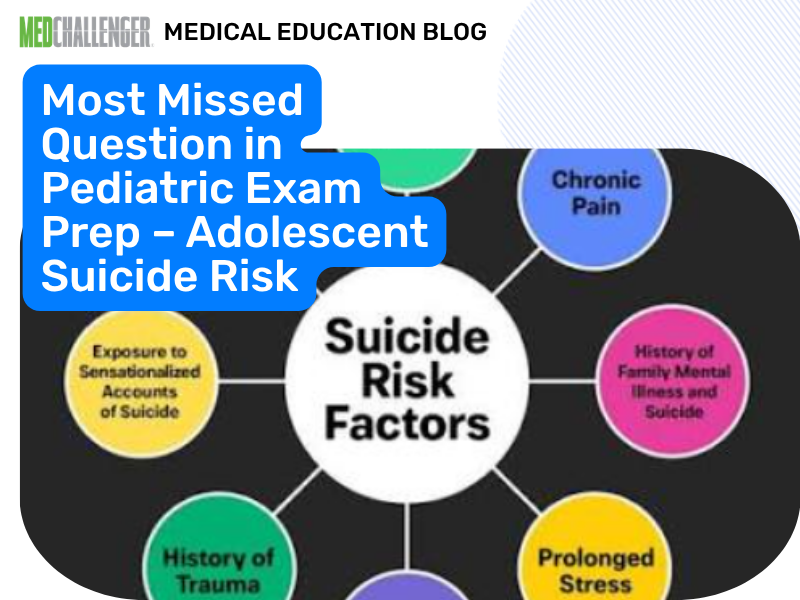
Access to firearms in the home is an independent, evidence-based risk factor for completed suicide in adolescents and should prompt lethal-means safety counseling.
Question – Adolescent Suicide Risk
You are counseling the mother of teenage twin boys about risk factors for suicide in adolescents. The mother tells you that the boys' father has lately become interested in "prepping" and has begun to store dry goods, water, batteries, and emergency medical supplies in a spare bedroom of the home. The father has also recently purchased a rifle and a handgun as part of his prepping supplies.
How does the father's survivalist behavior influence the risk of suicide for these teenage twin boys?
Answer Options:
-
Hanging/suffocation is the leading method of suicide. Having access to a gun in the home neither increases nor decreases the rate or success of suicide.
-
Self-poisoning is the leading method of suicide. Although access to guns should be restricted, the presence of a gun within the home neither increases nor decreases the rate or success of suicide.
-
Firearms are the leading method of suicide; however, restricting access to firearms and locking the firearms and ammunition together effectively reduces the risk of the firearm being used in an attempted suicide.
-
Risk of suicide is dependent on psychiatric factors such as depression, and having a firearm in the home does not independently increase the risk.
-
Firearms are the leading method of suicide. If a gun is in the home, then it is may be used as a method of suicide and is much more likely to be in the home of successful suicide victims relative to age-matched controls.
Firearm access is not just a correlate of “prepping”—it is a major, modifiable, independent risk factor for suicide death because firearms have high lethality and require little time between impulse and attempt. The AAP (2022) emphasizes that the presence of firearms in the home increases risk of suicide and unintentional injury among children/adolescents and supports counseling on safe storage and reducing access during periods of risk. CDC WISQARS data consistently show firearms as a leading mechanism for suicide deaths in U.S. adolescents (method distributions vary by age/sex over time, but firearms remain a top contributor to fatalities).
Board-takers often miss this item by over-attributing suicide risk to psychiatric diagnosis alone (e.g., depression) and under-weighting access to lethal means. For exams, the key move is recognizing that means availability changes outcomes—especially for high-fatality methods like firearms—so “psychiatric factors only” is incorrect.
Why This Pediatric Medicine Question Is Often Missed
- Confusing attempt frequency (often higher with poisoning) with death counts/case-fatality (very high for firearms).
- Assuming firearm risk is fully mediated by underlying depression rather than being an independent risk factor.
- Overstating the protective value of “locking together” gun + ammunition (storage details matter; some practices are not best practice).
What the Distractors Indicate
| Option |
What It Tests / Implies |
Why It’s Wrong Here |
| Hanging/suffocation is the leading method of suicide. Having access to a gun in the home neither increases nor decreases the rate or success of suicide. |
Misidentifies leading method; denies firearm access effect |
Firearm access is associated with increased suicide risk; hanging/suffocation is commonly second but firearms are a leading method in U.S. youth deaths (CDC WISQARS). |
| Self-poisoning is the leading method of suicide. Although access to guns should be restricted, the presence of a gun within the home neither increases nor decreases the rate or success of suicide. |
Poisoning as leading method; denies firearm access effect |
Self-poisoning is common in attempts, but less lethal; denying risk increase contradicts AAP (2022) and epidemiologic evidence. |
| Firearms are the leading method of suicide; however, restricting access to firearms and locking the firearms and ammunition together effectively reduces the risk of the firearm being used in an attempted suicide. |
Acknowledges firearms lead but suggests “locking together” as effective |
Best practice is unloaded, locked firearm; ammunition locked separately (AAP 2022). Locking them together does not reflect recommended safer storage. |
| Risk of suicide is dependent on psychiatric factors such as depression, and having a firearm in the home does not independently increase the risk. |
Suicide risk only psychiatric; firearms not independent |
Contradicts evidence that firearm presence/access independently raises suicide death risk and lethality (AAP 2022; multiple observational studies). |
| Firearms are the leading method of suicide. If a gun is in the home, then it is may be used as a method of suicide and is much more likely to be in the home of successful suicide victims relative to age-matched controls. |
Firearms are leading method; home access increases risk and decedents more likely to have firearm access |
Matches guideline-consistent counseling: lethal means access increases risk and lethality; home firearm presence is associated with suicide deaths. |
High-Yield Pearl for Exam Prep
When evaluating suicide risk in adolescents, access to firearms is an independent, high-impact risk factor because it markedly increases case-fatality—counsel on lethal-means restriction and safe storage.
Core Learning Objectives
- Identify firearm access in the home as an independent risk factor for adolescent suicide death and a target for prevention.
- Apply evidence-based lethal-means safety counseling, including safer firearm storage principles.
The Exam “Test Trick” at Play
The stem distracts with “prepping” as a behavioral quirk; the real tested concept is that *introducing firearms into the home changes suicide lethality and completion risk*, independent of psychiatric diagnosis. Exams reward recognizing modifiable environmental risks, not just DSM-based risk factors.
Additional Practice Questions and Remediation for Adolescent Suicide Risk & Lethal Means Counseling
Pediatric Medicine Practice Question 1 - Lethal means counseling
A 16-year-old with recent suicidal ideation is being discharged after ED evaluation with a safety plan and close follow-up. The family has firearms at home. Which recommendation is most consistent with pediatric guidance on safer storage?
- A. Store the firearm loaded in a locked safe for quick protection
- B. Store the firearm locked, unloaded, with ammunition locked separately
- C. Store the firearm and ammunition locked together in the same safe
- D. Hide the firearm in the home so the teen cannot find it
- E. Keep the firearm in the car trunk to reduce home risk
Pediatric Medicine Practice Question 2 - Method lethality
A resident says, “Poisoning is the biggest concern because it’s the most common way teens die by suicide.” Which correction is most accurate for board-style counseling?
- A. Poisoning is the leading cause of suicide death in teens.
- B. Firearms account for a large proportion of adolescent suicide deaths because they are highly lethal.
- C. Hanging is never a relevant counseling point because it is uncommon.
- D. Firearm access only matters if the teen has a major depressive disorder diagnosis.
- E. If a firearm is locked, it eliminates suicide risk.
Pediatric Medicine Practice Question 3 - Independent risk factor
A 15-year-old denies depression symptoms but has escalating impulsivity and intermittent suicidal thoughts. The parent reports a newly purchased handgun at home. What is the best interpretation?
- A. Firearm presence is irrelevant without major depression.
- B. Firearm access increases suicide death risk even without a formal psychiatric diagnosis.
- C. Risk is determined only by family history of suicide.
- D. Only prior attempts make means counseling necessary.
- E. The main risk is accidental ingestion of medications, not firearms.
Pediatric Medicine Practice Question 4 - Counseling goal
In lethal-means counseling for a teen with suicidal ideation, what is the primary prevention aim?
- A. Reduce anxiety by reassuring the family
- B. Diagnose major depressive disorder
- C. Create time and distance between suicidal impulse and access to a high-lethality method
- D. Ensure the teen promises not to self-harm
- E. Promote firearm familiarity and training
Pediatric Medicine Practice Question 5 - Best next step in office
A 17-year-old screened positive for suicidal ideation on a validated tool at a well visit. Which additional assessment is most important to perform immediately?
- A. Lipid panel
- B. Urine drug screen on all adolescents
- C. Ask about access to firearms and other lethal means at home
- D. Sleep study referral
- E. Developmental screening for autism
Mini Case Discussion Prompt
How would your counseling differ for (1) a teen with passive suicidal ideation and no plan but firearms unsecured at home versus (2) a teen with a specific plan, access to a loaded firearm, and recent intoxication?
Mini FAQ
Q1: Do boards expect you to know the “leading method” of adolescent suicide?
A: Yes—pediatric and family medicine boards commonly test that firearms contribute to a large share of adolescent suicide deaths (CDC WISQARS) and that access increases fatal risk.
Q2: Is firearm access still important if the teen has no diagnosed depression?
A: Yes—exams expect recognition that lethal means access is an independent, modifiable risk factor (AAP 2022).
Q3: What storage counseling is most exam-reliable?
A: Recommend firearms locked and unloaded, with ammunition locked separately; emphasize temporary removal/off-site storage during periods of elevated risk (AAP 2022).
Q4: Are “no-suicide contracts” adequate?
A: No—boards favor safety planning, close follow-up, and lethal-means safety rather than relying on contracts.
Find this and other Pediatric Medicine exam prep questions in Med-Challenger Pediatric Medicine Exam Review with CME
Try for free and save. Ace your exams and meet your CME/MOC requirements for just $35 a month!
/PEDS%20CHALLENGER.png?width=250&height=218&name=PEDS%20CHALLENGER.png)
No matter your program, no matter the size, Med-Challenger for Groups and Institutions can better prepare your program or group, fulfill industry requirements, and increase test scores.
For personal medical education that includes board's prep, MOC, and CME requirements, Med-Challenger has you covered in Family Medicine, Emergency Medicine, Internal Medicine, Pediatrics, Pediatric Emergency Medicine, OBGYN, Physician Assistants, and Nurse Practitioners.
Never miss a thing. Subscribe to our blog and save!