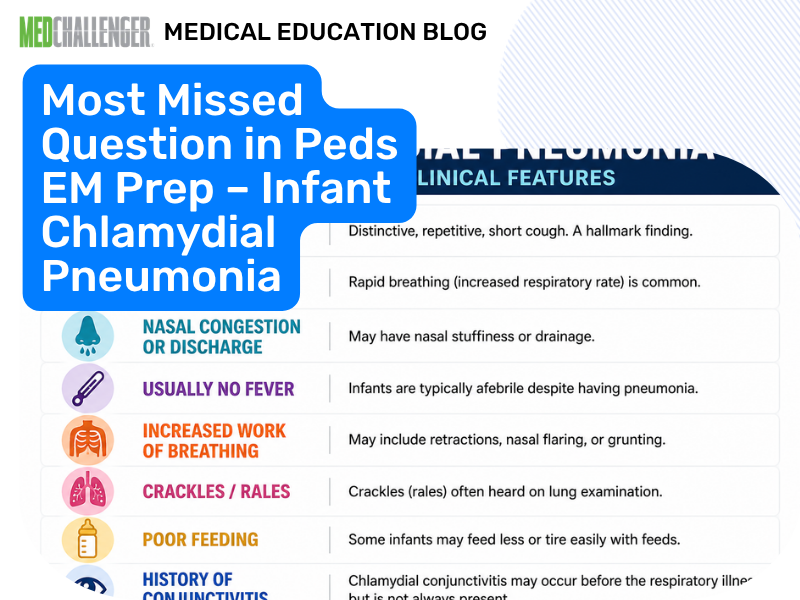
A 2-month-old with staccato cough plus conjunctivitis history should prompt evaluation for Chlamydia trachomatis with chest radiography and nasopharyngeal diagnostic testing.
Question – Staccato cough
A foster parent brings in a 2 mo infant with concern for cough. The parent states the child has been having poor sleep due to this persistent cough. The coughing is described as short and sharp coughs that comes in bursts and is often follow by difficulty breathing. The parent also states the baby has been having intermittent eye discharge that causes occasional eye swelling.
What is a reasonable next step in evaluation for this child?
Answer Options:
- A. Educate parent on lacrimal duct massage technique and follow up with primary care doctor
- B. Nasopharyngeal swab to isolate for cause of infection and CXR
- C. Neonatal septic work-up and initiation of IV antibiotics
- D. Start the infant on azithromycin to prevent further spread of illness and admit for observation.
The keyed answer is functionally correct, but the wording is non-ideal for modern guideline language: clinicians generally order a nasopharyngeal specimen for Chlamydia trachomatis testing (NAAT or culture, depending on lab validation) plus a CXR. Per the CDC STI Treatment Guidelines (2021) and consistent AAP Red Book recommendations, infant chlamydial pneumonia (often age 1–3 months) is suggested by afebrile, repetitive “staccato” cough, tachypnea, and a history of conjunctivitis; CXR classically shows hyperinflation and bilateral interstitial infiltrates.
Boards commonly test that this is not simple nasolacrimal duct obstruction, and it is not a routine “neonatal sepsis work-up” presentation in an otherwise stable 2-month-old with a characteristic chlamydial syndrome.
Why This Pediatric Emergency Medicine Question Is Often Missed
- Learners over-anchor on “eye discharge” and choose nasolacrimal duct obstruction counseling rather than integrating the staccato cough + age pattern.
- “Evaluate vs treat” is tricky: guidelines allow empiric therapy for suspected chlamydial pneumonia, but the question asks specifically for evaluation, making imaging + pathogen testing the exam-safe move.
- Gonococcal ophthalmia vs chlamydial disease timing is often confused; the stem’s age (2 months) strongly favors Chlamydia.
What the Distractors Indicate
| Option |
What It Tests / Implies |
Why It’s Wrong Here |
| Educate parent on lacrimal duct massage technique and follow up with primary care doctor |
Nasolacrimal duct obstruction management |
Doesn’t explain paroxysmal/staccato cough with breathing difficulty; misses systemic infectious syndrome. |
| Nasopharyngeal swab to isolate for cause of infection and CXR |
Targeted evaluation for infant chlamydial pneumonia (CXR + NP diagnostic testing) |
Best match to syndrome; modern nuance is “NAAT/culture” rather than vague “isolate.” |
| Neonatal septic work-up and initiation of IV antibiotics |
Full neonatal sepsis pathway |
A 2-month-old with classic chlamydial phenotype is typically afebrile and not automatically a “neonate sepsis work-up” unless ill/toxic or febrile. |
| Start the infant on azithromycin to prevent further spread of illness and admit for observation. |
Empiric macrolide + admit “to prevent spread” |
Rationale is off: treatment is to cure infant infection (and manage contacts), not primarily “prevent spread,” and admission depends on severity; also question asks *evaluation* first. |
High-Yield Pearl for Exam Prep
In a 1–3 month infant with afebrile staccato cough and conjunctivitis history, think *Chlamydia trachomatis* pneumonia → CXR + nasopharyngeal diagnostic testing (NAAT/culture) and treat appropriately.
Core Learning Objectives
- Recognize the classic clinical pattern of infant Chlamydia trachomatis pneumonia and distinguish it from nasolacrimal obstruction and neonatal sepsis presentations.
- Select guideline-consistent diagnostic evaluation for suspected infant chlamydial pneumonia (CXR plus appropriate respiratory/ocular testing).
The Exam “Test Trick” at Play
The stem blends a common benign complaint (eye discharge) with a high-yield infectious syndrome clue (“short, sharp coughs…in bursts” at 2 months). The board-relevant move is to integrate timing + cough quality + conjunctivitis and choose targeted evaluation for chlamydial pneumonia—not reassurance or an automatic sepsis algorithm.
Additional Peds EM Practice Questions and Remediation for Infant Chlamydial Pneumonia
Pediatric Emergency Medicine Practice Question 1 - Afebrile staccato cough
A 6-week-old presents with tachypnea and repetitive staccato cough. No fever. Mother had untreated cervicitis in pregnancy. Best next diagnostic step?
- A. Blood culture and lumbar puncture
- B. Chest radiograph and nasopharyngeal testing for Chlamydia trachomatis
- C. Rapid influenza/RSV antigen only
- D. CT chest with contrast
- E. Sweat chloride test
Pediatric Emergency Medicine Practice Question 2 - Conjunctivitis timing
A 10-day-old has conjunctival injection and watery-to-mucopurulent discharge. Afebrile, well-appearing. Most likely etiology?
- A. HSV keratoconjunctivitis
- B. Chlamydia trachomatis
- C. Neisseria gonorrhoeae
- D. Adenovirus
- E. Allergic conjunctivitis
Pediatric Emergency Medicine Practice Question 3 - Imaging pattern
CXR in suspected infant chlamydial pneumonia most commonly shows:
- A. Lobar consolidation with air bronchograms
- B. Hyperinflation with bilateral interstitial infiltrates
- C. Cavitary lesions
- D. Pleural effusion/empyema
- E. Miliary nodules
Pediatric Emergency Medicine Practice Question 4 - When to broaden work-up
A 7-week-old with suspected chlamydial pneumonia now appears lethargic with poor perfusion and temp 38.5°C. Next step?
- A. Outpatient azithromycin only
- B. Full sepsis evaluation and parenteral antibiotics with admission
- C. Reassurance and PCP follow-up
- D. Nebulized albuterol trial and discharge
- E. Topical erythromycin eye ointment only
Pediatric Emergency Medicine Practice Question 5 - Treatment nuance
Which statement is most accurate regarding treatment of infant chlamydial pneumonia?
- A. Topical ocular antibiotics alone are sufficient
- B. Oral macrolide therapy is used; caregivers should be counseled about pyloric stenosis risk in young infants
- C. IV ceftriaxone is first-line
- D. No treatment is needed because infection self-resolves
- E. Oral doxycycline is preferred in infants
Mini Case Discussion Prompt
How would your diagnostic and disposition approach change between (1) a well-appearing, afebrile 2-month-old with staccato cough and conjunctivitis history and (2) a febrile, ill-appearing 6-week-old with copious purulent eye discharge and chemosis?
Mini-FAQ
Q1: What single clinical clue should make me think of infant chlamydial pneumonia on boards?
A: The ABP/PEM-style clue is an afebrile staccato cough in a 1–3 month infant, often with a preceding conjunctivitis history (CDC STI Guidelines 2021; AAP Red Book).
Q2: What tests are typically used to confirm infant chlamydial infection?
A: A nasopharyngeal specimen for C. trachomatis testing (NAAT where validated, or culture) plus supportive CXR findings; conjunctival specimens may also be tested when eye disease is present (CDC 2021).
Q3: When do I escalate to a neonatal/young infant sepsis work-up?
A: Board algorithms prioritize fever and toxic appearance; if the infant is febrile or ill-appearing, treat as high-risk and broaden work-up/admit regardless of a suspected chlamydial syndrome.
Q4: Why not just treat immediately without testing?
A: Many clinicians treat when suspicion is high, but exam questions that ask for “evaluation” often want the paired step of CXR + pathogen testing; it’s the most defensible guideline-consistent evaluation approach.
Find this and other Pediatric Emergency Medicine exam prep questions in Med-Challenger Pediatric Emergency Medicine 3rd Edition Exam Review with CME
Try for free and save. Ace your exams and meet your CME/MOC requirements.