

Group Education
Improve Residency Education Despite Budget and Bureaucracy Constraints
Residency Directors Facing Budget Cuts & More Bureaucracy Can Improve Resident Education Outcomes Easily
Discover the pediatric domains residents find most challenging on the ABP exam, why they’re difficult, and how to study high-risk topics more effectively.

Pediatrics residents often ask the same question as exam day approaches: "Which topics are hardest on the ABP exam?" The truth is that the exam blueprint determines what appears most frequently, but difficulty comes from how topics are tested — not just from how much they weigh on the outline. This guide explains what makes certain domains feel more challenging, how to recognize high-risk question patterns, and how to use the ABP outline to focus your studying where it matters most.
👉ABP General Pediatrics Certifying Exam 2025: How to Prepare and Pass
Several factors make certain pediatric topics feel more difficult, regardless of their blueprint percentage:
Understanding why topics feel difficult helps you study more strategically instead of trying to memorize everything with equal intensity.
👉How to Build Your Pediatrics Board Study Plan
The ABP publishes its blueprint and domain weights, but it does not classify domains as "hard." Difficulty is therefore an editorial interpretation based on how these domains are commonly experienced in residency and how they function on the exam.
Below are domains that residents consistently report as cognitively demanding — not because they are obscure, but because they require multi-step reasoning rather than recognition.
👉ABP Content Outline Explained: How to Study All 24 Pediatric Domains
These domains involve presentations that overlap with endocrine, psychosocial, reproductive, and developmental frameworks. Questions often hinge on subtle safety, confidentiality, or risk-assessment cues. Residents sometimes overlook the psychosocial dimension when focusing too heavily on physiology.
These questions typically require:
Heme/Onc questions challenge residents because the reasoning often depends on patterns rather than single findings.
Endocrine conditions frequently present with subtle signs, and correct answers depend on understanding:
The difficulty increases when disorders interact — for example, endocrine issues presenting as behavioral changes.
Although commonly encountered, ID is difficult on the boards because:
You must identify the "clinical clue" that distinguishes one infection scenario from another, which is harder under time pressure.
Neurology questions often require multi-step reasoning:
The cognitive load of integrating symptoms, timing, and triggers makes neuro one of the exam's most demanding areas.
Rheum is difficult because most residents see fewer of these patients during training. Questions require:
When symptoms overlap multiple systems, residents must slow their reasoning — something that feels harder during a timed exam.
Some domains appear straightforward but contain nuance-heavy questions.
👉How ABP Exam Questions Are Written: the Logic Behind the Design
These seem simple on the surface, but:
Residents often underestimate these domains because they see them every day — but the ABP tests them at a higher reasoning level.
Newborn questions challenge residents because:
The timing of symptoms is often the key — a detail easily missed under pressure.
The ABP exam is built around the Universal Task Categories:
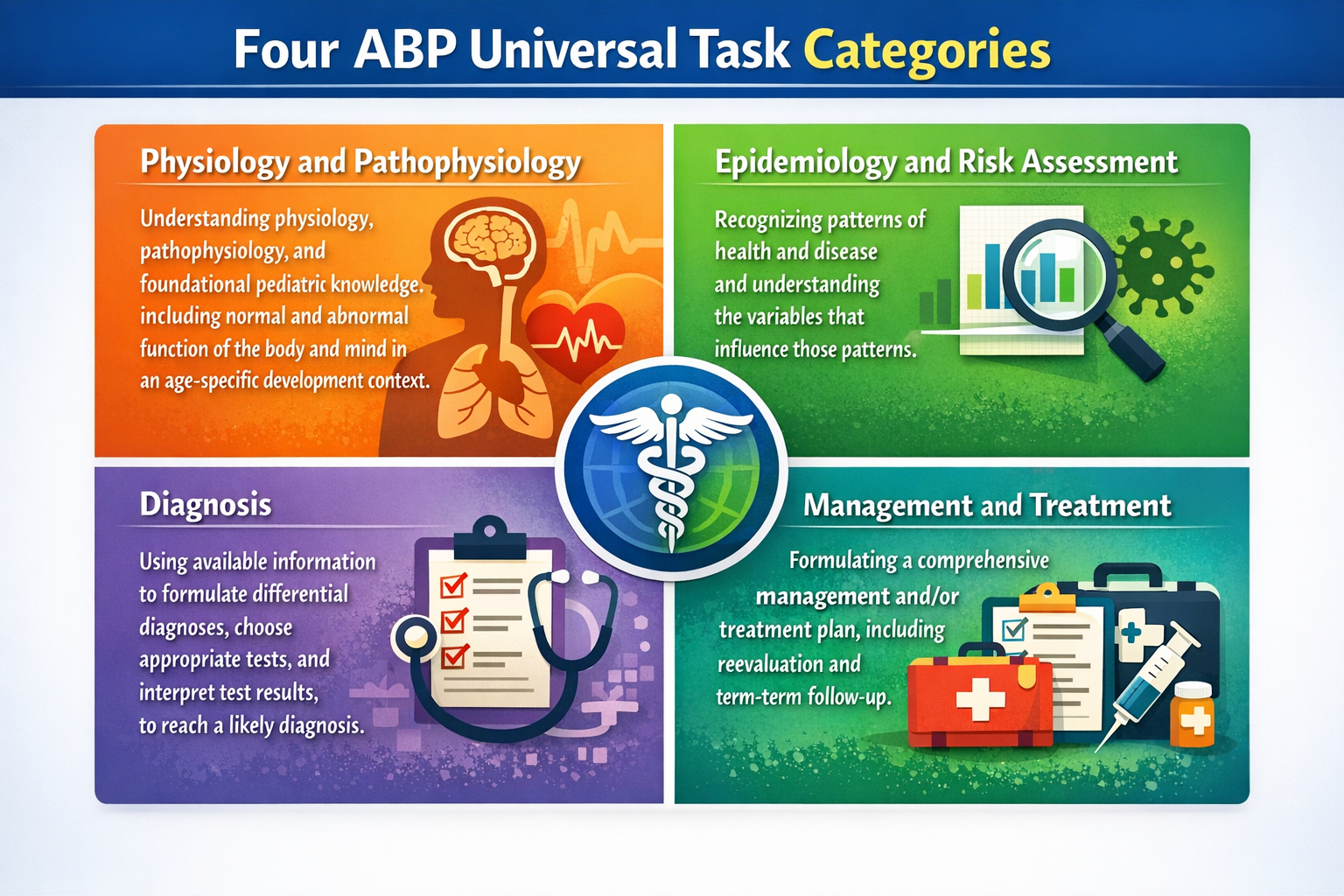
Difficulty comes from the task, not just the topic.
Examples:
Once you understand which task category is being tested, many questions become easier to interpret.
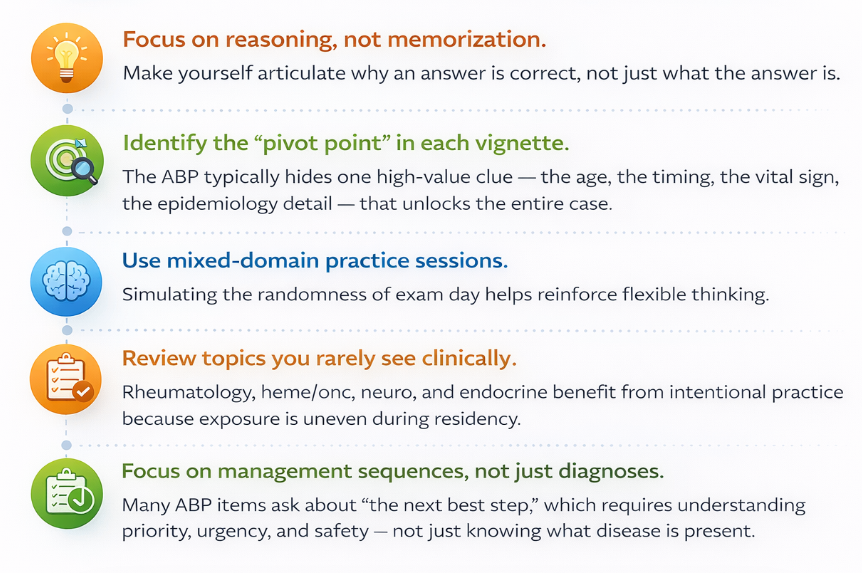
Below are editorial recommendations grounded in how the ABP writes questions.
👉Study Strategies That Work for the ABP Pediatrics Board Exam
If you are starting your study plan:
Blend question practice with targeted review of high-risk domains like neuro, heme/onc, and adolescent medicine.
If you are mid-preparation:
Adjust your plan based on which domains consistently challenge your reasoning.
If your exam is approaching:
Use mixed-domain practice to strengthen flexible thinking and sharpen your ability to find the key clue in each vignette.
If you want structured support:
Some platforms organize questions and explanations in ways that amplify high-yield patterns and reinforce core reasoning. Tools such as Med-Challenger provide mixed-domain practice and explanation-driven learning that support these strategies.
Residency Directors Facing Budget Cuts & More Bureaucracy Can Improve Resident Education Outcomes Easily
Most effective study aids for medical resident board preparation.
Understanding the differences between a transitional year and a preliminary year in residency can help you make the right decision for your future.