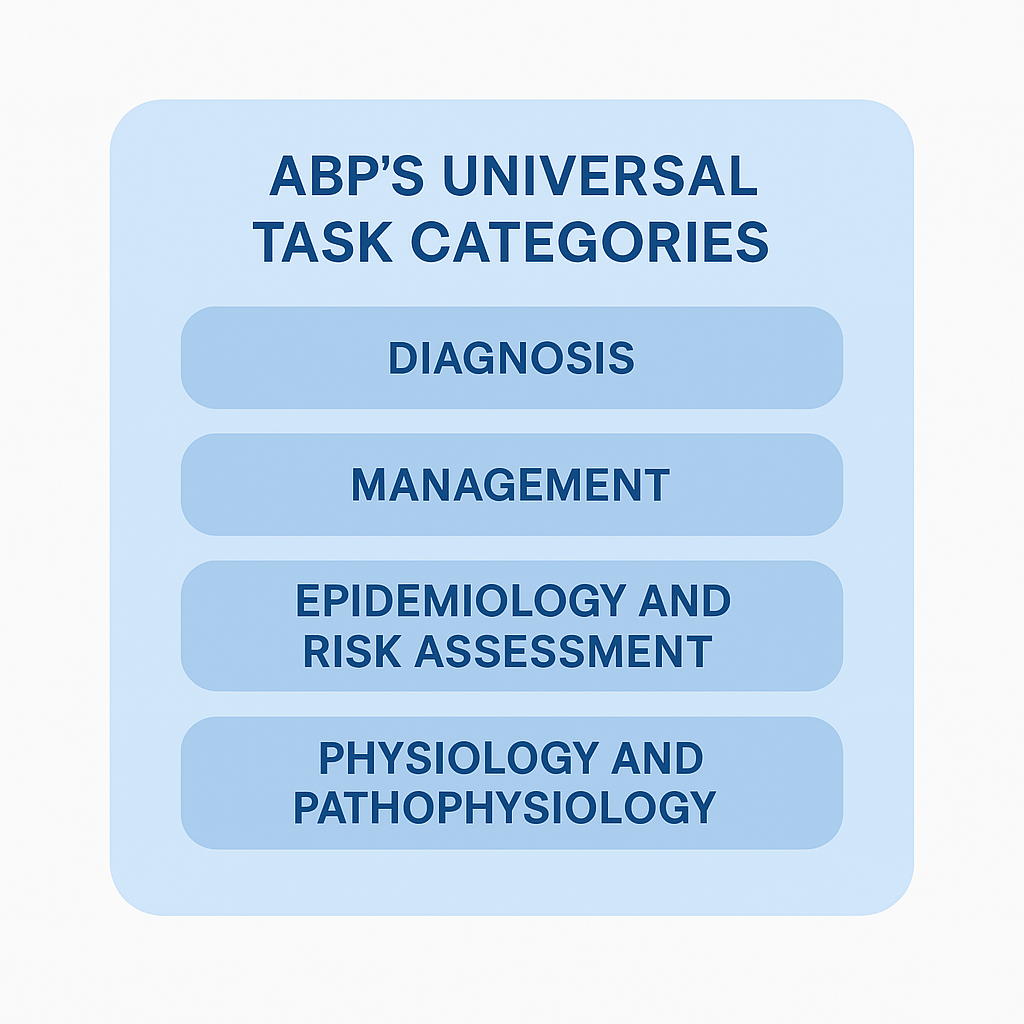
Residents preparing for the ABP General Pediatrics Certifying Exam often wonder how questions are created and what makes them feel so different from everyday clinical reasoning. While the ABP does not publish its internal item-development processes, it does provide the structure that governs every exam question: the content outline, the Universal Task Categories, and the single-best-answer format. Together, these elements reveal what the exam is designed to measure and how question styles shape the way you should study. Understanding how ABP questions function helps you approach the exam with clearer reasoning and stronger confidence.
For broader context about exam eligibility, scoring, and expectations, review our comprehensive ABP exam guide.
What the ABP Actually Tells Us About How Questions Must Be Written
The ABP documents several foundational rules that directly influence how every exam item is constructed.
Every question must map to one of the ABP’s 24 content domains
The General Pediatrics Content Outline defines the full universe of examinable topics. These domains are broad and include everything from newborn care and preventive pediatrics to subspecialties such as neurology, endocrinology, cardiology, rheumatology, and infectious diseases.

This means:
- The exam is blueprint-driven
- No question exists outside the published scope
- You are only tested on content ABP considers essential for general pediatrics
Blueprint alignment prevents “surprise topics” and keeps the exam grounded in real pediatric practice.
👉ABP Content Outline Explained: How to Study All 24 Pediatric Domains
Every question must also map to a Universal Task Category
Your ABP files define the four task categories:
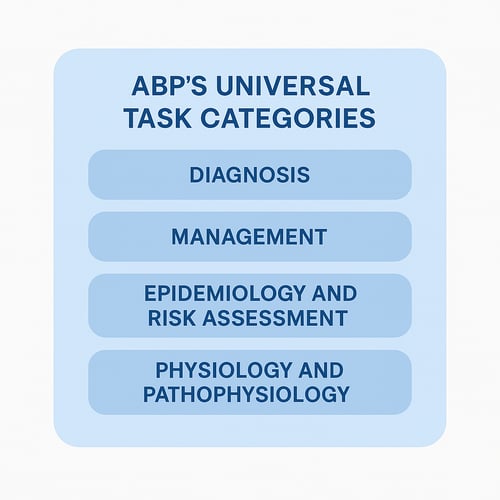
These categories determine how the question frames the clinical scenario. Because of this structure, questions test reasoning rather than isolated facts.
The ABP uses single-best-answer multiple-choice questions
This format requires:
- Several plausible options
- Only one truly correct or superior answer
- Clear logic supporting why distractors are not the best choice
This structure is why ABP questions often feel harder than expected. The challenge is not identifying what is true — it is identifying what matters most for the specific patient in the vignette.
👉How to Build Your Pediatrics Board Study Plan
How These Rules Shape the Way Questions Feel
ABP questions are designed to mirror real clinical reasoning, not memorization.
Most questions require you to integrate multiple clues — age, timing, vital signs, exam features, and contextual details — before arriving at the best answer. The ABP task categories emphasize this structure.
Questions often contain distractors that represent common reasoning errors. Distractors are not random; they frequently reflect the most tempting but incorrect choices that residents make in practice. Recognizing these patterns helps you avoid predictable traps.
The exam frequently embeds a “pivot point” — a single detail that determines the correct answer.
This could be:
- The patient’s age
- The duration of symptoms
- A vital sign trend
- A red-flag descriptor
- An epidemiologic clue
Teaching yourself to identify the pivot point early in the vignette improves both speed and accuracy.
The ABP question style rewards prioritization, not recall. Even if you know the diagnosis, the exam may ask:
- “What is the next best step?”
- “Which management strategy is most appropriate?”
- “What is the most important initial test?”
These questions test judgment, safety, and sequencing — core skills for independent pediatrics practice.
👉What Topics Are Hardest on the ABP Exam? A Resident's Guide
How to Read ABP Questions Like an Item Writer
Below are strategies based on the logic of ABP’s blueprint and task categories.
Identify the task category before choosing an answer
Ask yourself whether the question is about diagnosis, management, epidemiology, or pathophysiology. Once you know the task, the correct answer becomes clearer.
Read the last sentence first
The question stem often asks for a specific type of decision, and reading the final line first helps frame the reasoning.
Examples:
- “What is the most likely diagnosis?”
- “Which test should be ordered next?”
- “What is the most appropriate management step?”
This prevents you from focusing on irrelevant details.
Look for subtle red flags
Because the ABP tests clinical judgment, even one small detail can completely change the correct answer.
Examples include:
- Poor perfusion
- Abnormal neuro findings
- Toxic appearance
- Timing inconsistent with benign causes
- A missing vaccine in the history
Work backward from why an answer is wrong
Eliminating distractors is often faster than confirming the correct choice. Distractors usually represent:
- Outdated recommendations
- Overly aggressive workups
- Under-management of dangerous conditions
- Misinterpretations of key symptoms
Train yourself to explain why an answer is not the best choice.
Notice patterns in management questions
Many ABP management questions hinge on:
- Stabilization before diagnostics
- When to escalate care
- When to admit
- When to reassess
- When guidelines dictate specific timing or intervals
These patterns repeat across domains, even when the clinical topic changes.
👉Study Strategies That Work for the ABP Pediatrics Board Exam
FAQs
Does the ABP publish how items are written or reviewed?
No. The ABP does not release internal item-development procedures. Only the blueprint, task categories, and exam format are provided.
How can I understand ABP question logic without internal details?
Focus on the Universal Task Categories and on learning to identify the pivotal clue in each vignette. These two skills align closely with how the exam is structured.
Are ABP questions intentionally tricky?
No. Blueprint alignment ensures questions test core pediatric reasoning. Difficulty often comes from subtle clinical cues, not from trick wording.
Is there a specific number of distractors or question templates?
No. However, recognizing patterns in how options are structured will help you eliminate incorrect choices more efficiently.
Next Steps
If you want to improve how you interpret ABP questions:
Practice identifying the task category and the pivotal clue before choosing an answer.
If you want to analyze question logic more effectively:
Review why each distractor is wrong — this reveals reasoning traps the ABP expects you to avoid.
If you want to prepare more like an item writer:
Study mixed-domain question sets and look for recurring patterns in how vignettes are constructed.
If you want structured support that aligns with ABP question style:
Platforms such as Med-Challenger present single-best-answer pediatric questions with explanation-driven reasoning, making it easier to internalize the patterns that the ABP exam emphasizes.