

emergency medicine
ABEM Board Exam Guide 2025: How to Prepare and Pass
ABEM Board Exam Guide 2025: study strategy, exam format, and high-yield topics to pass the ABEM certifying exam
Complete guide to the ABOG Board Exam: eligibility, Qualifying and Certifying exam format, case lists, pass rates, 2026 dates, fees, and prep for OBGYN
Last updated: February 2026
ABOG board certification is a major milestone for every OBGYN, and understanding the process early can make the difference between a smooth application cycle and unnecessary stress. The ABOG Board Exam includes two required steps—the Qualifying Exam (written) and the Certifying Exam (oral)—designed to evaluate not just medical knowledge, but real-world clinical judgment across obstetrics, gynecology, and office practice. In this guide, we break down exactly how ABOG certification works, who is eligible, what to expect from each exam, key deadlines, case list requirements, and practical preparation strategies to help you approach the process with confidence.
👉 Start preparing now with Med-Challenger’s ABOG OBGYN Exam Review Course
The ABOG Board Exam (a shorthand way of referring to the ABOG Specialty Certification) is the two-step certification process administered by the American Board of Obstetrics and Gynecology to determine whether a physician is prepared for independent practice in obstetrics and gynecology. The process evaluates applied medical knowledge, clinical judgment, and real-world decision-making across obstetrics, gynecology, and office-based women’s health.
Although board certification is voluntary, it is widely regarded as a professional standard. For most physicians, completing ABOG certification represents the transition from supervised residency training to independently accountable clinical practice.
👉 The OBGYN Board Exam: A Comprehensive Guide
ABOG specialty certification is completed in two sequential steps. The first is the Qualifying Examination, a computer-based multiple-choice exam that assesses clinical knowledge and reasoning. The second is the Certifying Examination, an in-person oral exam that evaluates how candidates manage patient care using cases drawn from their own clinical practice.
A candidate must pass the Qualifying Examination on their most recent attempt before becoming eligible to apply for the Certifying Examination.
From a practical standpoint, this structure reflects ABOG’s view that earning certification requires more than just written knowledge. Candidates are expected not only to know what to do, but also to demonstrate how they work through problems in clinical practice.
Eligibility for the Qualifying Examination is based on completion of accredited residency training and formal verification by the training program.
But there’s more to it than that. To be eligible, candidates must complete 48 months of graduate medical education in an ACGME-accredited obstetrics and gynecology residency program or an explicitly approved equivalent pathway. Residency training must be completed no later than September 30 of the exam year, and candidates must have fulfilled chief resident responsibilities as defined by their accredited program.
ABOG enforces limits on vacation, sick leave, and other leaves of absence. Formal attestation from the residency Program Director is required, and training completed in programs not accredited by ACGME or the approved alternatives does not count toward eligibility.
ABOG requires residents to complete a minimum of two months, or the equivalent, of structured education and clinical experience incomprehensive family planning during residency. This requirement applies to residency graduates from the 2022–2023 academic year forward.
The required experience must include education and clinical exposure to all forms of contraception, counseling on procedural and medical abortion options, and management of abortion-related complications. Residency programs may use simulation to supplement clinical experience.
Residents who have religious, moral, or ethical objections are not required to perform procedures. However, the knowledge, judgment, and skills associated with this area of care are assessed on both the Qualifying and Certifying Examinations.
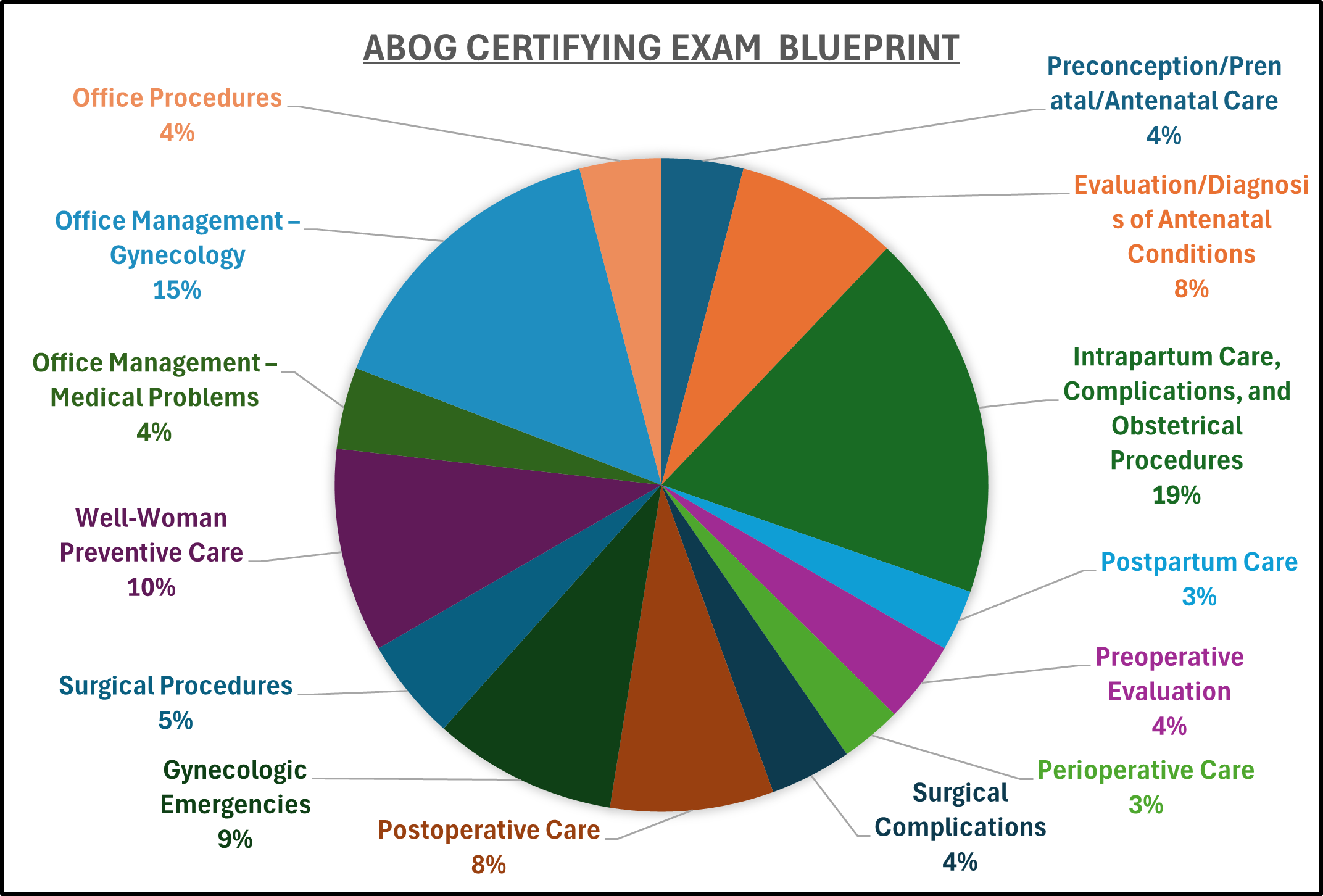
The Qualifying Examination is a single-day, computer-based exam administered in English at Pearson VUE testing centers. The exam consists of single-best-answer multiple-choice questions built around clinically focused scenarios. The exam blueprint is based on job task analyses of practicing obstetrician-gynecologists and is designed to reflect contemporary clinical practice rather than isolated factual recall.
Questions are intentionally written so that multiple answers may appear reasonable, but only one represents the most appropriate management given the clinical context. Exam content follows the ABOG Exam Blueprint and, within that, is distributed approximately in thirds across obstetrics, gynecology, and office practice.
👉 ABOG Qualifying Exam Format, Length, and Blueprint Explained
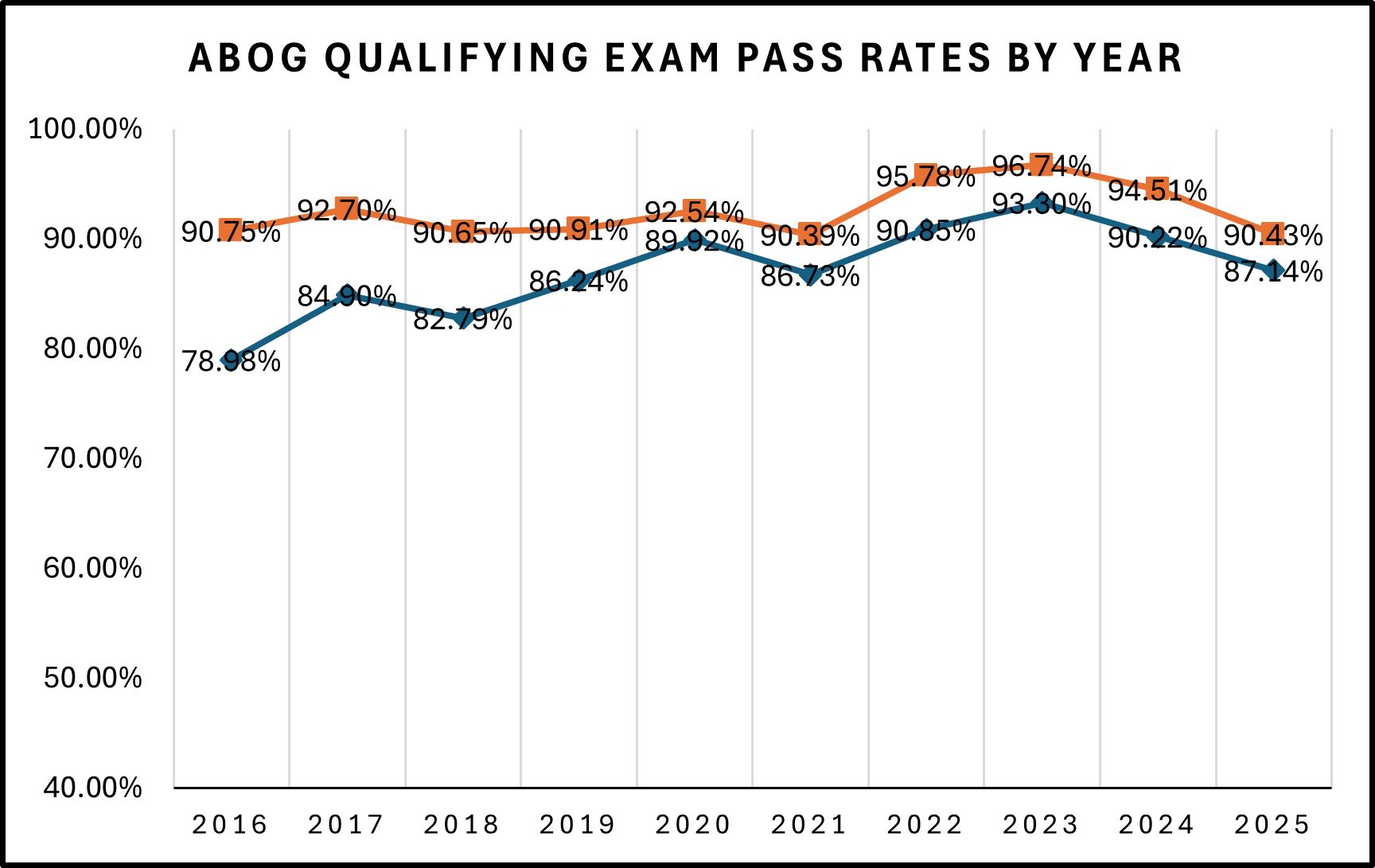
Official ABOG Qualifying Examination results show that pass rates are consistently high, particularly among first-time test takers.
Across recent exam years, overall pass rates generally fall in the high-80s to low-90s percent range. First-time Qualifying Exam pass rates are consistently higher and often exceed 90 percent. Lower pass rates are more commonly observed among repeat test takers, candidates who delay testing, or those with gaps in eligibility.
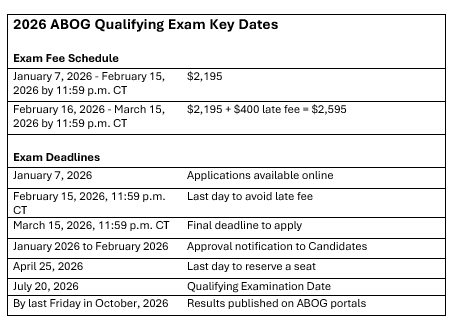
The Qualifying Examination is offered once per year. For the2026 exam cycle, applications open in January, the exam is administered in July, and results are released on or before the last Friday in October.
Candidates must apply, receive approval, and reserve a testing seat by published deadlines. Seating at Pearson VUE centers is limited as these centers are used for many types of testing. Candidates should apply early - inability to secure a preferred location does not qualify for a refund.
👉 ABOG Qualifying Exam and Certifying Exam Dates, Fees, and Deadlines
Candidates who apply and submit payment by mid-February pay the standard application fee. Applications submitted after that date incur a late fee, with a final application deadline in mid-March. Candidates are notified of approval during the winter and early spring and must reserve a Pearson VUE testing seat by the published reservation deadline in April.
The Qualifying Examination is administered in July 2026.Results are released on or before the last Friday in October through the candidate’s ABOG portal.
👉 ABOG Qualifying Exam Day at Pearson VUE: What to Expect
Passing the Qualifying Examination is needed before a candidate can proceed to the Certifying Examination. But there are additional requirements. And all eligibility requirements must be met when applying for the Certifying Examination.
In addition to passing the QE, candidates must complete a Surgical Skills Program requirement through Fundamentals of Laparoscopic Surgery or Essentials in Minimally Invasive Gynecologic Surgery and submit documentation confirming completion. Candidates must also, at the time of application, hold at least one active, unrestricted medical license, maintain unrestricted hospital privileges, and be actively engaged in unsupervised clinical practice.
👉 ABOG Qualifying vs Certifying Exam: What’s the Difference?
The Certifying Examination is an in-person oral exam administered at the ABOG National Center. This is not a test of memorized facts. The CE is designed to evaluate how candidates approach and manage real clinical scenarios.
Examiners use cases submitted by the candidate to explore diagnostic reasoning, treatment planning, recognition and management of complications, and follow-up care. Candidates are also asked how their management would change under different patient circumstances, such as changes in age, comorbidities, or clinical stability.
Bottom line - the Certifying Examination assesses how candidates think. Examiners are evaluating clinical judgment, prioritization, and adaptability rather than looking for rigid or scripted answers.
👉 ABOG Certification Exam: Key Topics Explored in Depth
Performance on the Certifying Examination is scored using a Multi-Facet Rasch Model, which adjusts for examiner severity and case difficulty. This approach is designed to improve fairness and consistency across exam administration.
Results are released several weeks after the exam following statistical analysis and quality assurance reviews.
Case lists are a central component of the Certifying Examination and are intended to reflect a candidate’s actual clinical practice.
Candidates must submit de-identified case lists in office practice, gynecology, and obstetrics. Each category has minimum case requirements, inclusion rules, and exclusions. Normal, uncomplicated obstetric patients are not included. Case lists are subject to audit, and incomplete or inaccurate submissions may result in disqualification or disciplinary action.
In practice, case list preparation is one of the most common sources of difficulty in the certification process. Candidates who begin organizing cases early are far less likely to encounter eligibility problems later.
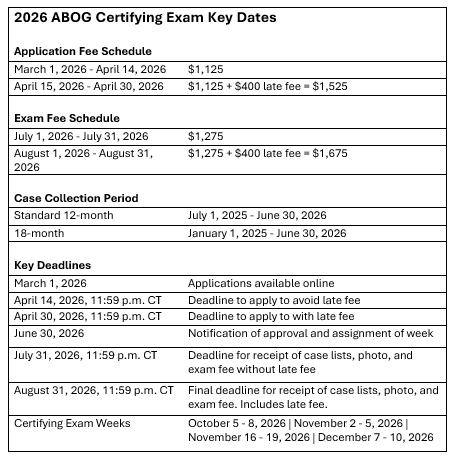
Applications for the 2026 Certifying Examination open in early March. Candidates who apply by mid-April pay the standard application fee, while applications submitted later in April incur a late fee.
After application approval, candidates submit case lists and examination fees during the summer. Case lists and fees must be received by ABOG no later than the final deadline at the end of August.
Certifying Examination weeks for 2026 are scheduled in October, November, and December. Candidates are notified of their assigned examination week in late June and receive their specific exam date and time several weeks before their scheduled exam.
Most candidates benefit from thinking about ABOG certification as a multi-year process rather than as a single exam event.
In late PGY-3 or early PGY-4, candidates should confirm eligibility requirements, ensure that family planning training requirements are met, and become familiar with the Qualifying Examination blueprint. Midway through PGY-4, attention typically shifts to registration, exam scheduling, and structured Qualifying Exam preparation.
After taking the Qualifying Exam in July, candidates generally use the post-exam period to confirm surgical skills documentation and begin planning for Certifying Exam requirements. During the first year of independent practice, the focus should be on tracking cases consistently and maintaining documentation rather than attempting to reconstruct case data later.
In the year of Certifying Exam application, candidates submit case lists and required attestations and prepare for the oral examination format, which emphasizes reasoning and explanation over factual recall.
From a practical standpoint, most Certifying Exam stress arises from administrative and case list issues rather than the oral exam itself. Early organization is one of the highest-yield strategies available to candidates.
For the Qualifying Examination, preparation is most effective when it focuses on applied clinical reasoning rather than exhaustive memorization. Questions are written so that multiple answers may seem plausible, but only one represents the best management choice given the clinical context. Candidates benefit from working with a high quality QE exam preparation resource such as Med-Challenger OB-GYN.
For the Certifying Examination, preparation should shift away from content review and pivot toward verbalizing clinical decision-making. Candidates benefit from practicing aloud how they explain diagnoses, justify management choices, and respond to complications. It is one thing to know and understand a course of action, quite another to explain it verbally.
Across both exams, alignment with the ABOG blueprint is more important than any single study resource.
One common misconception is that case lists can be addressed after passing the written exam. In reality, case list preparation often takes longer than expected and is a frequent source of eligibility problems.
Another misconception is that areas outside a candidate’s personal scope of practice will not be tested. The exams assess knowledge across the full breadth of obstetrics and gynecology, regardless of individual practice focus.
Some candidates mistakenly assume that passing the Qualifying Exam means the most difficult part of the process is complete. The QE is a critical and essential benchmark. But in practice, administrative requirements, documentation, and case lists continue to play a significant role after the written exam.
👉 Preparing for the ABOG Qualifying Exam Using the Specialty Blueprint
Is ABOG board certification required to practice obstetrics and gynecology?
No. Board certification is voluntary, though it is widely recognized and often expected by employers and institutions.
Can I take the Certifying Exam without passing the Qualifying Exam?
No. Passing the Qualifying Exam on the most recent attempt is required before applying for the Certifying Examination.
Are case lists audited?
Yes. ABOG audits case lists for completeness and accuracy.
Are accommodations available for the exams?
Yes. Disability and lactation accommodations are available if requested by published deadlines.
If you are early in residency, focus on understanding eligibility rules, training requirements, and documentation expectations. If you are nearing graduation, confirm that attestations, surgical skills requirements, and application deadlines are in place. If you are preparing for the Certifying Exam, begin organizing case list data early and practice articulating clinical reasoning clearly.
ABEM Board Exam Guide 2025: study strategy, exam format, and high-yield topics to pass the ABEM certifying exam
How to prepare for your family medicine board exam. ABFM study guide. How to pass the ABFM board exam. ABFM exam tips.
How to prepare for your family medicine board exam. ABFM study guide. How to pass the ABFM board exam. ABFM exam tips.