ABOG board certification is a two-step process, and the two exams – the Qualifying Exam and the Certifying Exam - are built to test different things. These exams are not interchangeable, and they are designed to evaluate different aspects of readiness for independent practice. If you only remember one point, make it this: the QE tests how well you can apply clinical knowledge in written scenarios, while the CE tests how well you can explain and defend clinical judgment out loud in real time.
👉 ABOG OBGYN Board Exam: How to Prepare and Pass
The Big Picture
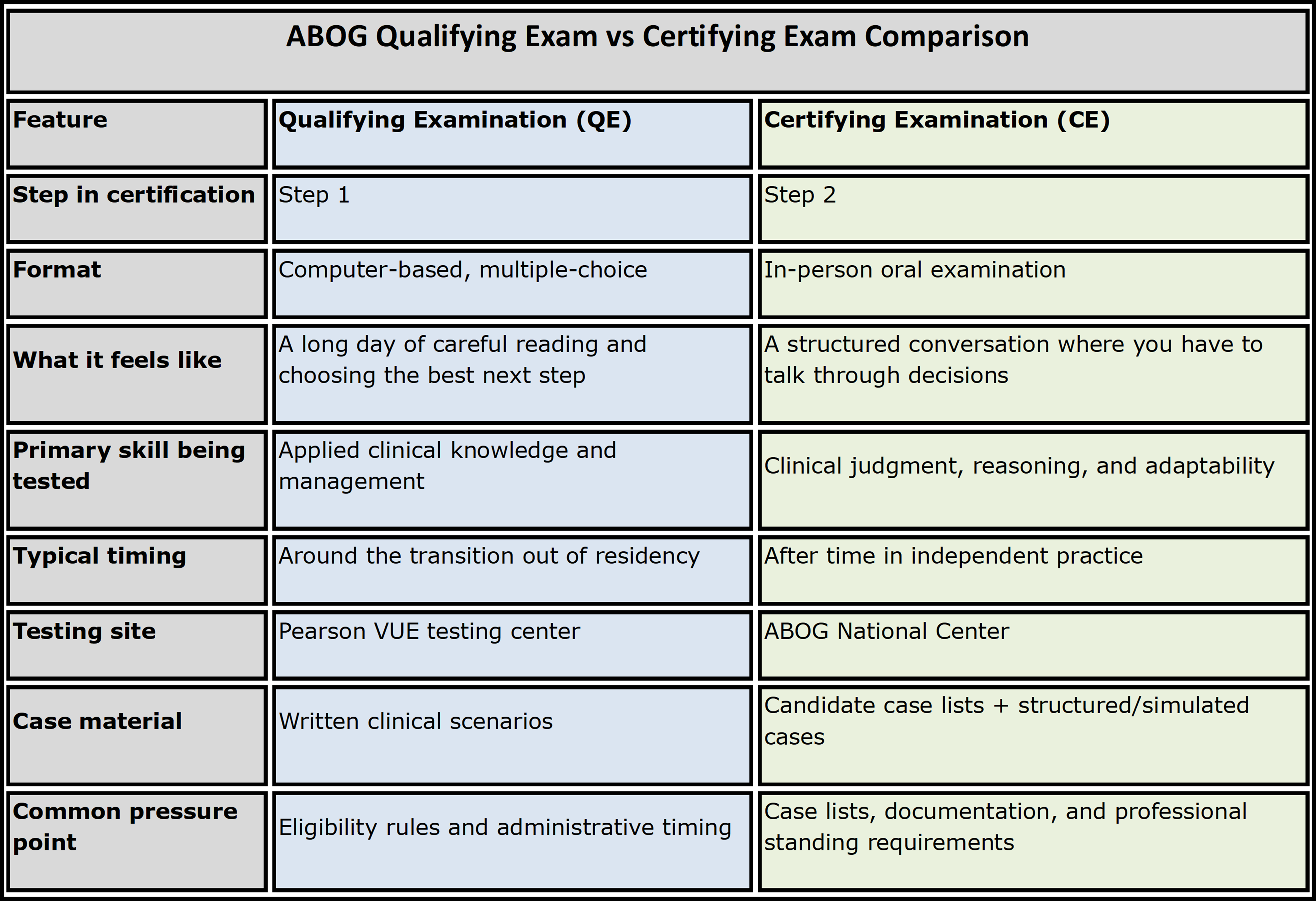
The Qualifying Examination (QE) is a computer-based multiple-choice examination. It evaluates broad clinical knowledge and the ability to apply that knowledge to common clinical problems across obstetrics, gynecology, and office-based women’s health.
The Certifying Examination (CE) is an in-person oral examination. It evaluates clinical judgment through discussion of case-based scenarios, including cases drawn from the candidate’s own practice and structured cases provided by ABOG.
Qualifying Examination (QE)
What the QE is really testing
The QE is built around common clinical situations. Most questions are not trying to trick you with obscure facts. They are testing whether you can look at a scenario, sort out what matters, and choose the most appropriate management.
A frequent source of frustration is that multiple answer choices can look reasonable. That’s intentional. The point is to identify the option that best fits the clinical context—patient factors, timing, stability, what has already been done, and what the next step needs to accomplish.
👉 ABOG Qualifying Exam Format, Length, and Blueprint Explained
QE Exam format
The QE is a single-day, computer-based exam with 230 single-best-answer multiple-choice questions. It is administered in English.
QE Content areas
The QE spans three broad domains:
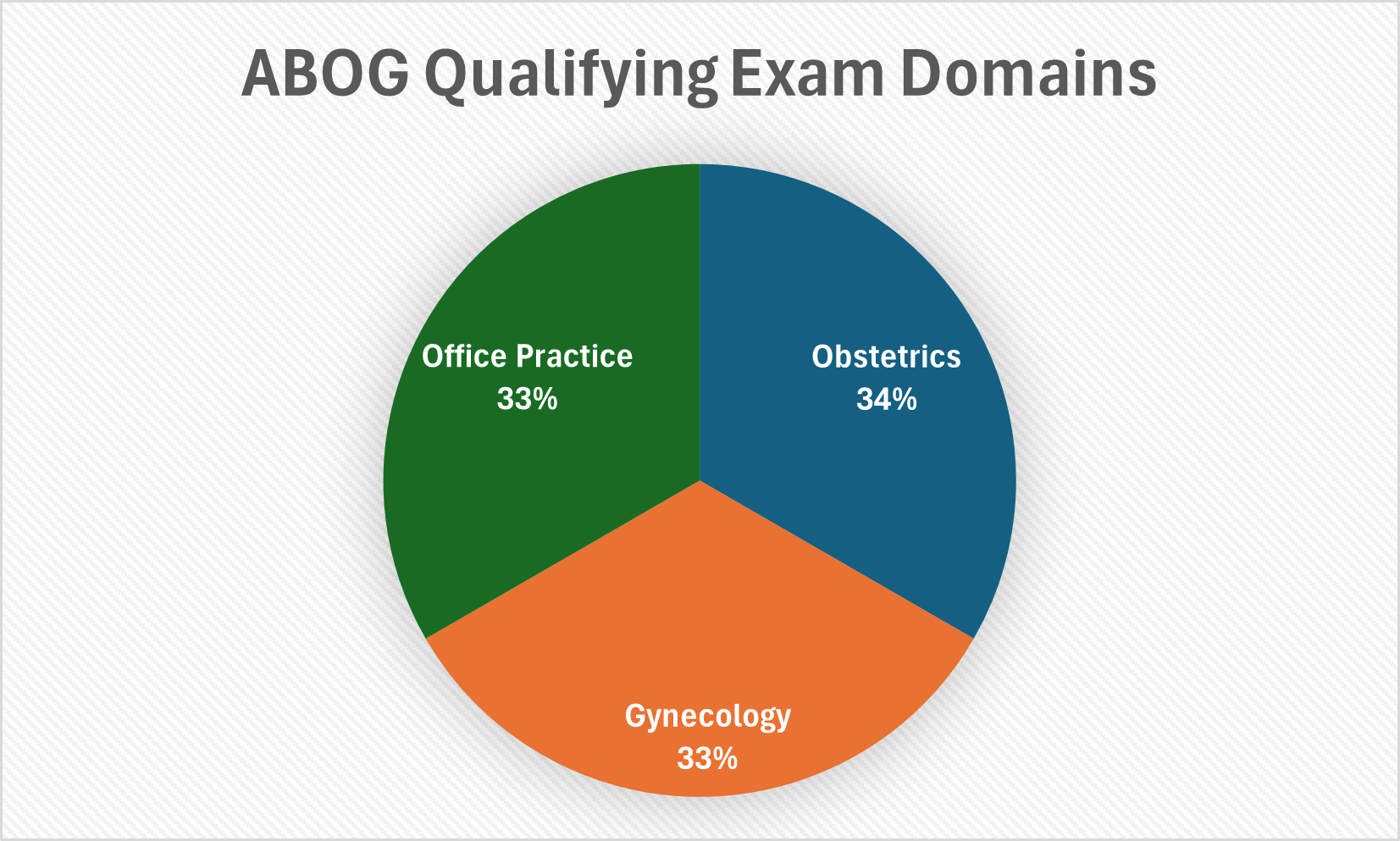
Those domains are weighted roughly equally. Office practice is often broader than people expect—preventive care, contraception, routine gynecology, and office-based management problems that show up every day, regardless of practice focus.
👉 Preparing for the ABOG Qualifying Exam Using the Specialty Blueprint
Administration
The QE is taken at Pearson VUE testing centers in the United States and Canada. After approval to test, candidates reserve a seat. Availability depends on location, so scheduling logistics matter more than many people anticipate.
Certifying Examination (CE)
What the CE is really testing
The CE is less about producing the “perfect” answer and more about demonstrating that your decisions are coherent, safe, and defensible. Examiners want to hear how you approach a problem, what you prioritize first, how you choose between reasonable options, and what you do when the case gets more complicated.
The discussion commonly expands beyond the initial diagnosis to complications, alternative management paths, follow-up planning, and how your approach changes with different patient factors.
👉 The OBGYN Board Exam: A Comprehensive Guide
CE Exam format and structure
The CE is an in-person oral exam at the ABOG National Center. It lasts three hours, divided evenly across:
- Obstetrics
- Gynecology
- Office Practice
Within each hour, the exam is split between:
- Cases drawn from the candidate’s submitted case list
- Structured or simulated cases provided by ABOG
That mix matters. The case-list portion reflects real practice. The structured portion creates standardized scenarios designed to probe judgment and consistency.
👉 ABOG Certification Exam: Key Topics Explored in Depth
Case lists
Case lists are central to the CE. Candidates submit de-identified cases intended to reflect their actual clinical practice during the defined collection period. Categories have minimum numbers and specific inclusion rules. Case lists may be audited, and accuracy matters.
For many candidates, the case list process is where stress accumulates—less because the rules may seem mysterious, and more because it takes time to track cases cleanly and consistently.
How the two exams differ day-to-day
The QE is quiet and self-contained. You are alone with a screen, moving question by question. The work is recognizing the pattern, interpreting the details, and selecting the best management step without overthinking.
The CE feels closer to a professional conversation, but it is still an exam. You talk through your decisions, you get follow-up questions, and you are expected to adjust as new details are introduced. Even when a topic overlaps with the QE, the skill being evaluated is different: less “pick the best answer” and more “show your thinking.”
Eligibility sequence
Passing the QE on the most recent attempt is required before applying for the CE. CE eligibility also includes additional requirements at the time of application related to professional standing, including licensure and hospital privileges, and any applicable documentation requirements.
Frequently Asked Questions
Is the ABOG board exam one test or two?
Two exams: the Qualifying Examination followed by the Certifying Examination.
Can the Certifying Examination be taken without passing the Qualifying Examination?
No. Passing the QE on the most recent attempt is required before applying for the CE.
Do both exams cover obstetrics, gynecology, and office practice?
Yes. Both exams are organized around those three domains.
Is the Certifying Examination based only on the candidate’s own cases?
No. The CE includes both cases from the candidate’s submitted case list and structured or simulated cases provided by ABOG.
Where are the exams taken?
The QE is taken at a Pearson VUE testing center. The CE is administered in person at the ABOG National Center.
Next Steps
If the QE is the next step, focus on broad coverage across obstetrics, gynecology, and office practice and get comfortable choosing the best management option when more than one answer seems plausible. Working with a proven test preparation question bank like Med-Challenger can help you get a leg up. If the CE is the next step, focus on case list organization early and practice explaining clinical decisions out loud in a structured way.