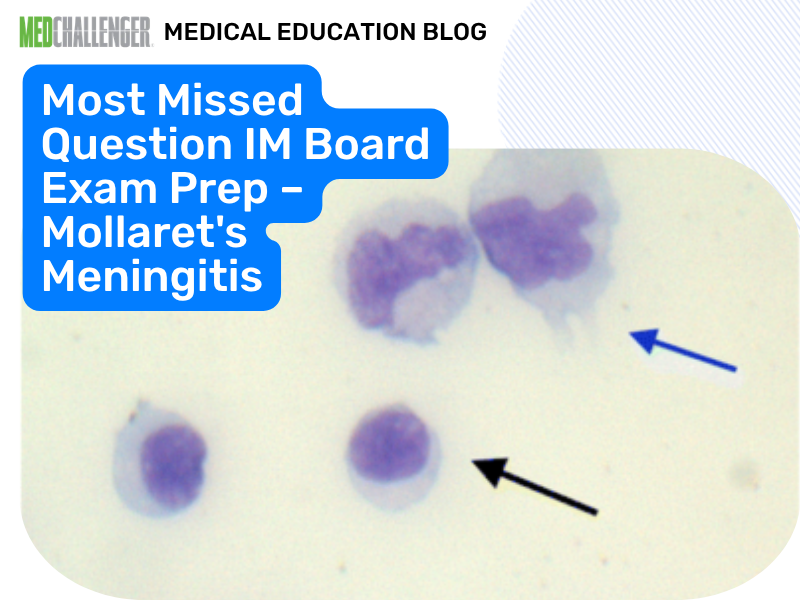
Recurrent, brief episodes of lymphocytic meningitis strongly suggest HSV-2 (Mollaret meningitis) and do not imply a specific primary immunodeficiency in an otherwise healthy adult.
Question - Recurrent meningitis
A 43-year-old woman presents to you with aseptic meningitis. It is her third episode in the past 4 years. The presentation seems to be the same every time: intense headache, fever, photophobia, and neck tenderness lasting for 4 to 5 days, with rapid resolution after starting intravenous acyclovir. During today's visit, results from lumbar puncture show lymphocytic pleocytosis and a mild elevation in protein.
What underlying primary immunodeficiency does this patient have?
Answer Options:
- A. natural killer cell deficiency
- B. severe combined immunodeficiency
- C. none
- D. common variable immunodeficiency
This presentation is most consistent with Mollaret meningitis (classically HSV-2–associated recurrent benign lymphocytic meningitis). For board purposes, recurrent HSV-2 meningitis in an immunocompetent adult is not considered a marker of a particular primary immunodeficiency—so “none” is the best answer.
The boards often try to bait test-takers into choosing an immunodeficiency whenever they see “recurrent” + “herpesvirus.” While severe or disseminated HSV disease can suggest impaired cellular immunity (including rare NK-cell disorders), the vignette here is stereotyped, self-limited, and recurrent over years in an adult—most consistent with HSV-2 recurrence rather than a congenital immunodeficiency syndrome. CDC STI guidance (2021) frames HSV-2 as a lifelong infection with recurrence; CNS recurrence can occur without an underlying primary immune disorder. IDSA encephalitis guidance (2018) supports acyclovir treatment for suspected HSV CNS disease, but does not link this pattern to a defined primary immunodeficiency as an expected association.
Why This Internal Medicine Question Is Often Missed
- “Recurrent HSV” triggers reflex selection of NK-cell deficiency despite the patient being a thriving adult with localized, self-limited episodes.
- Test-takers over-interpret “responds to acyclovir” as evidence of severe immunocompromise requiring an immune diagnosis.
- The stem asks for an immunodeficiency even though the exam-reliable teaching point is that none is required for Mollaret meningitis.
What the Distractors Indicate
| Option |
What It Tests / Implies |
Why It’s Wrong Here |
| natural killer cell deficiency |
Predisposition to severe/disseminated herpesvirus infections (HSV, VZV, CMV) |
Would more often present earlier and/or with severe, disseminated, unusual infections—not isolated recurrent benign lymphocytic meningitis in an otherwise healthy adult. |
| severe combined immunodeficiency |
Profound T- and B-cell dysfunction with opportunistic infections |
Typically presents in infancy/early childhood with severe/recurrent infections, chronic diarrhea, failure to thrive; not compatible with this adult course. |
| none |
Mollaret meningitis (recurrent HSV-2 aseptic meningitis) without specific primary immunodeficiency |
Correct: classic board linkage is HSV-2 recurrent lymphocytic meningitis without a defined primary immunodeficiency. |
| common variable immunodeficiency |
Humoral deficiency → recurrent sinopulmonary infections/encapsulated bacteria |
CVID is not classically associated with recurrent HSV-2 meningitis; phenotype is mainly bacterial respiratory/GI infections. |
Internal Medicine High-Yield Pearl for Exam Prep
Recurrent, brief (days-long), lymphocytic aseptic meningitis episodes in an adult = HSV-2 (Mollaret) until proven otherwise, and do not mandate a primary immunodeficiency diagnosis.
Core Learning Objectives
- Identify the classic board presentation of Mollaret (HSV-2) recurrent lymphocytic meningitis.
- Differentiate recurrent localized HSV-2 meningitis from patterns that truly suggest primary cellular immunodeficiency.
The Exam “Test Trick” at Play
The question is written to make “recurrent HSV” feel synonymous with “immunodeficiency.” Board writers reward pattern recognition: Mollaret meningitis is a *recurrent benign lymphocytic meningitis* classically tied to HSV-2 in otherwise immunocompetent adults; choosing “none” shows you recognize the syndrome rather than forcing an immune diagnosis.
Additional Internal Medicine Practice Questions and Remediation for Mollaret (HSV-2) Meningitis
Internal Medicine Practice Question 1 — Recurrent brief meningitis
A 35-year-old woman has her 4th episode of severe headache, photophobia, meningismus, and fever lasting 3–5 days. CSF shows lymphocytic pleocytosis and mildly elevated protein; Gram stain is negative. Which etiology is most likely?
- A. Enterovirus
- B. HSV-2
- C. Listeria monocytogenes
- D. Neisseria meningitidis
- E. Cryptococcus neoformans
Internal Medicine Practice Question 2 — When to suspect immunodeficiency
Which HSV-related presentation most strongly suggests an underlying primary defect in cellular immunity (e.g., NK/T-cell dysfunction)?
- A. Recurrent genital herpes outbreaks
- B. Recurrent 3–5 day lymphocytic meningitis episodes over years
- C. Severe disseminated HSV infection with visceral involvement
- D. Single episode of HSV-2 meningitis
- E. HSV-1 cold sores triggered by stress
Internal Medicine Practice Question 3 — CSF pattern recognition
A patient with suspected Mollaret meningitis undergoes LP. Which CSF profile is most consistent?
- A. Very low glucose, very high protein, neutrophilic predominance
- B. Normal glucose, mild protein elevation, lymphocytic pleocytosis
- C. Elevated opening pressure, very low glucose, lymphocytic predominance with India ink positive
- D. Eosinophilic predominance
- E. RBCs always >10,000/µL
Internal Medicine Practice Question 4 — Management framing (exam-safe)
A 29-year-old with suspected HSV meningitis is clinically stable after LP. Which immediate management is most exam-appropriate while awaiting PCR in a patient with significant symptoms?
- A. No antivirals; discharge with NSAIDs only
- B. Start acyclovir
- C. Start ampicillin only
- D. Start dexamethasone only
- E. Start fluconazole
Internal Medicine Practice Question 5 — Most likely
A 40-year-old otherwise healthy woman has recurrent, self-limited HSV-2 meningitis. She asks what immune disorder she has. Best answer?
- A. NK-cell deficiency
- B. SCID
- C. CVID
- D. No specific primary immunodeficiency is typically associated
- E. Chronic granulomatous disease
Mini Case Discussion Prompt
How would your differential and initial management change if the same patient had recurrent “aseptic meningitis” episodes plus recurrent severe VZV, CMV viremia, or disseminated HSV lesions?
Mini-FAQ
Q1: What’s the single most testable cause of recurrent benign lymphocytic meningitis (Mollaret)?
A: HSV-2. The ABIM expects recognition of this recurrent aseptic meningitis pattern.
Q2: Does recurrent HSV-2 meningitis require a primary immunodeficiency workup?
A: Not routinely on exams; Mollaret meningitis is classically seen in otherwise immunocompetent adults.
Q3: When should I think about NK-cell or T-cell defects with herpesviruses?
A: With severe, disseminated, atypical, or persistent herpesvirus infections (multiorgan disease, unusual pathogens, early onset).
Q4: What CSF profile best fits HSV-2 aseptic meningitis?
A: Lymphocytic pleocytosis with relatively normal glucose and mild protein elevation.
This question appears in Med-Challenger Internal Medicine Review with CME
Try for free and save. Ace your exams and meet your CME/MOC requirements for just $35 a month!