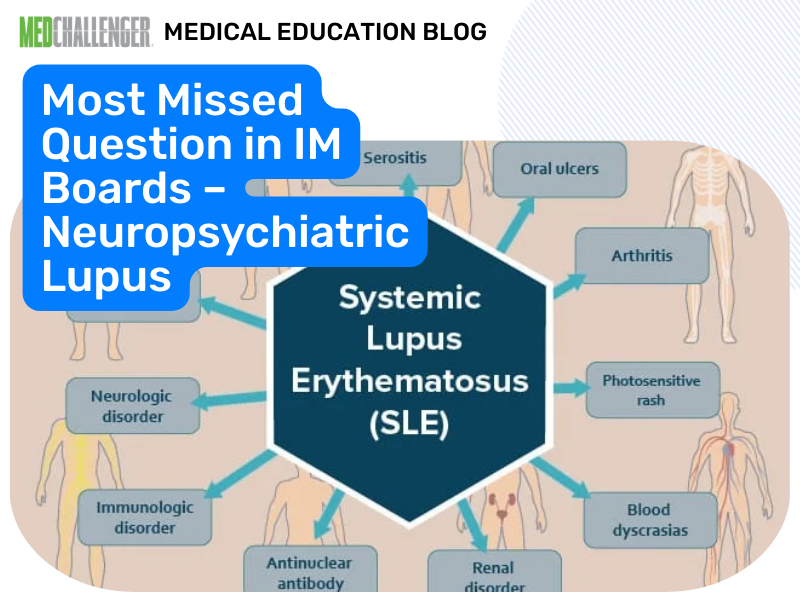
Key takeaway: Neuropsychiatric SLE has no single confirmatory test—MRI, CSF, and EEG can support the diagnosis, but boards expect you to recognize it as a diagnosis of exclusion/attribution.
Question - Confirmatory test
A 46-year-old female with a history of systemic lupus erythematosus has been lost to follow-up. Apparently, she has failed to fill her medications and has not been keeping up with her appointments. The daughter believes the patient has been using illicit drugs. She comes with a fever of 39°C, severe frontal headaches, confusion, and paranoid ideation. Her laboratory test results show leukopenia, hypocomplementemia and an elevated anti-double-stranded DNA antibody.
Which of the following is a confirmatory test for lupus cerebritis?
Answer Options:
A. CT scan of the head
B. MRI of the brain
C. Lumbar puncture
D. EEG
E. None of the above
Examinees often want one “slam-dunk” study (e.g., MRI or CSF) to confirm neuropsychiatric lupus. The point this question tests is that while MRI abnormalities, inflammatory CSF (pleocytosis/protein), and EEG changes are common, they are nonspecific and can overlap with infection (meningoencephalitis), toxin/drug effects, primary psychiatric disease, metabolic encephalopathy, and cerebrovascular events (including antiphospholipid-related thrombosis). Contemporary consensus and society guidance treat neuropsychiatric SLE as a multimodal diagnosis based on clinical syndrome + supportive studies + exclusion of alternative etiologies rather than a single confirmatory test.
Therefore, E (None of the above) remains the most board-reliable answer: these tests are evaluative/supportive, not confirmatory.
Why This Question Is Often Missed
- “Lupus cerebritis” is colloquial; boards increasingly frame it as neuropsychiatric SLE, which is attribution-based rather than test-confirmed.
- MRI/LP/EEG are commonly abnormal in NPSLE but lack specificity and can’t rule out infection/drug-induced causes.
- The stem includes fever and possible illicit drug use—designed to force you to remember infection/toxin must be excluded.
What the Distractors Indicate
| Option |
What It Tests / Implies |
Why It’s Wrong Here |
| A. CT scan of the head |
Rapid rule-out of hemorrhage/mass |
Helpful in acute evaluation, but typically insensitive for NPSLE and not confirmatory. |
| B. MRI of the brain |
Best imaging for inflammatory/ischemic lesions |
Can support NPSLE (white matter lesions, infarcts), but findings are nonspecific and may reflect APS stroke, infection, or other pathology. |
| C. Lumbar puncture |
CSF pleocytosis/protein; rule out infection |
CSF can be abnormal in NPSLE but also in infection; LP is for exclusion and supportive data, not confirmation. |
| D. EEG |
Encephalopathy/seizure tendency |
Nonspecific diffuse slowing or epileptiform activity does not confirm NPSLE. |
| E. None of the above |
Recognizes lack of a single confirmatory test |
Correct: diagnosis is clinical + supportive testing + exclusion of alternatives. |
Internal Medicine High-Yield Pearl for Exam Prep
For neuropsychiatric lupus, MRI/CSF/EEG are supportive and primarily help exclude mimics—none is confirmatory.
Core Learning Objectives
- Distinguish supportive diagnostic studies for neuropsychiatric SLE from tests that confirm a diagnosis.
- Prioritize evaluation to exclude infection, toxin/drug effects, and APS-related thrombosis in an SLE patient with acute neuropsychiatric symptoms.
The Exam “Test Trick” at Play
The stem “hands you” active SLE (low complement, high anti-dsDNA) and neuropsychiatric symptoms, tempting you to pick the most sophisticated test (MRI). But the word confirmatory is the trap: boards reward recognizing that NPSLE is diagnosed through pattern recognition plus exclusion, not a single definitive study.
Additional Practice Questions and Remediation for Neuropsychiatric SLE
Internal Medicine Practice Question 1 — Infection vs NPSLE
A 28-year-old woman with SLE on prednisone and mycophenolate presents with fever, headache, photophobia, and confusion. Which test is most urgent to help exclude a key alternative diagnosis before attributing symptoms to NPSLE?
- A. Serum anti-dsDNA level
- B. Lumbar puncture with CSF studies
- C. EEG
- D. Brain PET scan
- E. Complement levels
Internal Medicine Practice Question 2 — APS stroke clue
A 40-year-old woman with SLE develops sudden right-sided weakness and aphasia. MRI shows an acute left MCA infarct. Which additional finding most strongly supports antiphospholipid syndrome as the mechanism rather than inflammatory NPSLE?
- A. Low C3 and C4
- B. Positive lupus anticoagulant on two occasions 12 weeks apart
- C. Diffuse EEG slowing
- D. CSF lymphocytic pleocytosis
- E. Elevated anti-dsDNA
Internal Medicine Practice Question 3 — “Confirmatory test” concept
A patient with SLE has new psychosis and seizures. MRI shows scattered T2/FLAIR white matter hyperintensities; CSF protein is mildly elevated. Which statement is most accurate?
- A. MRI confirms lupus cerebritis
- B. CSF confirms lupus cerebritis
- C. EEG confirms lupus cerebritis
- D. No single test confirms neuropsychiatric SLE; diagnosis is clinical and by exclusion
- E. Anti-dsDNA level confirms CNS involvement
Internal Medicine Practice Question 4 — Medication/toxin mimic
A 33-year-old woman with SLE has agitation, paranoia, and insomnia starting 5 days after a prednisone dose increase to 60 mg/day. Afebrile; normal complement and stable anti-dsDNA. Most likely explanation?
- A. CNS infection
- B. Glucocorticoid-induced psychosis
- C. Lupus vasculitis (NPSLE)
- D. Serotonin syndrome
- E. Posterior reversible encephalopathy syndrome
Internal Medicine Practice Question 5 — Best next step framing
A 45-year-old with known SLE presents with fever, confusion, and headache. Exam shows nuchal rigidity. What is the best next step?
- A. Start high-dose IV steroids immediately for NPSLE
- B. Order anti-ribosomal P antibody to confirm NPSLE
- C. Empiric antimicrobials and urgent evaluation for CNS infection (including CSF if safe)
- D. EEG to confirm encephalitis due to lupus
- E. CT head alone is sufficient to confirm lupus cerebritis
Mini Case Discussion Prompt
Compare two SLE patients with acute confusion: one with fever and nuchal rigidity, and one who became psychotic after a major prednisone escalation—how does your diagnostic sequencing differ, and what “can’t-miss” etiologies change immediate management?
Mini-FAQ
Q1: Is “lupus cerebritis” a distinct diagnosis with a specific test?
A: No. The ABIM-style expectation is that neuropsychiatric SLE is an attribution diagnosis supported by studies but not confirmed by any single test.
Q2: Why isn’t MRI considered confirmatory if it’s often abnormal?
A: Because MRI abnormalities (white matter lesions, infarcts) are nonspecific and overlap with APS thrombosis, infection, migraine, small vessel disease, and other inflammatory conditions—boards test specificity.
Q3: What is the role of lumbar puncture in suspected NPSLE?
A: Primarily to exclude infection and to gather supportive inflammatory data; it does not definitively establish NPSLE.
Q4: What competing diagnosis is especially board-relevant in SLE with stroke symptoms?
A: Antiphospholipid syndrome–related thrombosis; the ABIM expects you to distinguish thrombotic stroke from inflammatory NPSLE processes.
This question appears in Med-Challenger Internal Medicine Review with CME
Try for free and save. Ace your exams and meet your CME/MOC requirements for just $35 a month!