When patients require NSAIDs, calcium channel blockers are the antihypertensive class whose BP-lowering effect is least blunted.
Question - NSAID interaction
A 66-year-old white woman with a longstanding history of rheumatoid arthritis presents to you for a routine visit. On a visit 3 months ago, her blood pressure was 145/90 mm Hg and you recommended lifestyle changes. Today, her blood pressure is 150/86 mm Hg and you diagnose her with hypertension.
She also complains of pain, so she is taking acetaminophen and ibuprofen to manage her pain in addition to monthly injections of anti-tumor necrosis factor α agents, which are managed by her rheumatologist.
Which class of antihypertensive agents is most effective in patients receiving non-steroidal anti-inflammatory drugs?
Answer Options:
A. beta-blockers
B. angiotensin-converting enzyme inhibitors
C. angiotensin receptor blockers
D. calcium channel blockers
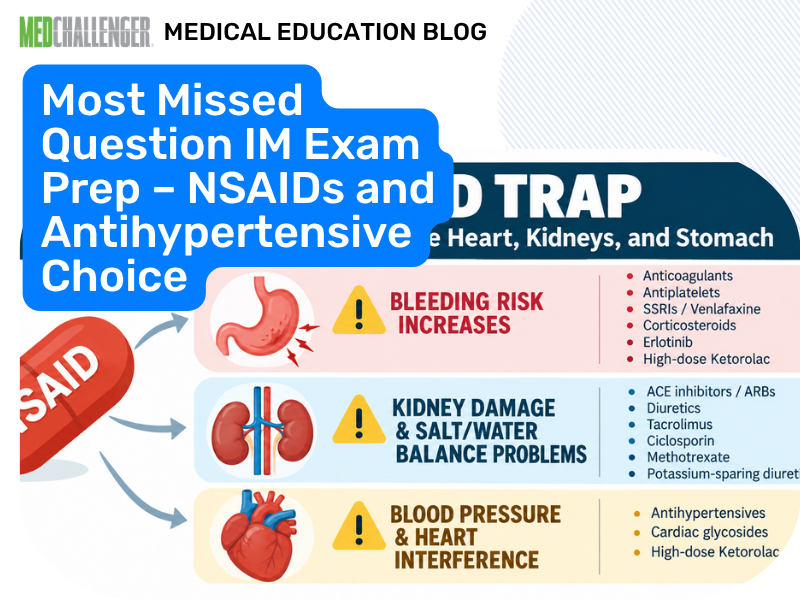
Examinees often miss this because they overgeneralize “first-line HTN therapy” (ACEi/ARB/thiazide/CCB) without accounting for drug-induced hypertension and pharmacodynamic antagonism. NSAIDs (e.g., ibuprofen at anti-inflammatory doses) can raise BP and commonly blunt the antihypertensive effect of agents dependent on renal prostaglandin–mediated vasodilation and natriuresis—most notably RAAS blockers and diuretics.
For board purposes, the most testable takeaway is that calcium channel blockers—especially dihydropyridines—maintain BP-lowering efficacy better than other classes during NSAID use. This aligns with contemporary hypertension guidance that flags NSAIDs as contributors to poor BP control (ACC/AHA 2017; AHA resistant hypertension statement 2018) and with the long-standing clinical pharmacology consensus used in exam item banks.
Why This Internal Medicine Question Is Often Missed
- Learners default to “ACE inhibitor for most patients” and forget NSAIDs can attenuate RAAS-blocker BP lowering.
- The test pivot is not rheumatoid arthritis or anti‑TNF therapy; it’s the NSAID–antihypertensive interaction.
- “Most effective with NSAIDs” is asking for least blunted, not “best first-line in general.”
What the Distractors Indicate
| Option |
What It Tests / Implies |
Why It’s Wrong Here |
| beta-blockers |
Recognition of alternative first-line agents/compelling indications |
NSAIDs can still worsen BP control; beta-blockers are not the classic “least affected” class in NSAID users and are not first-line absent a compelling indication. |
| angiotensin-converting enzyme inhibitors |
Standard first-line HTN therapy |
NSAIDs can blunt ACEi effects via reduced renal prostaglandins and altered renal hemodynamics (and can worsen kidney function risk in combination settings). |
| angiotensin receptor blockers |
Same as ACEi but with different tolerability |
Similar NSAID-related attenuation of BP lowering as ACE inhibitors. |
| calcium channel blockers |
Drug interaction recognition |
Correct: CCB BP-lowering is least affected by NSAIDs and is the most exam-reliable choice in this scenario. |
Internal Medicine High-Yield Pearl for Exam Prep
In a patient who must take NSAIDs, pick a calcium channel blocker when asked which antihypertensive is least blunted by NSAID therapy.
Core Learning Objectives
- Identify how NSAIDs raise blood pressure and interfere with antihypertensive efficacy via renal prostaglandin inhibition.
- Select the antihypertensive class whose BP-lowering effect is least attenuated by concurrent NSAID use.
The Exam “Test Trick” at Play
The stem tempts you to focus on “new HTN in an older adult” or RA comorbidities, but the hidden hinge is the medication list: ibuprofen. Boards love asking which antihypertensive “still works” when NSAIDs are on board—this is a pharmacology/renal physiology question disguised as routine primary care.
Additional Internal Medicine Practice Questions and Remediation for NSAIDs + Hypertension
Internal Medicine Practice Question 1 — “Worsening control on ibuprofen”
A 58-year-old man with HTN controlled on lisinopril develops knee OA and starts daily ibuprofen. Two weeks later, BP increases from 128/78 to 148/92. Best explanation?
- A. Increased renin release causes vasodilation
- B. Renal COX inhibition causes sodium retention and blunts RAAS-blocker BP effect
- C. Ibuprofen directly activates aldosterone receptors
- D. Reduced sympathetic tone decreases antihypertensive efficacy
- E. Increased nitric oxide production causes fluid retention
Internal Medicine Practice Question 2 — “Most reliable class with NSAIDs”
A 70-year-old woman requires chronic naproxen for inflammatory arthritis. Which antihypertensive class is least affected by NSAIDs?
- A. Thiazide diuretics
- B. ACE inhibitors
- C. ARBs
- D. Calcium channel blockers
- E. Direct renin inhibitors
Internal Medicine Practice Question 3 — “Triple-whammy risk”
A patient with CKD stage 3 is on losartan and hydrochlorothiazide. He starts high-dose ibuprofen for back pain. What complication is he now at increased risk for?
- A. Hypercalcemia
- B. Acute kidney injury
- C. Nephrotic syndrome
- D. Respiratory alkalosis
- E. Fanconi syndrome
Internal Medicine Practice Question 4 — “BP med choice in chronic pain”
A 62-year-old man with HTN and chronic inflammatory pain cannot stop NSAIDs. No CAD, HF, or CKD. Best initial antihypertensive to avoid loss of efficacy?
- A. Metoprolol
- B. Losartan
- C. Lisinopril
- D. Amlodipine
- E. Hydrochlorothiazide
Internal Medicine Practice Question 5 — “Recognize medication-induced HTN”
A 55-year-old woman’s BP becomes difficult to control after starting a new medication for musculoskeletal pain. Which medication is most likely responsible?
- A. Acetaminophen (intermittent)
- B. Ibuprofen (high-dose daily)
- C. Loratadine
- D. Omeprazole
- E. Levothyroxine at stable dose
Mini Case Discussion Prompt
How would your antihypertensive choice and monitoring plan change if this same patient also had CKD stage 3 and was already taking an ACE inhibitor plus a thiazide when she started daily NSAIDs?
Mini-FAQ
Q1: Why do NSAIDs raise blood pressure?
A: The ABIM expects recognition that renal COX inhibition lowers vasodilatory prostaglandins, promoting sodium retention and increased systemic vascular resistance.
Q2: Which antihypertensive class is least affected by NSAIDs on exams?
A: Calcium channel blockers (especially dihydropyridines) are the classic “least blunted” choice.
Q3: Why are ACE inhibitors/ARBs less effective with NSAIDs?
A: Boards test the concept that NSAIDs counteract renal hemodynamic and natriuretic pathways that support RAAS-blocker BP lowering.
Q4: What’s the kidney danger combination with NSAIDs?
A: The high-yield triad is NSAID + ACEi/ARB + diuretic (“triple whammy”) increasing AKI risk—commonly tested alongside BP control issues.
This question appears in Med-Challenger Internal Medicine Review with CME
Try for free and save. Ace your exams and meet your CME/MOC requirements for just $35 a month!