cme
Make the Most of Your CME Funds Before It's Too late!
Don’t let your CME funds go to waste. Use it before it's too late!
Waxing/waning confusion suggests delirium from systemic illness or meds; focal intracranial lesions are least likely. High-yield board review.
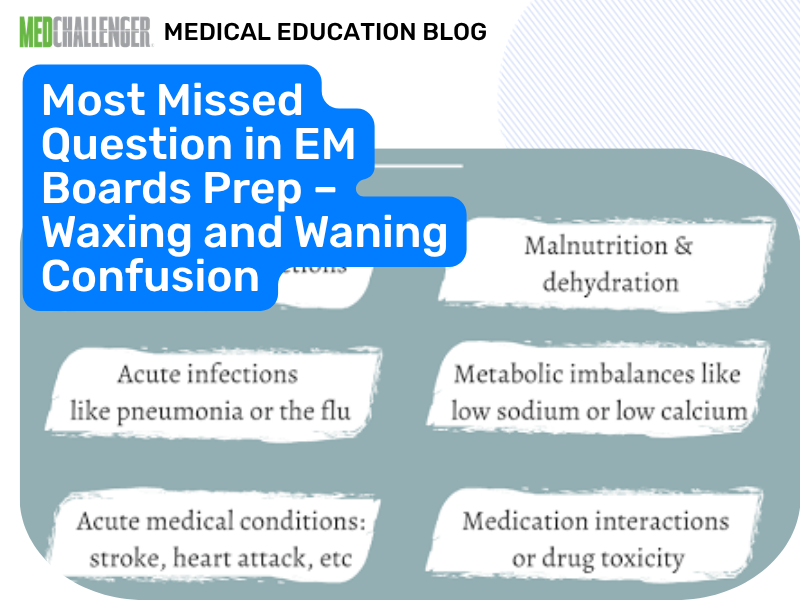
Waxing/waning confusion is most consistent with delirium physiology (toxic-metabolic/systemic/medication) rather than a focal intracranial lesion.

An 86-year-old woman is unsure how she got to the emergency department or why she is there. Her family states that she occasionally has these confused episodes but eventually returns to a higher-functioning state.
Which of the following categories of problems is LEAST likely to present with waxing and waning confusion?
Waxing and waning confusion is a board-style clue for delirium, which is characterized by acute onset, fluctuating course, and impaired attention and is most often precipitated by systemic illness (toxic-metabolic) or medications/toxins—especially in older adults (ACEP Clinical Policy on Altered Mental Status, 2019; and consistent with geriatric prescribing risk frameworks such as AGS Beers Criteria, 2023).
By contrast, focal intracranial lesions (tumor, many ischemic strokes) more commonly produce persistent neurologic deficits, focal findings, aphasia/neglect, or decreased level of consciousness rather than isolated, intermittent “back to baseline” confusion. While transient events exist (e.g., TIA, seizure/postictal states), the option as written (“tumor, stroke”) is the least likely category to present with a fluctuating delirium-like course in this vignette.
| Option | What It Tests / Implies | Why It’s Wrong Here |
|---|---|---|
| intracranial lesions (eg, tumor, stroke) | Structural CNS disease as a cause of confusion | Correct: focal lesions more often produce persistent deficits/LOC changes; isolated waxing/waning confusion is less typical as a category. |
| underlying systemic illness (eg, diabetes) | Toxic-metabolic/systemic delirium triggers | Systemic derangements (glucose, infection, hypoxia, electrolyte issues) commonly cause fluctuating delirium. |
| undiagnosed dementia | Baseline cognitive disorder | Dementia is usually chronic, but patients can have episodic worse function (variable performance, stress) and frequently develop superimposed delirium—so it’s not “least likely.” |
| adverse events from a medication she's taking | Medication-induced delirium | Very common in older adults; anticholinergics, sedative-hypnotics, opioids, and polypharmacy can cause waxing/waning confusion (AGS Beers Criteria, 2023). |
On boards, waxing/waning confusion = delirium until proven otherwise, so think toxic-metabolic and medication causes first, not focal structural lesions.
The stem is testing trajectory (intermittent confusion with return to a higher-functioning baseline), a classic delirium clue. Exams reward choosing the etiology class most consistent with a fluctuating course rather than the scariest diagnosis.
An 82-year-old hospitalized man is intermittently inattentive and disoriented, worse at night, and improved in the morning. Which feature best supports delirium over dementia?
A 78-year-old woman develops acute confusion after starting a new medication for urinary urgency. Which is the most likely medication class?
A 69-year-old man presents with acute fluctuating confusion. Vitals: T 38.6°C, HR 112. No focal deficits. What is the most appropriate initial category of evaluation?
Which finding in a confused older adult most strongly pushes toward an intracranial structural lesion rather than delirium?
A 76-year-old with mild baseline memory impairment becomes acutely disoriented after dehydration from gastroenteritis, then returns to baseline after fluids. Best explanation?
How would your differential and immediate workup change if this patient’s “return to baseline” stops occurring and the family reports new unilateral weakness or aphasia?
Q1: What single stem clue most strongly suggests delirium on boards?
A: A fluctuating course with inattention; exam writers use this to steer you toward toxic-metabolic/medication causes.
Q2: Can stroke cause confusion without focal deficits?
A: Yes (e.g., some posterior circulation events), but boards expect you to weigh fluctuation and return to baseline more heavily toward delirium unless focal signs/red flags appear.
Q3: Why is medication history so high-yield in older adults with confusion?
A: The ABEM/EM-style exams commonly test polypharmacy and anticholinergic/sedative burden as major delirium precipitants (AGS Beers Criteria, 2023).
Q4: How does dementia usually present differently from delirium?
A: Dementia is chronic and progressive; delirium is acute and fluctuating, often triggered by systemic illness or drugs (NICE NG97, 2018).
Find this and other Emergency Medicine exam prep questions in Med-Challenger Emergency Medicine Review with CME
Try for free and save. Ace your exams and meet your CME/MOC requirements for just $35 a month!



No matter your program, no matter the size, Med-Challenger for Groups and Institutions can better prepare your program or group, fulfill industry requirements, and increase test scores.

Don’t let your CME funds go to waste. Use it before it's too late!
Learn why antibiotics only modestly outperform placebo in adult sinusitis trials and when guidelines support watchful waiting vs treatment.
Manage and monitor cohorts, AI in education, nursing programs turn down qualified applicants, and ChatGPT shows less concern for warning signs.