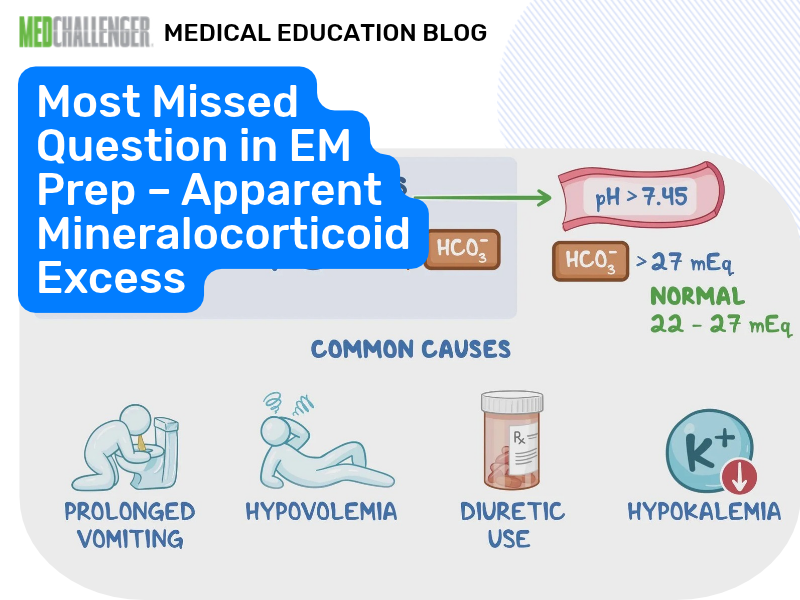
Recognize the pattern of hypokalemic metabolic alkalosis with hypernatremia as a clue for licorice-induced mineralocorticoid effect, not toxic alcohols or salicylates.
Question - Electrolyte pattern
A 55-year-old man presents to you with profound weakness and lethargy. A chemistry panel is obtained demonstrating a potassium level of 2.5, bicarbonate level of 30, and a sodium level of 155. A blood gas study reveals a serum pH level of 7.50.
Which of the following ingestions is most likely responsible for these derangements?
Answer Options:
A. ethylene glycol
B. licorice
C. methanol
D. salicylate
The keyed answer (licorice) is correct. This vignette is testing the board-classic tox/electrolyte pattern: hypokalemia + metabolic alkalosis (HCO₃⁻ 30, pH 7.50) + hypernatremia from apparent mineralocorticoid excess due to licorice (glycyrrhizin). Glycyrrhizin inhibits 11β-hydroxysteroid dehydrogenase type 2 (11β-HSD2), allowing cortisol to activate mineralocorticoid receptors in the distal nephron, driving Na⁺ retention and K⁺/H⁺ wasting.
This is a frequent testable contrast item in EM exams: toxic alcohols (ethylene glycol, methanol) produce a high anion gap metabolic acidosis (often with an early osmolar gap), whereas salicylates classically produce a mixed disorder (primary respiratory alkalosis plus metabolic acidosis), not isolated metabolic alkalosis with hypokalemia.
Why This Emergency Medicine Question Is Often Missed
- Learners anchor on “ingestion” and reflexively pick toxic alcohols, forgetting they cause anion gap acidosis, not alkalosis.
- Many miss that licorice is pharmacologically active (pseudohyperaldosteronism) and can produce striking electrolyte changes.
- Weakness is nonspecific; the discriminators here are the acid–base status and electrolytes.
What the Distractors Indicate
| Option |
What It Tests / Implies |
Why It’s Wrong Here |
| ethylene glycol |
Toxic alcohol ingestion → osmolar gap then anion gap metabolic acidosis; renal injury, calcium oxalate |
Patient has alkalemia with elevated HCO₃⁻, not acidosis |
| licorice |
Glycyrrhizin → apparent mineralocorticoid excess → Na⁺ retention, K⁺/H⁺ loss |
Matches hypernatremia + hypokalemia + metabolic alkalosis |
| methanol |
Toxic alcohol → anion gap metabolic acidosis; visual symptoms |
Not consistent with metabolic alkalosis |
| salicylate |
Mixed disorder: respiratory alkalosis + metabolic acidosis |
Would expect low HCO₃⁻/anion gap metabolic acidosis component, not elevated HCO₃⁻ |
High-Yield Pearl for ABEM Exam Prep
Hypokalemic metabolic alkalosis with sodium retention after an “ingestion” clue strongly suggests licorice (glycyrrhizin) → apparent mineralocorticoid excess.
Core Learning Objectives
- Identify licorice (glycyrrhizin) as a cause of apparent mineralocorticoid excess leading to hypernatremia, hypokalemia, and metabolic alkalosis.
- Differentiate expected acid–base patterns of toxic alcohols (anion gap metabolic acidosis) and salicylates (mixed respiratory alkalosis + metabolic acidosis) from metabolic alkalosis patterns.
The Exam Trick at Play
The item is a pattern-recognition trap: it uses the generic word “ingestion” to steer test-takers toward classic poisons (toxic alcohols, salicylates), but the labs are instead the signature of mineralocorticoid physiology (Na⁺ retention with K⁺/H⁺ wasting), which is most tightly linked (among the options) to licorice.
Additional Practice Questions & Remediation for Apparent Mineralocorticoid Excess / Toxidrome Acid–Base
Emergency Medicine Practice Question 1 — Licorice hypertension
A 48-year-old woman with new hypertension has K⁺ 2.9 mEq/L and HCO₃⁻ 33 mEq/L. Renin and aldosterone are low. She reports eating large amounts of “natural” black licorice candy. Best mechanism?
- A. Increased aldosterone secretion from adrenal adenoma
- B. Inhibition of 11β-HSD2 allowing cortisol to stimulate mineralocorticoid receptors
- C. Inhibition of carbonic anhydrase in the proximal tubule
- D. Competitive antagonism of aldosterone receptors
- E. Increased ADH secretion
Emergency Medicine Practice Question 2 — Toxic alcohol pattern
A 32-year-old man is confused after “antifreeze” exposure. Labs: pH 7.18, HCO₃⁻ 10, anion gap 28. Most likely ingestion?
- A. Ethylene glycol
- B. Licorice
- C. Opioids
- D. Acetaminophen
- E. Iron
Emergency Medicine Practice Question 3 — Salicylate mixed disorder
A 21-year-old presents with tinnitus, tachypnea, and vomiting. ABG shows pH 7.48, PaCO₂ 25, HCO₃⁻ 18. Most consistent ingestion?
- A. Methanol
- B. Salicylates
- C. Licorice
- D. Benzodiazepines
- E. Ethylene glycol
Emergency Medicine Practice Question 4 — Lab clue: low renin/aldo
A patient has hypertension, hypokalemia, metabolic alkalosis, low renin, low aldosterone. Which exposure is most likely?
- A. Thiazide diuretic
- B. Licorice (glycyrrhizin)
- C. ACE inhibitor
- D. Addison disease
- E. SIADH
Emergency Medicine Practice Question 5 — Treatment implication
A patient with licorice-associated hypokalemic metabolic alkalosis is symptomatic with arrhythmias. Best initial ED management?
- A. Fomepizole and bicarbonate infusion
- B. Potassium repletion and stop exposure; consider mineralocorticoid receptor antagonism if needed
- C. Flumazenil
- D. N-acetylcysteine
- E. Defer treatment; self-limited
Mini Case Discussion Prompt
How would your differential and first tests change if this same patient had anion gap metabolic acidosis instead of alkalosis—specifically regarding toxic alcohols (osmolar gap, calcium oxalate crystalluria, visual symptoms) versus salicylates?
Mini-FAQ
Q1: What’s the single best lab pattern clue for licorice toxicity on boards?
A: The ABEM-style discriminator is hypokalemic metabolic alkalosis with sodium retention (often with hypertension)—an apparent mineralocorticoid excess picture.
Q2: Why don’t methanol and ethylene glycol fit when the pH is 7.50 with HCO₃⁻ 30?
A: Boards expect toxic alcohols to produce high anion gap metabolic acidosis, not alkalemia with elevated bicarbonate.
Q3: What mixed acid–base disorder do salicylates classically cause?
A: Respiratory alkalosis plus metabolic acidosis; the ABIM/ABEM expectation is to recognize this pairing (often with tinnitus).
Q4: What mechanism links licorice to mineralocorticoid effects if aldosterone is low?
A: Glycyrrhizin inhibits 11β-HSD2, so cortisol (not aldosterone) activates mineralocorticoid receptors in the kidney.
Find this and other Emergency Medicine exam prep questions in Med-Challenger Emergency Medicine Review with CME
Try for free and save. Ace your exams and meet your CME/MOC requirements for just $35 a month!