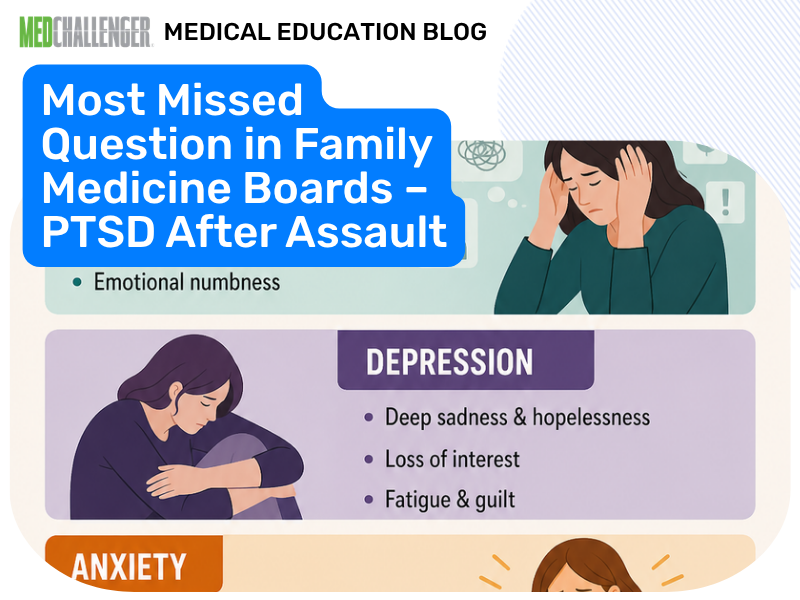
Board questions often test which factors predict persistent PTSD symptoms after trauma, especially psychiatric history, social support deficits, and ongoing threat—beyond the traumatic event itself.
Question – PTSD risk
A 25-year-old woman presents for treatment following a sexual assault that occurred the previous night. She was also assaulted 2 years ago.
In addition to the preceding sexual assault, what other factors may put this patient at an increased risk of post-traumatic stress disorder (PTSD)?
Answer Options:
A. history of mental health difficulties, including self-harm, lack of social support, perception and/or evidence of an ongoing threat
B. history of mental health difficulties, including self-harm, perception and/or evidence of an ongoing threat
C. history of mental health difficulties, including self-harm, substance abuse problems, lack of social support, perception and/or evidence of an ongoing threat
D. substance abuse problems, lack of social support, perception and/or evidence of ongoing threat
E. history of mental health difficulties, including self-harm, substance abuse problems, lack of social support, evidence of an ongoing threat
In this item, the keyed answer (A) is consistent with current, exam-reliable risk domains, but the remediation cites an outdated (2012) guideline and the answer choices reflect an incomplete set of modern predictors. Current consensus-based guidance (e.g., APA 2017; VA/DoD 2023) emphasizes that pre-trauma psychiatric vulnerability (including prior mental health disorders and self-harm), low social support, and ongoing threat/lack of safety are associated with greater risk of persistent post-traumatic symptoms. Among the offered options, A best matches these repeatedly tested risk factors.
Clinically and on boards, the high-yield concept is that PTSD risk is not determined by trauma exposure alone: prior trauma and psychiatric history plus poor social buffering and continued threat are powerful predictors of chronicity and impaired recovery.
Why This Family Medicine Question Is Frequently Missed
- Test-takers over-focus on the assault itself and miss that boards ask about modifiers of PTSD risk (social support, ongoing threat).
- Many assume substance use must be included; while relevant in populations, it’s not as consistently “core” as psychiatric history + low support + ongoing threat in exam phrasing.
- The answer set is “list-comparison” style; small wording differences (e.g., “perception and/or evidence”) drive the key.
What the Distractors Indicate
| Option |
What It Tests / Implies |
Why It’s Wrong Here |
| history of mental health difficulties, including self-harm, lack of social support, perception and/or evidence of an ongoing threat |
Classic exam cluster: pre-existing mental health issues/self-harm + low support + ongoing threat perception |
Best match to widely taught risk domains; includes low social support and threat perception/evidence |
| history of mental health difficulties, including self-harm, perception and/or evidence of an ongoing threat |
Same as A but omits social support |
Low social support is a key risk amplifier and commonly tested predictor |
| history of mental health difficulties, including self-harm, substance abuse problems, lack of social support, perception and/or evidence of an ongoing threat |
Adds substance abuse to A |
Substance use may correlate with risk, but this option is “too inclusive” relative to the stem/rationale set and not consistently prioritized in guideline-style summaries |
| substance abuse problems, lack of social support, perception and/or evidence of ongoing threat |
Focuses on SUD + low support + threat, omits psychiatric history/self-harm |
Pre-existing psychiatric history/self-harm is a major predictor; omission makes it less complete |
| history of mental health difficulties, including self-harm, substance abuse problems, lack of social support, evidence of an ongoing threat |
Similar to C but missing “perception” language |
The “perception and/or evidence” phrasing is important; PTSD risk relates to perceived ongoing threat even absent objective evidence |
High-Yield Pearl for Family Medicine Exam Prep
For PTSD after sexual assault, boards repeatedly reward: prior trauma + pre-existing mental health problems + low social support + ongoing threat/safety concerns.
Core Learning Objectives
- Identify core predictors of PTSD risk after sexual assault that are repeatedly tested on board exams (psychiatric history, social support, ongoing threat).
- Distinguish “most exam-reliable” risk domains from broader correlates that may be true epidemiologically but are less consistently used as keyed factors.
The “Test Trick” at Play
This is a *best-answer completeness* question: multiple options contain true statements, but the key is the option that most closely reproduces the canonical, board-tested cluster of risk factors—especially low social support and perceived ongoing threat, not just psychiatric history alone.
Additional FM Practice Questions and Remediation for PTSD Risk Factors After Sexual Assault
Family Medicine Practice Question 1 - safety threat
A 29-year-old patient is seen 48 hours after sexual assault. Which factor most increases concern for later PTSD due to impaired recovery conditions?
- A. Age <30
- B. Assault occurred indoors
- C. Ongoing contact with the perpetrator and inability to secure safety
- D. No physical injuries documented
- E. Normal vitals on exam
Family Medicine Practice Question 2 - social buffering
A 24-year-old sexual assault survivor reports she has told no one, is isolated, and has no supportive relationships in the area. What risk factor is this highlighting?
- A. Low social support
- B. Secondary gain
- C. Malingering risk
- D. Somatic symptom disorder
- E. Bipolar disorder
Family Medicine Practice Question 3 - psychiatric history
A 27-year-old patient was sexually assaulted last night. History reveals prior suicide attempt and chronic depression. Which statement best reflects board-relevant PTSD risk?
- A. Prior depression lowers PTSD risk by increasing treatment engagement
- B. Pre-existing mental health disorders and self-harm history increase PTSD risk
- C. Psychiatric history predicts only acute stress disorder, not PTSD
- D. Psychiatric history matters only if there is psychosis
- E. PTSD risk is determined solely by trauma severity
Family Medicine Practice Question 4 - differentiate correlates
Which factor is most consistently emphasized across exam-style summaries as increasing PTSD risk after sexual assault?
- A. Heightened appetite
- B. Mild hypercholesterolemia
- C. Prior trauma exposure and low social support
- D. Seasonal variation
- E. Left-handedness
Family Medicine Practice Question 5 - acute stress symptoms
A 32-year-old sexual assault survivor presents 1 week later with intrusive memories, avoidance, negative mood, and hyperarousal. Which interpretation is most board-accurate?
- A. Symptoms at 1 week exclude later PTSD
- B. Significant acute stress symptoms increase risk of later PTSD
- C. Early symptoms predict only adjustment disorder
- D. Early symptoms indicate factitious disorder
- E. Early symptoms mean PTSD is already diagnosed regardless of duration
Mini Case Discussion Prompt
How would your PTSD risk assessment and follow-up plan differ for (1) a survivor with strong family support and immediate safety vs (2) a survivor who must return to shared housing with the perpetrator and has prior self-harm?
Mini-FAQ
Q1: Which PTSD risk factors are most “board-reliable” after sexual assault?
A: The ABIM/AAFP-style emphasis is on prior trauma, pre-existing mental health problems (including self-harm), low social support, and ongoing threat/safety concerns.
Q2: Why does “perception of ongoing threat” matter if there’s no objective evidence?
A: Boards expect recognition that subjective safety appraisal and continuing stress exposure drive persistence of post-traumatic symptoms and avoidance/hyperarousal.
Q3: Does substance use always need to be included as a risk factor?
A: Substance use can co-occur and worsen outcomes, but exam keys more consistently prioritize psychiatric history + social support + ongoing threat when forced to choose.
Q4: What’s the testable difference between acute stress disorder and PTSD?
A: The ABIM expects duration-based recognition: significant symptoms soon after trauma can be acute stress disorder; PTSD requires persistence beyond the acute window per diagnostic criteria.
Find this and other Family Medicine exam prep questions in Med-Challenger Family Medicine Review with CME
Try for free and save. Ace your exams and meet your CME/MOC requirements for just $35 a month!
No matter your program, no matter the size, Med-Challenger for Groups and Institutions can better prepare your program or group, fulfill industry requirements, and increase test scores.
For personal medical education that includes board's prep, MOC, and CME requirements, Med-Challenger has you covered in Family Medicine, Emergency Medicine, Internal Medicine, Pediatrics, Pediatric Emergency Medicine, OBGYN, Physician Assistants, and Nurse Practitioners.
Never miss a thing. Subscribe to our blog and save!