Lead toxicity is a classic boards presentation where the peripheral smear clue is coarse basophilic stippling.
Question - Smear finding
A 23-year-old healthy man who works in a plant that manufactures pigments is brought to you by his wife. The patient is normally outgoing and expansive. For the last year his personality has changed and he has developed anxiety, cognitive decline, and hostility.
His physical examination reveals a blood pressure of 170/105 mm Hg. There is dark discoloration in the spaces between his teeth and gum in all of his lower incisors. There is evidence of sensory neuropathy on neurologic examination.
Laboratory evaluation shows anemia. His lactate dehydrogenase level is elevated and his haptoglobin level is low. You suspect lead poisoning.
What finding in the peripheral smear will be most likely found?
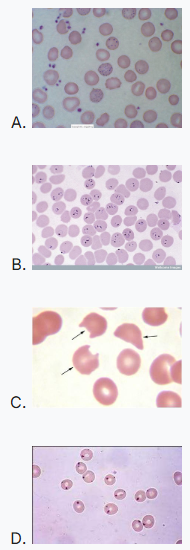
Answer Options:
- Image A
- Image B
- Image C
- Image D
Basophilic stippling is the exam-reliable smear association for lead toxicity (coarse blue granules in RBCs representing aggregated ribosomal RNA). This vignette is loaded with occupational exposure (pigment manufacturing), neuropsychiatric change, HTN, neuropathy, hemolysis markers (↑LDH, ↓haptoglobin), anemia, and a gingival “lead line,” all of which support lead poisoning. CDC/ATSDR toxicology resources describe hematologic effects (anemia/hemolysis and disrupted heme synthesis); basophilic stippling remains a classic supportive smear clue used in test settings (confirmation is by blood lead level).
Why This Internal Medicine Question Is Often Missed
- Test-takers over-anchor on “hemolysis” and choose bite cells/Heinz bodies (G6PD) instead of the toxin-exposure clue set.
- Image-based hematology questions are often missed because learners memorize associations but can’t map them to a picture under time pressure.
- Lead poisoning is conflated with iron deficiency or thalassemia—both can involve microcytosis, but the occupational + neuro + gingival findings are the giveaway.
What the Distractors Indicate
| Option |
What It Tests / Implies |
Why It’s Wrong Here |
| Image A |
Basophilic stippling (lead, some hemoglobinopathies/thalassemias) |
Correct for lead toxicity supportive smear finding. |
| Image B |
Intraerythrocytic parasites (malaria) |
No travel/fever/cyclic symptoms; occupational toxin story instead. |
| Image C |
Bite cells (degmacytes) from splenic removal of Heinz body material |
Points to oxidative hemolysis (e.g., G6PD), which doesn’t fit pigment/lead exposure + gingival lead line. |
| Image D |
Heinz bodies (denatured Hb; typically needs supravital stain) |
Suggests oxidative injury (G6PD, unstable Hb); not the highest-yield smear clue for lead. |
Internal Medicine High-Yield Pearl for Exam Prep
In a patient with occupational exposure + neuro/psychiatric symptoms + anemia, the smear clue you reach for is coarse basophilic stippling.
Core Learning Objectives
- Identify basophilic stippling as a characteristic peripheral smear finding supportive of lead poisoning.
- Differentiate lead-toxicity anemia from oxidative hemolysis patterns (bite cells/Heinz bodies) and parasitic etiologies on smear.
The Exam “Test Trick” at Play
This item tests whether you can prioritize the *exposure history and toxidrome* over a generic “hemolysis” lab pattern. Boards commonly pair lead exposure with neurocognitive changes, neuropathy, HTN, and gingival discoloration—then ask for the one hematology image association that should become reflexive: basophilic stippling.
Additional Internal Medicine Practice Questions and Remediation for Lead Poisoning / Smear Recognition
Internal Medicine Practice Question 1 — Battery recycler anemia
A 41-year-old battery plant worker has abdominal pain, constipation, wrist drop, and microcytic anemia. Which peripheral smear finding is most supportive?
- A. Spherocytes
- B. Coarse basophilic stippling
- C. Schistocytes
- D. Howell–Jolly bodies
- E. Macro-ovalocytes
Internal Medicine Practice Question 2 — Smear image logic (oxidative hemolysis)
A man develops jaundice and dark urine after taking TMP-SMX; smear shows “blister/bite” cells. What is the best interpretation?
- A. Lead poisoning
- B. Oxidative hemolysis (e.g., G6PD deficiency)
- C. Malaria
- D. B12 deficiency
- E. Warm AIHA
Internal Medicine Practice Question 3 — Confirmatory test
A patient with suspected chronic occupational lead exposure has anemia and neuropathy. What is the confirmatory diagnostic test?
- A. Serum iron and ferritin
- B. Venous whole blood lead level
- C. Serum haptoglobin level
- D. Reticulocyte count
- E. Direct antiglobulin (Coombs) test
Internal Medicine Practice Question 4 — Distractor
A febrile traveler with cyclic chills has anemia; smear shows ring forms within RBCs. Best diagnosis?
- A. Lead poisoning
- B. Malaria
- C. G6PD deficiency
- D. Thalassemia trait
- E. Sickle cell disease
Internal Medicine Practice Question 5 — Boards-style pairing
Which pairing is most accurate?
- A. Lead poisoning — Howell–Jolly bodies
- B. Warm AIHA — schistocytes
- C. Lead poisoning — basophilic stippling
- D. G6PD deficiency — hypersegmented neutrophils
- E. Malaria — spherocytes
Mini Case Discussion Prompt
How would your differential and first confirmatory test change if the same patient had episodic hemolysis after fava beans and the smear showed bite cells rather than basophilic stippling?
Mini-FAQ
Q1: Is basophilic stippling specific for lead poisoning?
A: No—boards treat it as a high-yield association (also seen in some thalassemias), but the ABIM-style expectation is to connect it to lead when the exposure/neuro/gingival clues are present.
Q2: What confirms suspected lead poisoning?
A: A venous whole blood lead level; smear findings are supportive but not diagnostic (CDC/ATSDR 2020).
Q3: Why does lead cause anemia?
A: Lead disrupts heme synthesis pathways and can contribute to hemolysis; exam questions often bundle this with neuro/renal/HTN findings to force recognition.
Q4: How do I avoid confusing lead with G6PD deficiency on smear questions?
A: Lead → basophilic stippling; G6PD/oxidative hemolysis → Heinz bodies (supravital stain) and bite cells.
This question appears in Med-Challenger Internal Medicine Review with CME
Try for free and save. Ace your exams and meet your CME/MOC requirements for just $35 a month!