family medicine
Most Missed Question in FM Boards Prep – Ashman Phenomenon
Learn to recognize Ashman phenomenon in AF (long–short cycle wide QRS) and avoid unnecessary VT treatments on board exams.
Post‑Whipple weight loss with low vitamins A/D suggests pancreatic exocrine insufficiency. Optimize PERT: enteric‑coated enzymes + add PPI.
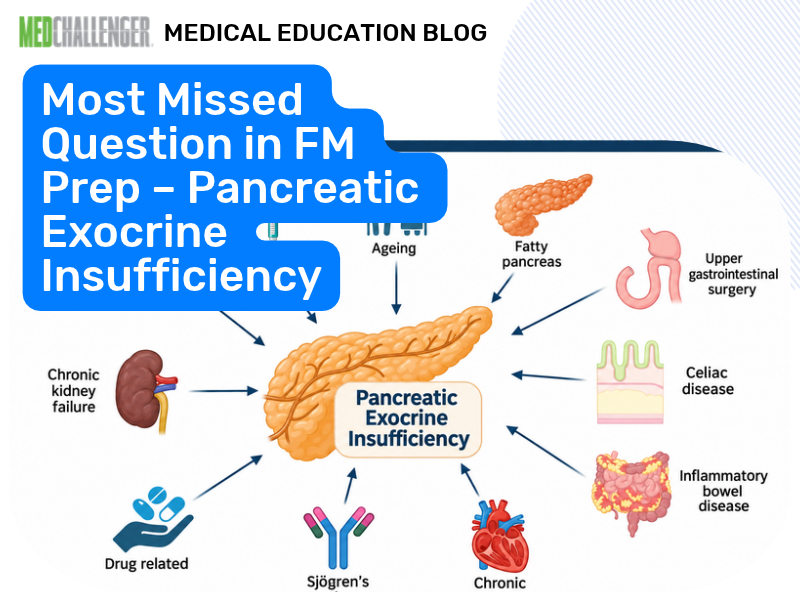
After a Whipple procedure, persistent weight loss with low fat-soluble vitamins despite “enzymes” usually means PERT isn’t being delivered effectively—optimize formulation and add acid suppression.

A 52-year-old man is evaluated for weight loss. He underwent pylorus-sparing pancreaticoduodenectomy (Whipple resection) for pancreatic cancer 9 months ago and experienced an initial 20-pound weight loss during the immediate postoperative period.
Over the past 6 months, he has continued to lose weight despite having a good appetite. He denies any abdominal pain, but he does have mild bloating and 3 to 4 semisolid stools per day. His current medications include daily aspirin 81 mg, daily hydrochlorothiazide 25 mg, unencapsulated pancreatic enzymes containing 60,000 units of lipase with each meal, and simvastatin 20 mg at bedtime.
Laboratory studies are as follows:
Which of the following measures will help the most with his ongoing weight loss?
Answer Options:
Persistent weight loss, bloating, frequent semisolid stools, low albumin, and deficiencies in vitamins A and D (plus iron deficiency) strongly suggest ongoing fat malabsorption from pancreatic exocrine insufficiency (PEI) after pancreaticoduodenectomy. He is already taking “60,000 units of lipase with meals,” which is often within an acceptable therapeutic range—yet he remains malabsorptive, implying delivery/activation failure rather than simply “not enough units.”
Boards often test the practical optimization sequence for PERT: use an enteric-coated (encapsulated) formulation, ensure it’s taken with meals, and if response is inadequate, add acid suppression (PPI or H2 blocker) to prevent acid-mediated inactivation and improve duodenal pH for enzyme activity. This approach is consistent with modern expert guidance (e.g., AGA CPU on EPI 2023; NCCN supportive care recommendations in pancreatic cancer; recent European consensus/practical guidance).
Why This Family Medicine Question Is Frequently Missed
| Option | What It Tests / Implies | Why It’s Wrong Here |
|---|---|---|
| decreasing total fat intake | Old-school management of steatorrhea by fat restriction | Worsens weight loss and does not address the core issue; standard care is adequate calories + effective PERT and vitamin repletion, not fat avoidance. |
| doubling his current dose of pancreatic enzymes | “More units fixes malabsorption” | Increasing dose can help in some cases, but the bigger problem is formulation/acid inactivation (unencapsulated enzymes). Guidelines emphasize optimizing formulation + timing + acid suppression before extreme dose escalation. |
| adding cholestyramine | Bile acid diarrhea after ileal disease/resection; post-cholecystectomy diarrhea | The phenotype is fat malabsorption with fat-soluble vitamin deficiency after pancreatic surgery; cholestyramine does not correct pancreatic lipase deficiency. |
| adding a proton pump inhibitor and changing to encapsulated pancreatic enzymes | Evidence-based escalation for inadequate response to PERT | Correct: improves enzyme survival and delivery to the small bowel; directly targets ongoing PEI after Whipple. |
After Whipple, fat-soluble vitamin deficiencies + chronic loose stools = pancreatic exocrine insufficiency; treat with enteric-coated PERT and add a PPI if response is incomplete.
The stem deliberately includes “unencapsulated pancreatic enzymes” to reward examinees who know that formulation and gastric acidity can blunt efficacy. The question isn’t “does he need enzymes?”—it’s “why aren’t they working, and what optimization step most improves outcomes?”
A 60-year-old with chronic pancreatitis has greasy stools and weight loss despite taking enteric-coated pancrelipase with meals. He takes it correctly. What is the best next step?
A 55-year-old s/p Whipple has bloating, weight loss, and chronic diarrhea. Labs show low vitamin D and prolonged INR that corrects with vitamin K. Best diagnosis?
A patient with PEI asks how to take pancrelipase. Best instruction?
A post-Whipple patient on optimized enteric-coated PERT plus PPI still has diarrhea but no fat-soluble vitamin deficiencies; stool is watery and occurs soon after meals. Best next evaluation?
A patient with PEI is on enteric-coated pancrelipase 25,000 lipase units with meals and has persistent steatorrhea. He is taking it correctly. Next step?
Compare two post-Whipple patients: one with fat-soluble vitamin deficiencies and steatorrhea despite enzymes, and another with watery postprandial diarrhea and normal vitamin levels—how would your differential and first management step differ?
Q1: What clinical clue most strongly points to pancreatic exocrine insufficiency on board questions?
A: Fat-soluble vitamin deficiencies (A/D/E/K) plus weight loss and chronic loose/greasy stools, especially after chronic pancreatitis or pancreatic surgery—this is a classic ABFM/ABIM-style pattern.
Q2: When should you add a PPI in suspected PEI?
A: When symptoms persist despite appropriate PERT dosing/timing—acid suppression can improve enzyme activity/delivery, a common testable escalation step (AGA Clinical Practice Update 2023).
Q3: Why is “unencapsulated enzymes” a red flag in this stem?
A: Non–enteric-coated preparations can be inactivated by gastric acid; switching to enteric-coated capsules improves small-bowel delivery and clinical response.
Q4: Should patients with PEI avoid fat to control symptoms?
A: Strict fat restriction is generally not the preferred exam answer because it worsens weight loss; boards expect adequate calories + effective PERT + vitamin repletion (NCCN supportive care principles; GI best practice).
Find this and other Family Medicine exam prep questions in Med-Challenger Family Medicine Review with CME
Try for free and save. Ace your exams and meet your CME/MOC requirements for just $35 a month!


No matter your program, no matter the size, Med-Challenger for Groups and Institutions can better prepare your program or group, fulfill industry requirements, and increase test scores.
For personal medical education that includes board's prep, MOC, and CME requirements, Med-Challenger has you covered in Family Medicine, Emergency Medicine, Internal Medicine, Pediatrics, Pediatric Emergency Medicine, OBGYN, Physician Assistants, and Nurse Practitioners.
Learn to recognize Ashman phenomenon in AF (long–short cycle wide QRS) and avoid unnecessary VT treatments on board exams.
As a physician assistant student, end-of-rotation exams are a reality. Let's look at some ways to help prepare for them.
Lower-lobe pneumonia often causes RUQ pain in kids. Recognize the mimic and order CXR when the abdomen is benign.