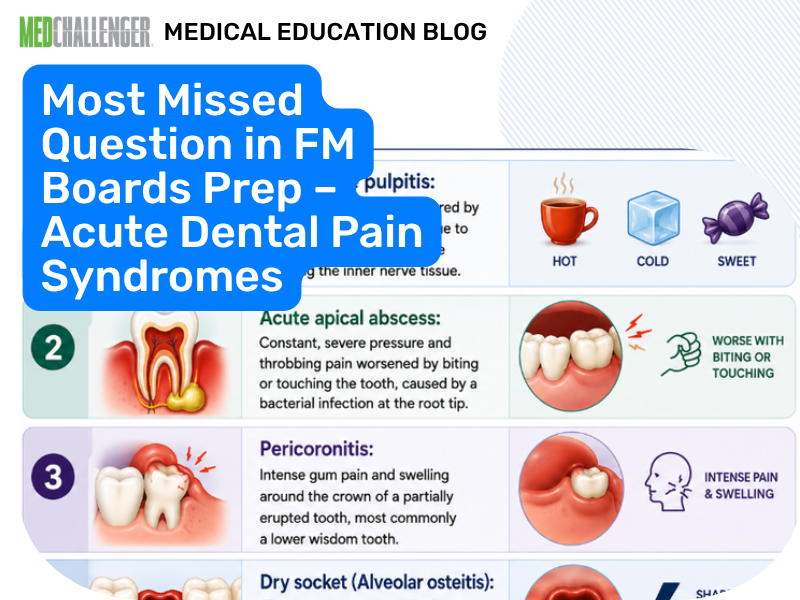
Severe dental pain after a root canal can represent an endodontic flare-up that often requires urgent dental intervention rather than “just more analgesics.”
Question – Oral pain diagnosis
A medical student presents a 52-year-old patient with severe oral pain to you. As you quiz the student on his differential thinking, you mentally rehearse your own differential list of oral pathology/pain syndromes and their typical management.
Which of the following statements is correct?
Answer Options:
A. Cracked tooth and split root syndromes – pain is sudden in onset, constant and unrelenting
B. Root canal pain - no relief from systemic analgesics or anesthetic nerve block; patient’s dentist or endodontist may need to be contacted urgently
C. Gingivitis/periodontitis – antibiotics and dental referral
D. Periodontal abscess versus periapical abscess – abscess formation within the gingiva versus within the pulp of the tooth
E. Immediate periosteitis/acute alveolar osteitis – 24 hours post-extraction loss of blood clot -> cover socket with e.g. Sed-a-Dent, pain medication, refer back to patient’s own dentist/oral surgeon within 24 hours.
This item’s keyed answer (B) is the best choice, though the phrasing “no relief” is too absolute. In current exam-relevant practice, severe pain after endodontic therapy can reflect persistent pulpitis/high intrapulpal pressure or an endodontic “flare-up,” where local anesthesia may be difficult and routine oral analgesics may be insufficient. The key management step is prompt dental/endodontic reassessment (e.g., decompression/re-opening the canal, occlusal adjustment, evaluation for swelling or infection), while clinicians provide temporizing analgesia—typically NSAIDs and/or acetaminophen as first-line per the American Dental Association acute pain guidance (ADA 2024).
Boards also increasingly test antibiotic stewardship: antibiotics are not indicated for uncomplicated dental pain without systemic involvement or spreading infection (ADA/CDC antibiotic stewardship resources, 2019+). If there are systemic signs (fever, malaise), rapidly progressive swelling, trismus, dysphagia, floor-of-mouth elevation, or concern for deep space infection/Ludwig angina, escalation is urgent and antibiotics plus airway-focused evaluation become appropriate.
Why This Family Medicine Question Is Frequently Missed
- Learners overgeneralize “tooth pain = antibiotics,” which conflicts with modern ADA/CDC stewardship (reserve antibiotics for systemic/spreading infection).
- “Root canal pain” is misunderstood as benign post-procedure soreness rather than a possible flare-up needing urgent dental intervention.
- Several options use imprecise anatomic language (gingiva vs pulp vs periapical tissues), tempting test-takers into near-true statements.
What the Distractors Indicate
| Option |
What It Tests / Implies |
Why It’s Wrong Here |
| Cracked tooth and split root syndromes – pain is sudden in onset, constant and unrelenting |
Cracked tooth/split root symptom pattern |
Classic cracked tooth pain is often sharp with biting/temperature, intermittent, and not typically constant/unrelenting. |
| Root canal pain - no relief from systemic analgesics or anesthetic nerve block; patient’s dentist or endodontist may need to be contacted urgently |
Post-endodontic flare-up/pulpal pressure; difficulty achieving analgesia; need for urgent dental contact |
Best option. Statement is directionally correct, though “no relief” is too absolute; key is urgent endodontic reassessment plus evidence-based analgesia. |
| Gingivitis/periodontitis – antibiotics and dental referral |
Gingivitis/periodontitis treatment approach |
Gingivitis/periodontitis are primarily inflammatory plaque-related diseases; antibiotics aren’t routine first-line unless acute necrotizing infection/systemic spread—so this is overbroad. |
| Periodontal abscess versus periapical abscess – abscess formation within the gingiva versus within the pulp of the tooth. |
Anatomy: periodontal vs periapical abscess |
Periodontal abscess involves periodontal pocket/gingival tissues; periapical abscess involves periapical tissues secondary to pulpal necrosis, not “within the pulp” as written. |
| Immediate periosteitis/acute alveolar osteitis – 24 hrs post-extraction loss of blood clot -> cover socket with e.g. Sed-a-Dent, pain medication, refer back to patient’s own dentist/oral surgeon within 24 hours. |
Timing/definition of dry socket |
Alveolar osteitis (dry socket) typically presents 2–5 days post-extraction with exposed bone/foul odor; not usually at 24 hours, and “immediate periosteitis” is not standard board terminology. |
High-Yield Pearl for Family Medicine Exam Prep
When dental pain is severe after a root canal and seems refractory, think endodontic flare-up requiring urgent dental management, not empiric antibiotics.
Core Learning Objectives
- Differentiate common dental pain syndromes (cracked tooth, periapical/periodontal abscess, post-endodontic pain, alveolar osteitis) by timeline and anatomy.
- Choose initial management that matches modern standards: NSAID±acetaminophen first-line and antibiotics only for systemic/spreading infection with timely dental referral.
The “Test Trick” at Play
The stem asks for the “correct” statement, but several options are “almost” right while containing a single anatomic or timeline error (periapical vs pulp; dry socket timing). Boards reward identifying the least wrong, most clinically actionable choice—here, urgent endodontic contact for severe post–root canal pain.
Additional FM Practice Questions and Remediation for Acute Dental Pain
Family Medicine Practice Question 1 - Dry socket timing
A 34-year-old has worsening pain and foul breath 3 days after molar extraction. Socket looks empty with exposed bone. Best next step?
- A. Start amoxicillin-clavulanate for 10 days
- B. Irrigate the socket and place medicated dressing; arrange dental follow-up
- C. Immediate incision and drainage of gingiva
- D. High-dose opioids only and reassure
- E. CT neck with contrast emergently in all cases
Family Medicine Practice Question 2 - Antibiotic stewardship
A 49-year-old with localized toothache from suspected irreversible pulpitis has no fever, no facial swelling, and normal vitals. Best treatment in primary care while awaiting dentist?
- A. NSAID plus acetaminophen and urgent dental referral
- B. Clindamycin and chlorhexidine rinse
- C. Prednisone burst
- D. Metronidazole monotherapy
- E. Admission for IV antibiotics
Family Medicine Practice Question 3 - Periodontal vs periapical
A patient has a fluctuant swelling along the gingival margin with a deep periodontal pocket and relatively normal tooth percussion. Most likely diagnosis?
- A. Periapical abscess
- B. Periodontal abscess
- C. Trigeminal neuralgia
- D. Aphthous ulcer
- E. Temporomandibular joint disorder
Family Medicine Practice Question 4 - Cracked tooth clue
A 56-year-old has sharp pain only when biting on one tooth, especially on release, and intermittent cold sensitivity. No facial swelling or fever. Best explanation?
- A. Cracked tooth syndrome
- B. Acute necrotizing ulcerative gingivitis
- C. Ludwig angina
- D. Peritonsillar abscess
- E. Acute alveolar osteitis
Family Medicine Practice Question 5 - Red flags for deep space infection
A 61-year-old with dental pain now has fever, trismus, muffled voice, and floor-of-mouth induration. Best next step?
- A. Discharge with oral penicillin and outpatient dental follow-up
- B. NSAIDs and reassurance
- C. Emergency evaluation for deep neck space infection/airway risk; start IV antibiotics per local protocol
- D. Chlorhexidine rinse only
- E. Treat as migraine
Mini Case Discussion Prompt
How would your triage and treatment differ between (1) localized pulpitis without swelling, (2) periapical abscess with localized vestibular swelling, and (3) floor-of-mouth swelling with dysphagia and trismus?
Mini-FAQ
Q1: When do boards expect antibiotics for dental pain?
A: Typically only when there are signs of systemic involvement or spreading infection (fever, cellulitis, progressive swelling, deep space infection concern), consistent with ADA/CDC stewardship expectations.
Q2: What’s first-line analgesia for acute dental pain?
A: The ADA (2024) emphasizes NSAIDs (often with acetaminophen) as first-line; opioids are reserved for select cases and usually short duration.
Q3: What distinguishes dry socket from normal post-extraction pain?
A: Dry socket usually worsens 2–5 days after extraction, may have foul odor and exposed bone, and improves with irrigation/medicated dressing.
Q4: Why can “root canal pain” be hard to anesthetize?
A: Inflamed pulpal/periapical tissues can create an “anesthetic failure” scenario; definitive relief often requires endodontic intervention (decompression/re-evaluation), not just escalating oral meds.
Find this and other Family Medicine exam prep questions in Med-Challenger Family Medicine Review with CME
Try for free and save. Ace your exams and meet your CME/MOC requirements for just $35 a month!

No matter your program, no matter the size, Med-Challenger for Groups and Institutions can better prepare your program or group, fulfill industry requirements, and increase test scores.
For personal medical education that includes board's prep, MOC, and CME requirements, Med-Challenger has you covered in Family Medicine, Emergency Medicine, Internal Medicine, Pediatrics, Pediatric Emergency Medicine, OBGYN, Physician Assistants, and Nurse Practitioners.
Never miss a thing. Subscribe to our blog and save!