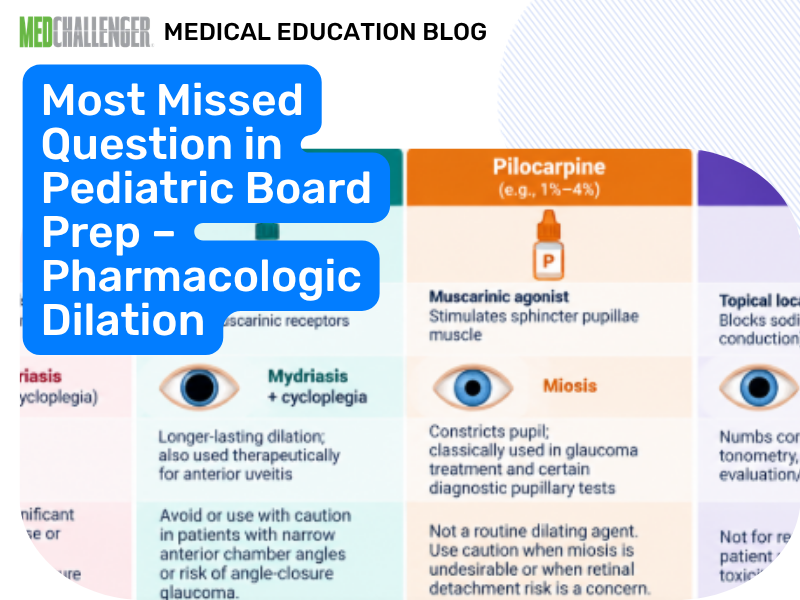
For a brief peripheral retinal exam (when dilation is permissible), choose a short-acting mydriatic—among these options, phenylephrine is the only appropriate agent.
Question – Retinal dilation
If the patient does not have narrow angle glaucoma or brain injury requiring ongoing evaluation of the pupils, he or she may be briefly dilated to view the peripheral retina via __.
Answer Options:
A. 1% pilocarpine
B. 2.5% phenylephrine
C. homatropine drops
D. proparacaine drops
The originally keyed answer (2.5% phenylephrine) is acceptable as the best choice from this option set, but the provided rationale is partly inaccurate/outdated: atropine is not short-acting (it produces prolonged mydriasis/cycloplegia, especially in children) and is generally not a “brief exam” drop. In current common practice for diagnostic dilation, tropicamide (short-acting antimuscarinic) is a standard choice and is often paired with phenylephrine to improve dilation—however, tropicamide is not offered here.
Why phenylephrine 2.5% fits: it is an α1-agonist mydriatic that dilates via iris dilator muscle contraction, with a transient effect relative to the longer-acting cycloplegics. By contrast, homoatropine is an antimuscarinic cycloplegic with longer duration than typical diagnostic agents like tropicamide, making it less ideal for “brief” dilation. AAO Preferred Practice Pattern guidance supports the general approach: dilation is typically performed with adrenergic and/or antimuscarinic agents, and must be avoided/used cautiously in those at risk for angle closure (AAO PPP Comprehensive Eye Evaluation 2020; AAO PPP Primary Angle Closure 2020).
Why This Pediatric Medicine Question Is Often Missed
- Many learners conflate mydriasis (phenylephrine) with cycloplegia (antimuscarinics like homatropine/atropine) and assume any “dilator” is equivalent.
- The stem’s exclusions (narrow angles; neuro pupillary monitoring) are classic test-writers’ cues that dilation is now allowed.
- The remediation’s mention of “short-acting atropine” can mislead—boards expect you to know atropine is long-acting, especially in pediatrics.
What the Distractors Indicate
| Option |
What It Tests / Implies |
Why It’s Wrong Here |
| 1% pilocarpine |
Recognizing miotics |
Pilocarpine is a muscarinic agonist → miosis; used in glaucoma contexts, not to dilate. |
| 2.5% phenylephrine |
Short-acting diagnostic mydriasis |
Best available brief mydriatic in the list; commonly used alone or with a short-acting antimuscarinic (e.g., tropicamide—not offered). |
| homatropine drops |
Cycloplegic vs mydriatic duration |
Antimuscarinic cycloplegic with longer duration, less ideal for a “brief” diagnostic dilation. |
| proparacaine drops |
Topical anesthesia vs dilation |
Local anesthetic for corneal procedures/tonometry; does not dilate pupils. |
High-Yield Pearl for Exam Prep
If dilation is permitted, pick a mydriatic (phenylephrine) for brief dilation; avoid miotics (pilocarpine) and recognize cycloplegics (homoatropine/atropine) last longer.
Core Learning Objectives
- Distinguish mydriatics (e.g., phenylephrine) from miotics (pilocarpine) and cycloplegics (homoatropine/atropine) in eye exam pharmacology.
- Apply exam-stem exclusions (e.g., narrow angle risk, need for serial neuro pupil checks) to decide when pupillary dilation is appropriate.
The Exam “Test Trick” at Play
The stem “clears” two classic contraindications/avoidances—angle-closure risk and neuro pupil monitoring—to push you toward the diagnostic dilation choice. The trap is picking any “eye drop you recognize” rather than the one that actually causes mydriasis and is reasonably short-acting for an exam.
Additional Practice Questions and Remediation for Ophthalmic Dilation/Exam Drops
Pediatric Medicine Practice Question 1 - Neuro monitoring
A 7-year-old with severe TBI in the ICU needs hourly pupil checks. Which is the best approach regarding dilating drops?
- A. Give phenylephrine now for retinal exam
- B. Avoid dilation because it interferes with serial neuro pupil assessment
- C. Use homatropine because it is reversible
- D. Use pilocarpine to improve visualization
- E. Use proparacaine to dilate without affecting pupils
Pediatric Medicine Practice Question 2 - Mechanism recognition
Which medication produces mydriasis primarily via α1-adrenergic agonism?
- A. Tropicamide
- B. Phenylephrine
- C. Pilocarpine
- D. Atropine
- E. Proparacaine
Pediatric Medicine Practice Question 3 - Identifying a miotic
A patient was mistakenly given a drop that caused marked miosis, making fundus exam harder. Which drug most likely was used?
- A. Pilocarpine
- B. Phenylephrine
- C. Tropicamide
- D. Homatropine
- E. Proparacaine
Pediatric Medicine Practice Question 4 - “Brief dilation” choice
For a routine outpatient funduscopic exam where brief dilation is desired, which combination is commonly used (if available) to maximize dilation while remaining relatively short-acting?
- A. Atropine + pilocarpine
- B. Tropicamide + phenylephrine
- C. Homatropine + atropine
- D. Proparacaine + pilocarpine
- E. Timolol + brimonidine
Pediatric Medicine Practice Question 5 - Contraindication cue
An adult with severe eye pain, halos around lights, headache, and vomiting presents with a fixed mid-dilated pupil and elevated IOP. What is the best next step regarding further dilation?
- A. Dilate with phenylephrine to examine the periphery
- B. Dilate with tropicamide to confirm the diagnosis
- C. Avoid further pharmacologic dilation and treat suspected acute angle-closure glaucoma
- D. Give homatropine for pain control
- E. Give proparacaine and discharge
Mini Case Discussion Prompt
How would your approach to pupillary dilation differ between (1) suspected retinal detachment requiring peripheral exam, (2) suspected acute angle-closure glaucoma, and (3) a child with head trauma requiring serial pupil checks?
Mini FAQ
Q1: Why does the stem mention narrow-angle glaucoma?
A: Boards expect you to recognize dilation can precipitate/worsen angle closure in susceptible patients (AAO PPP Primary Angle Closure 2020).
Q2: Why avoid dilation in brain injury?
A: ABP/board-style test logic: dilation confounds serial neurologic examinations of pupillary size/reactivity used to detect herniation or worsening ICP.
Q3: Is phenylephrine alone enough for a good dilation?
A: Often it’s paired with a short-acting antimuscarinic (commonly tropicamide) for stronger dilation; on exams, if tropicamide isn’t listed, phenylephrine is usually the best mydriatic option.
Q4: What’s the key medication-duration pitfall?
A: Atropine and other cycloplegics can be long-acting, especially in pediatrics—boards test that they are not “brief exam” agents.
Find this and other Pediatric Medicine exam prep questions in Med-Challenger Pediatric Medicine Exam Review with CME
Try for free and save. Ace your exams and meet your CME/MOC requirements for just $35 a month!
/PEDS%20CHALLENGER.png?width=250&height=218&name=PEDS%20CHALLENGER.png)
No matter your program, no matter the size, Med-Challenger for Groups and Institutions can better prepare your program or group, fulfill industry requirements, and increase test scores.
For personal medical education that includes board's prep, MOC, and CME requirements, Med-Challenger has you covered in Family Medicine, Emergency Medicine, Internal Medicine, Pediatrics, Pediatric Emergency Medicine, OBGYN, Physician Assistants, and Nurse Practitioners.
Never miss a thing. Subscribe to our blog and save!