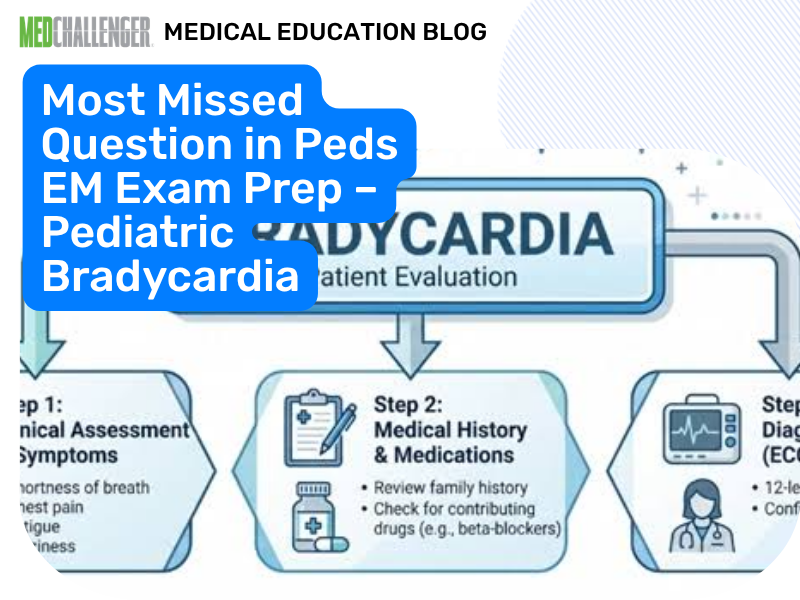
If a child’s heart rate stays <60/min with signs of poor perfusion despite adequate ventilation/oxygenation, begin CPR immediately per PALS.
Question – Bradycardia step
A grandfather brings his 14 mo grandson to the ED for altered mental status. He does not know any of the child’s past medical history. The patient appears pale and lethargic with shallow respirations. VS: T 37.2 ºC HR 52 RR18 BP 66/38 SpO2 93% on RA. His blood sugar is 76 mg/dL. You immediately begin positive pressure ventilation and there is no improvement in clinical status.
Which of the following is the most appropriate next step?
Answer Options:
A. Administer D10 bolus
B. Start CPR
C. Administer atropine
D. Start transthoracic pacing
In pediatrics, bradycardia is often secondary to hypoxia, but this stem explicitly tells you that positive pressure ventilation has already been initiated with no improvement and the child remains clinically compromised (altered, hypotensive, poor perfusion). Under the AHA Pediatric Advanced Life Support Guidelines Update (2020), when HR <60/min with cardiopulmonary compromise persists despite adequate oxygenation/ventilation, the next step is to start CPR (chest compressions).
This is frequently missed on boards because test-takers anchor on “bradycardia → atropine” or “altered infant → glucose,” but PALS prioritizes perfusion: once you’ve addressed ventilation and the HR is still <60 with signs of shock, you treat it like impending arrest—compressions first, then epinephrine and cause-directed therapy.
Why This Pediatric Emergency Medicine Question Is Often Missed
- Learners delay compressions while cycling through medications (atropine) that are not first-line in most pediatric bradycardia.
- Confusion between symptomatic bradycardia (adult ACLS mindset) versus PALS threshold: HR <60 + poor perfusion triggers compressions.
- “Blood sugar 76” tempts unnecessary dextrose; it is not hypoglycemia in a 14-month-old.
What the Distractors Indicate
| Option |
What It Tests / Implies |
Why It’s Wrong Here |
| Administer D10 bolus |
Treating hypoglycemia as a reversible cause |
Glucose 76 mg/dL is not hypoglycemia; and the immediate algorithmic step after failed ventilation with HR<60/poor perfusion is CPR, not dextrose. |
| Start CPR |
Correct PALS bradycardia escalation |
AHA PALS 2020: HR <60/min with poor perfusion despite oxygenation/ventilation → begin CPR. |
| Administer atropine |
Bradycardia from ↑vagal tone or primary AV block |
Atropine is not first-line for most pediatric bradycardia; consider only for specific etiologies (e.g., vagal/AV block) and typically after CPR has started if unstable. |
| Start transthoracic pacing |
Electrical therapy for refractory bradycardia |
Pacing is a consideration for refractory bradycardia (e.g., high-grade AV block) but not before initiating CPR in an infant/toddler with HR<60 and shock. |
High-Yield Pearl for Exam Prep
In PALS, HR <60/min + poor perfusion after effective ventilation = start CPR, then give epinephrine and treat reversible causes.
Core Learning Objectives
- Apply the AHA PALS bradycardia algorithm to identify when CPR is indicated in infants and children.
- Differentiate cause-directed therapies (e.g., atropine, pacing, dextrose) from the immediate resuscitative step required for bradycardia with shock.
The Exam “Test Trick” at Play
The stem baits you with “shallow respirations” and a borderline oxygen saturation to make you think ventilation alone should fix it—then explicitly says ventilation did not improve the clinical status. Once that box is checked and the child remains hypotensive/altered with HR 52, boards expect you to recognize the PALS threshold and initiate CPR immediately, rather than chasing secondary interventions.
Additional Peds EM Practice Questions and Remediation for Pediatric Bradycardia
Pediatric Emergency Medicine Practice Question 1 - Post-intubation bradycardia
A 2-year-old becomes bradycardic to 55/min immediately after laryngoscopy. He is pale with weak pulses. You provide effective ventilation with 100% O₂, but HR remains 55/min. Next best step?
- A. Atropine 0.02 mg/kg IV
- B. Start CPR
- C. Synchronized cardioversion
- D. Normal saline bolus only
- E. Transcutaneous pacing immediately
Pediatric Emergency Medicine Practice Question 2 - When atropine matters
A 9-year-old develops sudden bradycardia to 40/min during suctioning of an endotracheal tube. He is hypotensive. Ventilation is adequate and chest compressions have been started. Which medication is most specifically indicated for this mechanism?
- A. Atropine
- B. Adenosine
- C. Amiodarone
- D. Procainamide
- E. Verapamil
Pediatric Emergency Medicine Practice Question 3 - Dextrose indication
An 11-month-old is lethargic with HR 90/min, normal BP, and capillary glucose 38 mg/dL. Airway and breathing are supported. Best next step?
- A. D10W 5 mL/kg IV/IO bolus
- B. Start CPR
- C. Atropine
- D. Transcutaneous pacing
- E. Sodium bicarbonate
Pediatric Emergency Medicine Practice Question 4 - Refractory bradycardia sequence
A 6-year-old with severe asthma decompensates, becomes bradycardic to 50/min with weak pulses. Effective ventilation is ongoing; CPR has started. The next medication per PALS bradycardia algorithm is:
- A. Lidocaine
- B. Epinephrine
- C. Magnesium sulfate
- D. Dopamine infusion only
- E. Diltiazem
Pediatric Emergency Medicine Practice Question 5 - Pacing nuance
A 13-year-old has bradycardia (HR 35/min) due to complete heart block after cardiac surgery. He is hypotensive despite oxygenation/ventilation and CPR/epinephrine. Next best targeted therapy?
- A. Adenosine
- B. Sotalol
- C. Transcutaneous pacing
- D. Defibrillation
- E. Valsalva maneuver
Mini Case Discussion Prompt
Compare management of (1) an infant with HR 55/min and poor perfusion after adequate ventilation versus (2) an adolescent with HR 45/min, normal perfusion, and athletic baseline—how do your immediate actions differ and why?
Mini-FAQ
Q1: What is the PALS threshold for starting CPR in bradycardia?
A: The AHA PALS algorithm expects you to start CPR when HR <60/min with signs of poor perfusion despite adequate oxygenation and ventilation.
Q2: When should atropine be used for pediatric bradycardia?
A: Primarily when the bradycardia is due to increased vagal tone or primary AV block; on exams it should not delay CPR when the child is unstable.
Q3: Does a glucose of 76 mg/dL require dextrose in a 14-month-old with AMS?
A: No—this is not hypoglycemia. The boards expect algorithmic stabilization first (ventilation/CPR as indicated), then evaluation for other causes.
Q4: When is transcutaneous pacing appropriate in children?
A: Consider pacing for refractory bradycardia, especially with high-grade AV block, typically after initiating CPR and giving epinephrine per PALS.
Find this and other Pediatric Emergency Medicine exam prep questions in Med-Challenger Pediatric Emergency Medicine 3rd Edition Exam Review with CME
Try for free and save. Ace your exams and meet your CME/MOC requirements.