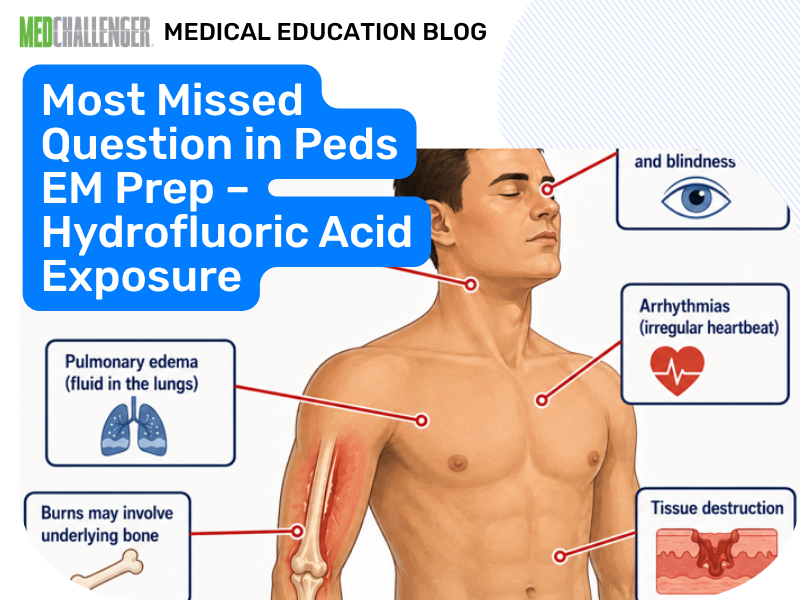
Key takeaway: Hydrofluoric acid burns can look deceptively mild but cause life-threatening hypocalcemia—classically producing QT prolongation on ECG.
Question – ECG finding
A 15 yo boy presents to the ED complaining of bilateral finger pain. Earlier in the day, he had spent several hours cleaning the rust off the hubcaps of his family’s car and then started having some mild pain in his fingers. However, his pain has steadily increased in intensity over the past several hours and he complains that his pain is the worst pain he has ever experienced. In the ED, his T 37.6°C HR 100 RR 12. His hands are not swollen but are grayish in color and extremely tender to palpation. As part of the evaluation, an ECG was obtained.
Which of the following ECG findings is the most consistent with this patient’s injury?
Answer Options:
- A. J wave
- B. Peaked T waves
- C. QRS prolongation
- D. QT prolongation
This is a classic hydrofluoric acid (HF) exposure scenario: delayed onset pain that becomes severe and out of proportion to exam, after cleaning rust/hubcaps (common HF-containing wheel/rust cleaners). The fluoride ion penetrates tissue and chelates calcium (and magnesium), leading to systemic toxicity. On boards, the highest-yield ECG association is hypocalcemia → prolonged QT interval with risk of ventricular dysrhythmias.
Current consensus toxicology/poison-control guidance (e.g., CDC/ATSDR HF medical management guidance) supports cardiac monitoring and aggressive correction of electrolyte abnormalities—especially calcium repletion (topical/intradermal/local calcium for pain and tissue binding; IV calcium for systemic toxicity or ECG/lab abnormalities). The stem is built to cue that the “finger pain + wheel cleaner + delayed severe pain” mechanism is fluoride-mediated hypocalcemia, so QT prolongation is the best match.
Why This Pediatric Emergency Medicine Question Is Often Missed
- HF is mistakenly treated like a “routine acid burn,” but the exam tests systemic electrolyte toxicity rather than surface appearance.
- Learners anchor on “pain” and pick hyperkalemia patterns (peaked T waves), missing that HF more classically triggers hypocalcemia → QT prolongation.
- The stem’s key clue is wheel/rust cleaner + delayed pain + gray discoloration—a toxidrome-style recognition task.
What the Distractors Indicate
| Option |
What It Tests / Implies |
Why It’s Wrong Here |
| J wave |
Hypothermia (Osborn waves) |
Patient is normothermic; exposure history points to HF. |
| Peaked T waves |
Hyperkalemia |
HF toxicity can involve K/Mg/Ca abnormalities, but the classic board-tested ECG finding is hypocalcemia → QT prolongation. |
| QRS prolongation |
Sodium channel blockade (e.g., TCAs, class I antiarrhythmics) |
Mechanism doesn’t fit; HF primarily causes Ca/Mg chelation with QT effects rather than QRS widening. |
| QT prolongation |
Hypocalcemia (also hypomagnesemia) |
Matches fluoride chelation physiology and the high-yield ECG association in HF exposures. |
High-Yield Pearl for Exam Prep
Wheel/rust cleaner exposure + delayed, disproportionate pain = HF burn → think hypocalcemia and look for QT prolongation.
Core Learning Objectives
- Recognize clinical clues for hydrofluoric acid dermal exposure and anticipate systemic toxicity despite minimal initial skin findings.
- Identify the most likely ECG abnormality of HF-associated hypocalcemia and connect it to immediate ED priorities (monitoring + calcium therapy).
The Exam “Test Trick” at Play
This item rewards toxidrome recognition: the “cleaning rust off hubcaps” clue is more important than the skin exam. Boards often test HF by pairing a deceptively mild burn appearance with escalating pain and then asking for the downstream systemic consequence—QT prolongation from hypocalcemia—rather than local burn staging.
Additional Peds EM Practice Questions and Remediation for Hydrofluoric Acid (HF) Toxicity
Pediatric Emergency Medicine Practice Question 1 — Wheel cleaner burn
A 22-year-old detailer spills wheel cleaner on his forearm. Pain is initially mild but becomes severe 4 hours later. ECG shows QT prolongation. Next best immediate management step?
- A. Activate charcoal administration
- B. Begin calcium therapy and continuous cardiac monitoring
- C. Administer sodium bicarbonate for QRS narrowing
- D. Give insulin/glucose for presumed hyperkalemia
- E. Treat with naloxone for altered mental status
Pediatric Emergency Medicine Practice Question 2 - Key electrolyte abnormality
After an HF fingertip exposure, which electrolyte abnormality most directly explains QT prolongation?
- A. Hypernatremia
- B. Hypocalcemia
- C. Hypercalcemia
- D. Hyperchloremia
- E. Respiratory alkalosis
Pediatric Emergency Medicine Practice Question 3 - Exposure clue recognition
Which household/work exposure is most suggestive of HF risk in the ED history?
- A. Drain opener (lye)
- B. Aluminum/steel wheel brightener or rust remover
- C. Household bleach (sodium hypochlorite)
- D. Vinegar (acetic acid)
- E. Laundry detergent pods
Pediatric Emergency Medicine Practice Question 4 - ECG interpretation
A patient with suspected HF exposure has muscle cramps and perioral numbness. Which ECG change would you most expect?
- A. J (Osborn) waves
- B. Prolonged QT interval
- C. Short PR interval with delta wave
- D. ST elevations in contiguous leads
- E. Brugada pattern
Pediatric Emergency Medicine Practice Question 5 - Treatment route nuance
A 17-year-old has a small HF burn to the fingertip with severe pain but stable vitals and normal ECG. Best targeted therapy for pain/toxin binding at the site?
- A. Topical steroid cream
- B. Topical calcium gluconate gel applied and reassessed
- C. Topical lidocaine only
- D. Silver sulfadiazine alone
- E. Ice-water immersion for 60 minutes
Mini Case Discussion Prompt
How would your management change between (1) a small fingertip HF exposure with normal ECG and (2) a larger surface-area exposure with QT prolongation and muscle cramps—specifically regarding topical vs IV calcium and monitoring?
Mini-FAQ
Q1: Why does HF cause such severe pain with little visible swelling early on?
A: Fluoride ions penetrate deeply and disrupt tissue and nerves; the ABIM/EM boards expect recognition that pain can be delayed and disproportionate to the initial skin findings.
Q2: What ECG abnormality is most classically tested with HF exposures?
A: QT prolongation from hypocalcemia (and sometimes hypomagnesemia); exam writers use this to force linkage from exposure → electrolyte derangement → ECG risk.
Q3: When should you escalate beyond topical therapy?
A: With significant exposures, persistent/worsening pain, abnormal ECG, or lab-confirmed electrolyte disturbances—boards expect “monitor + IV calcium” when systemic toxicity is suspected (per CDC/ATSDR HF medical management guidance).
Q4: Why isn’t “peaked T waves” the best single answer here?
A: Hyperkalemia can occur in severe poisoning, but the canonical board association for HF is calcium chelation → hypocalcemia → prolonged QT.
Find this and other Pediatric Emergency Medicine exam prep questions in Med-Challenger Pediatric Emergency Medicine 3rd Edition Exam Review with CME
Try for free and save. Ace your exams and meet your CME/MOC requirements.