family medicine
July 25, 2024 Customer Newsletter
Cyberattack on Hospitals Endangers Patients, Mixed Reactions to Federal Maternal Care Standards, Regulatory Framework for Cannabis, 10% Off in 3...
Holiday heart AF is usually stable and self-limited. Focus on supportive care, trigger correction, and rate control as needed—not routine cardioversion.
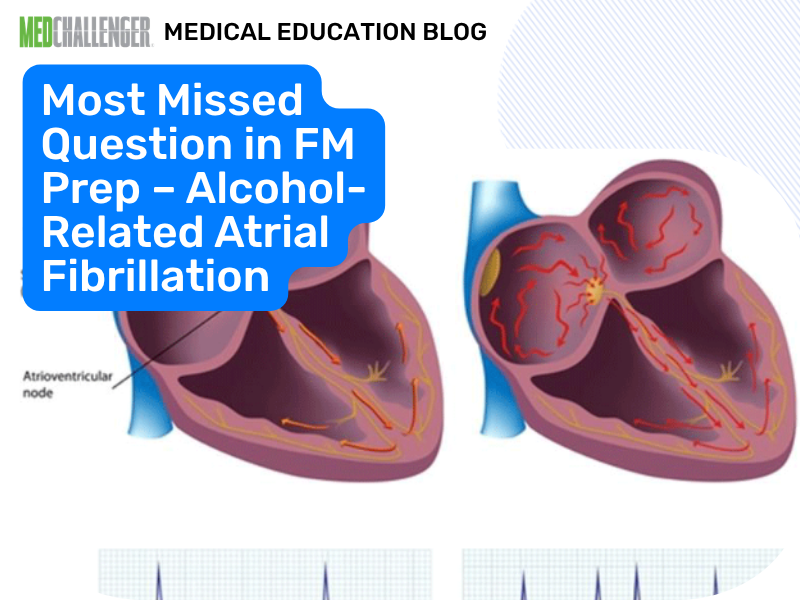
Stable “holiday heart” AF is usually treated with supportive care and correction of reversible triggers (often spontaneous conversion), not routine immediate cardioversion.

Atrial fibrillation (AF) is a commonly encountered dysrhythmia; so, when a patient in AF presents to a health care professional, he or she needs to initially determine whether the patient's overall condition is stable or unstable. Determining whether the AF is chronic or of new onset is also important.
The differential diagnosis for causes of new-onset AF is broad and includes a number of potentially life-threatening conditions. Underlying conditions that may cause AF include myocardial ischemia, hypoxia, chronic pulmonary disease, valvular heart disease (especially mitral valve), hypertensive heart disease, thyrotoxicosis, pulmonary embolus, electrolyte disturbances, myocarditis/pericarditis, hypertrophic cardiomyopathy, and intoxicants (eg, ethanol, cocaine, amphetamines).
Which of the following is the most appropriate intervention for new-onset AF associated with an alcohol binge, also known as the "holiday heart" syndrome?
Answer Options:
A. Cardiovert all patients with < 24-hour history of new-onset AF.Holiday heart syndrome is AF triggered by acute alcohol excess, often accompanied by dehydration, catecholamine surge, sleep deprivation, vomiting, and electrolyte shifts. Per major AF guidance (e.g., ACC/AHA/ACCP/HRS 2023; ESC 2020), initial priorities in new-onset AF are (1) hemodynamic stability, (2) identifying/treating reversible triggers, and (3) rate control when needed—recognizing that many stable patients convert spontaneously.
Among the options provided, supportive care with IV fluids best reflects “treat the trigger” management. The stem’s inclusion of thiamine before dextrose is not an AF-guideline requirement, but it is a common board-relevant toxicology/addiction medicine safety step for patients with heavy alcohol use who may be malnourished or at risk for Wernicke encephalopathy (context supported by addiction medicine guidance such as ASAM 2020). In practice and on exams, the key is: don’t reflexively cardiovert stable holiday-heart AF; stabilize, rehydrate, correct electrolytes, and control rate if needed.
| Option | What It Tests / Implies | Why It’s Wrong Here |
|---|---|---|
| Cardiovert all patients with < 24-hour history of new-onset AF. | Early cardioversion for AF <48h | Not indicated for stable holiday-heart AF; guidelines prioritize stability/rate control/trigger correction. Cardioversion is reserved for instability or selected symptomatic patients after appropriate evaluation. |
| Check serum magnesium level and give magnesium sulfate supplementation if serum level is low. | Magnesium-check-first approach | Alcohol use can be associated with total-body Mg deficit, but “check level then treat only if low” is too narrow; supportive care/trigger correction is primary, and Mg repletion may be empiric depending on context. |
| Provide intravenous hydration, ensuring that thiamine is administered before giving dextrose-containing fluids. | Supportive care; alcohol-use precautions | Best match to guideline-consistent concept: correct precipitant(s) and support physiologic recovery; thiamine step is conditional but commonly tested with heavy alcohol use. |
| Administer intravenous sodium bicarbonate 1 mEq/kg. | Sodium bicarbonate for toxicologic dysrhythmia | Not a treatment for AF from alcohol binge; used in specific poisonings (e.g., sodium channel blockade) or severe metabolic derangements. |
| Load the patient with intravenous phenytoin 17 mg/kg at a rate < 25 mg/minute. | Phenytoin loading for arrhythmia | Phenytoin is not an AF treatment; inappropriate and potentially harmful/delaying correct care. |
Stable “holiday heart” AF is usually managed with supportive care + correction of reversible triggers (often spontaneous conversion) rather than routine cardioversion.
This item tests whether you can resist the impulse to apply a blanket AF algorithm (e.g., “cardiovert because it’s new”) and instead recognize a classic reversible precipitant where supportive measures and time often resolve the rhythm—while still remembering real-world safety steps for heavy alcohol use patients.
A 68-year-old with AF and RVR is hypotensive (BP 78/40), confused, and diaphoretic. What is the most appropriate next step?
A 34-year-old presents after a weekend binge; ECG shows AF, HR 120, BP 128/76, normal mentation, no chest pain, no heart failure signs. Best initial management?
A stable patient has AF onset clearly 72 hours ago. You are considering elective cardioversion. What must be addressed before cardioversion?
A patient with new AF is febrile, tachypneic, and hypoxic with a right lower lobe infiltrate. Best next step alongside AF management?
A stable patient with AF and RVR has HFrEF (EF 25%) and pulmonary edema. Which rate-control agent is preferred?
How would your management differ between (1) stable holiday-heart AF likely <24 hours in a young patient and (2) stable AF of unknown duration in an older patient with multiple stroke risk factors?
Q1: When does the ABFM/ABIM expect immediate cardioversion in AF?
A: When AF causes hemodynamic instability (hypotension, shock, ischemia, acute heart failure, altered mental status), synchronized cardioversion is the exam-standard move (ACC/AHA/HRS 2023 principles).
Q2: Why isn’t routine cardioversion the best answer in holiday heart?
A: Because the rhythm is often trigger-mediated and self-limited; boards reward correcting the precipitant (fluids/electrolytes/withdrawal) and reserving cardioversion for instability or persistent severe symptoms.
Q3: Is “thiamine before dextrose” required for AF management?
A: Not for AF itself; it’s a commonly tested safety measure in patients with heavy alcohol use/malnutrition risk to prevent Wernicke encephalopathy (ASAM 2020 guidance context).
Q4: Should you always check magnesium in alcohol-related AF?
A: Magnesium abnormalities are common, but AF guidelines emphasize treating reversible causes broadly; empiric repletion may be reasonable in selected patients while you address dehydration/withdrawal and other triggers.
Find this and other Family Medicine exam prep questions in Med-Challenger Family Medicine Review with CME
Try for free and save. Ace your exams and meet your CME/MOC requirements for just $35 a month!



No matter your program, no matter the size, Med-Challenger for Groups and Institutions can better prepare your program or group, fulfill industry requirements, and increase test scores.
For personal medical education that includes board's prep, MOC, and CME requirements, Med-Challenger has you covered in Family Medicine, Emergency Medicine, Internal Medicine, Pediatrics, Pediatric Emergency Medicine, OBGYN, Physician Assistants, and Nurse Practitioners.
Cyberattack on Hospitals Endangers Patients, Mixed Reactions to Federal Maternal Care Standards, Regulatory Framework for Cannabis, 10% Off in 3...
DEA moves to reclassify marijuana, fulfill MOC needs, providers have questions regarding AI and patient care, and nursing program enrollment down
Lack of Primary Care linked to increased surgeries, AI in Vascular Medicine, things get easier still for IMGs, and Complete EM prep, CME, and MOC...