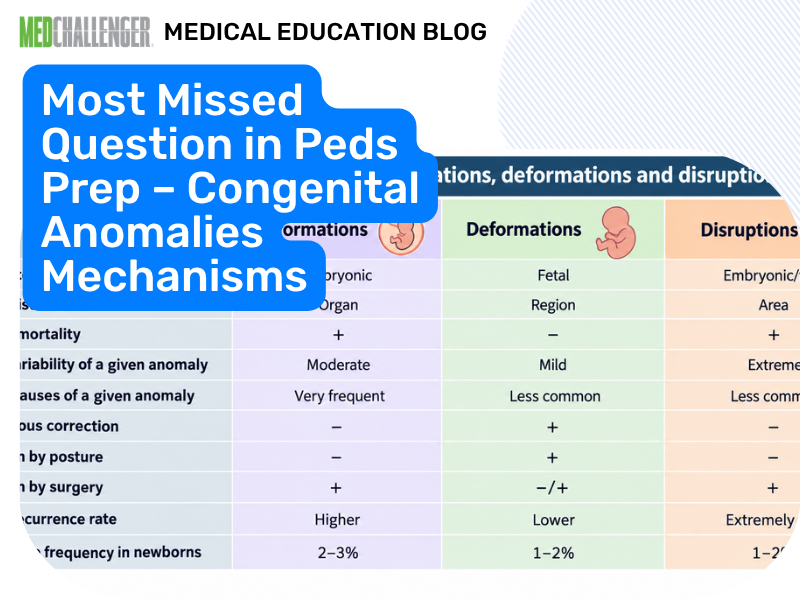
Breech-associated congenital hip dislocation is best explained by deformation—a mechanically induced distortion from intrauterine constraint rather than an intrinsic embryologic formation error.
Question – Mechanism term
A female infant is delivered via a scheduled cesarean delivery due to breech presentation. Ultrasonography of the hips is scheduled when she is 1 month old, and she is found to have bilateral hip dislocations.
Which of the following terms best describes the mechanism that could have caused this birth defect?
Answer Options:
A. disruption
B. dysplasia
C. deformation
D. malformation
E. agenesis
Breech presentation is a major risk factor for developmental dysplasia of the hip (DDH) per the American Academy of Pediatrics clinical report (2016) and is consistent with an extrinsic “packaging” problem. In congenital anomalies terminology, that maps to a deformation: an abnormal form, position, or alignment caused by mechanical forces (eg, crowding, constraint, abnormal fetal position). Exam writers commonly test that deformations are often musculoskeletal and occur later in gestation after the structure initially forms.
Learners miss this because “developmental dysplasia of the hip” contains the word dysplasia, but in birth defects classification “dysplasia” refers to abnormal cellular/tissue organization (often diffuse) rather than constraint-related positional deformity. The boards want the mechanism term, not the clinical label.
Why This Pediatric Medicine Question Is Often Missed
- The term DDH misleads test-takers into selecting dysplasia instead of the birth-defect mechanism (deformation).
- Many clinicians remember breech as a DDH risk factor (AAP 2016; AAOS 2022) but don’t map it to the congenital anomaly taxonomy.
- Confusion between “intrinsic developmental error” (malformation) vs “extrinsic constraint” (deformation).
What the Distractors Indicate
| Option |
What It Tests / Implies |
Why It’s Wrong Here |
| disruption |
Secondary destruction of a normally formed structure (eg, amniotic bands causing limb defects) |
No destructive event; hip instability/dislocation here is from constraint/positioning. |
| dysplasia |
Abnormal organization of cells within tissues (often generalized) |
Breech-associated hip dislocation is a mechanical packaging issue, not primary tissue architecture abnormality. |
| deformation |
Mechanical forces/constrained intrauterine environment altering shape/position |
Matches breech constraint and classic “packaging” musculoskeletal findings (eg, hip dislocation, torticollis). |
| malformation |
Intrinsic error of organ/tissue formation during embryogenesis (eg, CHD, NTD) |
The hip forms; abnormal positioning/relationship results from extrinsic forces later in gestation. |
| agenesis |
Complete absence due to failure of primordium formation (eg, renal agenesis) |
Not applicable; the hips are present. |
High-Yield Pearl for Exam Prep
Breech + congenital hip dislocation = deformation (packaging/constraint), not “dysplasia,” despite the DDH name.
Core Learning Objectives
- Distinguish deformation, malformation, disruption, and dysplasia using mechanism-based definitions.
- Apply the congenital anomaly taxonomy to a common pediatric board scenario: breech-associated DDH/hip dislocation.
The Exam “Test Trick” at Play
The test exploits terminology collision: “developmental dysplasia of the hip” tempts you toward “dysplasia,” but the stem gives you the true mechanism clue—breech presentation, an extrinsic mechanical constraint. When the mechanism is uterine positioning/crowding, the expected answer is deformation.
Additional Practice Questions and Remediation for Congenital Anomaly Mechanisms
Pediatric Medicine Practice Question 1 - Breech packaging
A term newborn delivered breech has congenital torticollis and metatarsus adductus. Which mechanism best explains these findings?
- A. Malformation
- B. Deformation
- C. Disruption
- D. Dysplasia
- E. Agenesis
Pediatric Medicine Practice Question 2 - Amniotic band
A newborn has distal limb constriction rings and autoamputation of toes; prenatal course notable for amniotic bands. Mechanism?
- A. Malformation
- B. Deformation
- C. Disruption
- D. Dysplasia
- E. Agenesis
Pediatric Medicine Practice Question 3 - Neural tube defect
A fetus is diagnosed with spina bifida aperta on prenatal ultrasound. Which mechanism best describes this anomaly?
- A. Malformation
- B. Deformation
- C. Disruption
- D. Dysplasia
- E. Agenesis
Pediatric Medicine Practice Question 4 - Skeletal dysplasia pattern
A newborn has disproportionate short limbs and radiographic findings consistent with achondroplasia; multiple bones are affected. Mechanism category?
- A. Malformation
- B. Deformation
- C. Disruption
- D. Dysplasia
- E. Agenesis
Pediatric Medicine Practice Question 5 - Renal absence
Prenatal ultrasound shows unilateral absent kidney with normal contralateral kidney and bladder. Best mechanism term?
- A. Malformation
- B. Deformation
- C. Disruption
- D. Dysplasia
- E. Agenesis
Mini Case Discussion Prompt
How would your mechanism classification change between (1) breech-associated hip dislocation, (2) amniotic band limb defects, and (3) achondroplasia—and what single stem clue most reliably distinguishes each on boards?
Mini FAQ
Q1: Why isn’t “dysplasia” the best answer for DDH?
A: On boards, “dysplasia” in congenital anomaly taxonomy means abnormal tissue organization, whereas DDH in breech infants is typically tested as mechanical packaging → deformation (AAP 2016; AAOS 2022 emphasize breech as a major risk factor).
Q2: What’s the fastest way to recognize a deformation in a stem?
A: Look for constraint/crowding clues: breech, oligohydramnios, multiple gestation, uterine anomalies—then think deformation.
Q3: How do tests distinguish disruption from deformation?
A: Disruption involves tissue loss/destruction after normal formation (eg, amniotic bands), while deformation is molding/positional change without a destructive event.
Q4: Which category is most associated with single-organ embryologic formation errors?
A: Malformation—an intrinsic developmental error during organogenesis (eg, neural tube defects, many congenital heart defects).
Find this and other Pediatric Medicine exam prep questions in Med-Challenger Pediatric Medicine Exam Review with CME
Try for free and save. Ace your exams and meet your CME/MOC requirements for just $35 a month!
/PEDS%20CHALLENGER.png?width=250&height=218&name=PEDS%20CHALLENGER.png)
No matter your program, no matter the size, Med-Challenger for Groups and Institutions can better prepare your program or group, fulfill industry requirements, and increase test scores.
For personal medical education that includes board's prep, MOC, and CME requirements, Med-Challenger has you covered in Family Medicine, Emergency Medicine, Internal Medicine, Pediatrics, Pediatric Emergency Medicine, OBGYN, Physician Assistants, and Nurse Practitioners.
Never miss a thing. Subscribe to our blog and save!