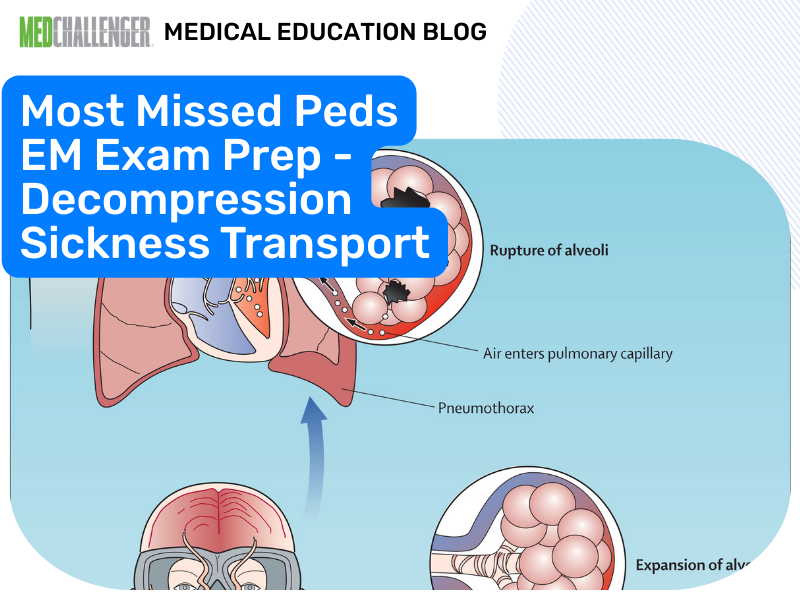
Patients with severe decompression sickness should be transferred for hyperbaric oxygen while avoiding altitude exposure—pressurized fixed-wing transport is usually the safest air option.
Question – Transport mode
A 16 yo boy is on a scuba diving trip with his father. They have done multiple deep dives in the last 2 days. Today the teenager developed joint pains and lethargy. He is taken to a nearby hospital and started on 100% oxygen at 15 L/min via non-rebreather mask. Despite this intervention, he continues to have worsening mental status. You, the referring physician, arrange for transfer to a tertiary ED that is 140 miles away.
The best mode of transport for this patient is:
Answer Options:
- A. Fixed wing aircraft
- B. Ground transport
- C. Helicopter that will fly at an altitude of 1000 feet above sea level
- D. Helicopter that will fly at an altitude of 1500 feet above sea level
Fixed-wing aircraft is the most exam-reliable choice because it is the option most compatible with a pressurized cabin and the ability to maintain a very low cabin altitude (ideally sea level). The clinical problem is that this stem describes significant/worsening DCS with neurologic involvement, and any reduction in ambient pressure (altitude) can expand inert gas bubbles and worsen symptoms.
Where this item can trip people up is the altitude threshold language: the remediation’s “must be below 500 feet” is more rigid than many contemporary exam references. Major diving medicine resources (e.g., U.S. Navy Diving Manual 2016; UHMS/DAN guidance) consistently emphasize:
- Give 100% oxygen, supportive care, and definitive recompression (hyperbaric oxygen) ASAP.
- Minimize altitude exposure during transport; pressurized aircraft is preferred, typically with cabin pressure equivalent to sea level/lowest possible.
- If unpressurized flight is unavoidable, keep altitude as low as operationally possible (commonly taught as around ≤1,000 ft in many dive-medicine teaching resources), recognizing that exact cutoffs vary by reference and scenario.
Given the options, “fixed wing aircraft” best matches the transport method that can be pressurized and controlled for cabin altitude over a 140-mile transfer in a deteriorating patient.
Why This Pediatric Emergency Medicine Question Is Often Missed
- Test-takers remember “air is bad” for DCS but forget that pressurized fixed-wing can be the *best* air option.
- The distractors exploit confusion between aircraft type and cabin altitude/pressurization (helicopters are typically unpressurized).
- Over-fixation on a single “magic altitude number” instead of the principle: lowest cabin altitude possible.
What the Distractors Indicate
| Option |
What It Tests / Implies |
Why It’s Wrong Here |
| Fixed wing aircraft |
Recognition that **pressurization** can control cabin altitude |
**Best option provided** for rapid transfer while minimizing altitude exposure (when pressurized). |
| Ground transport |
Avoidance of altitude entirely |
Too slow for a 140-mile transfer in a patient with **worsening mental status** needing urgent recompression capability. |
| Helicopter at 1000 ft |
Knowledge of “low altitude” mitigation |
Helicopters are typically **unpressurized**; even “low” altitude still reduces ambient pressure and may worsen DCS, and operational altitude may vary. |
| Helicopter at 1500 ft |
Same, but higher altitude |
Even greater pressure reduction → **higher risk** of worsening symptoms. |
High-Yield Pearl for Exam Prep
For serious suspected DCS, transfer for hyperbaric therapy with 100% oxygen and avoid altitude—pressurized fixed-wing with the lowest achievable cabin altitude is preferred.
Core Learning Objectives
1. Identify severe decompression sickness features that warrant urgent hyperbaric consultation/transfer.
2. Choose transport strategies that minimize ambient pressure reduction (altitude) during DCS evacuation.
The Exam “Test Trick” at Play
The stem baits you into choosing “no air transport” or “low-altitude helicopter,” but boards usually want the higher-order concept: pressurization and cabin altitude control matter more than “air vs ground” in isolation—especially when the patient is neurologically worsening and time to hyperbaric capability matters.
Additional Peds EM Practice Questions and Remediation - Decompression Sickness Transport
Pediatric Emergency Medicine Practice Question 1 — Neuro DCS triage
A 28-year-old diver develops confusion and ataxia 30 minutes after surfacing. He is on 100% oxygen. The nearest hyperbaric chamber is 2 hours away. Best next step?
- A. Discharge if symptoms improve after 30 minutes of oxygen
- B. Immediate hyperbaric consultation and transfer while continuing 100% oxygen
- C. Give IV furosemide to reduce pulmonary edema risk
- D. Start prophylactic heparin for presumed air embolism
- E. Place in Trendelenburg position
Pediatric Emergency Medicine Practice Question 2 - Transport principle
A diver with suspected DCS needs transfer. Which transport condition is most important to prevent clinical worsening?
- A. Cabin temperature below 20°C
- B. Lowest possible cabin altitude (ideally sea level)
- C. Avoid IV fluids to prevent pulmonary edema
- D. Withhold oxygen to avoid oxygen toxicity
- E. Hyperventilate to accelerate nitrogen washout
Pediatric Emergency Medicine Practice Question 3 - Ground vs air
A 17-year-old diver has severe joint pain and paresthesias but stable vitals. Hyperbaric center is 30 miles away by ground and 20 minutes by helicopter (unpressurized, typical flight altitude ~1,500–2,000 ft). Best transport choice?
- A. Ground transport with 100% oxygen
- B. Helicopter transport at typical altitude without pressurization
- C. Delay transfer until symptoms fully resolve
- D. Fixed-wing unpressurized to 3,000 ft
- E. No transfer needed if pain improves
Pediatric Emergency Medicine Practice Question 4 - Gas embolism clue
A diver surfaces rapidly and immediately develops seizures and focal weakness. Best initial ED therapy?
- A. Nitrous oxide analgesia and observation
- B. 100% oxygen and immediate hyperbaric consultation
- C. High-dose steroids for spinal cord inflammation
- D. Mannitol for presumed intracranial pressure crisis
- E. Induce hypothermia
Pediatric Emergency Medicine Practice Question 5 - Pressurized fixed-wing nuance
Which statement best reflects exam-consensus transport guidance for severe DCS?
- A. Helicopter is preferred because it is faster than fixed-wing
- B. Pressurized fixed-wing with sea-level/lowest cabin altitude is preferred when air transport is necessary
- C. Any flight is contraindicated regardless of pressurization
- D. If oxygen is given, altitude no longer matters
- E. Only divers with rash require hyperbaric therapy
Mini Case Discussion Prompt
Compare transport decisions for (1) mild joint pain improving on oxygen vs (2) worsening neurologic symptoms: how do time-to-chamber and cabin altitude constraints change your “ground vs pressurized fixed-wing vs helicopter” choice?
Mini-FAQ
Q1: What feature in this stem makes the case high risk?
A: Worsening mental status after repetitive deep dives suggests serious neurologic DCS/possible arterial gas embolism—boards expect urgent hyperbaric planning and expedited transfer.
Q2: Why isn’t “ground transport” automatically the best answer?
A: Ground avoids altitude, but if time is long and the patient is deteriorating, exam logic favors the option that can be rapid and minimize cabin altitude—typically pressurized fixed-wing.
Q3: What’s the board-relevant takeaway about helicopters?
A: The ABP/PEM-style testing point is that helicopters are usually unpressurized and may fly at altitudes that worsen symptoms; “low altitude” claims can be unreliable operationally.
Q4: Do guidelines agree on an exact safe altitude cutoff?
A: Not perfectly—most agree on the principle: pressurize to sea level/lowest cabin altitude and avoid altitude when possible; specific numeric thresholds (e.g., 500 vs 1,000 ft) vary across references.
Find this and other Pediatric Emergency Medicine exam prep questions in Med-Challenger Pediatric Emergency Medicine 3rd Edition Exam Review with CME
Try for free and save. Ace your exams and meet your CME/MOC requirements.