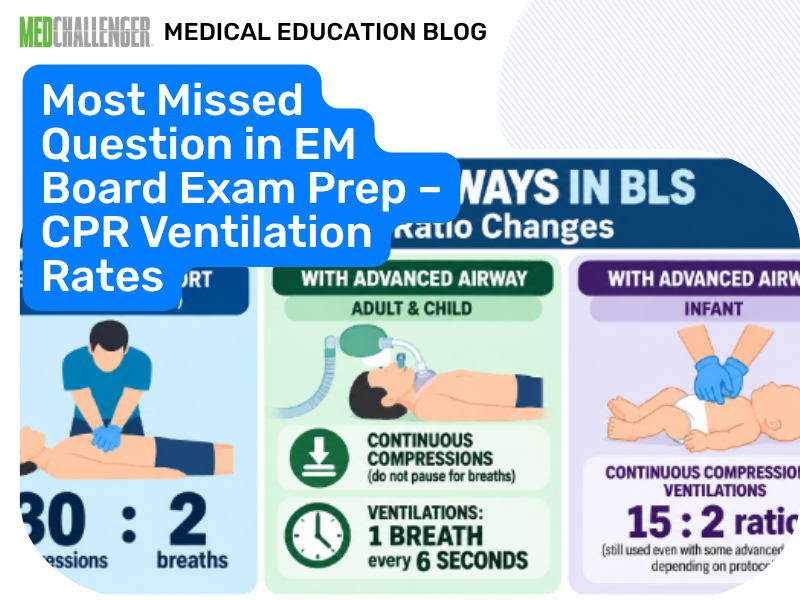
Once an advanced airway is placed during CPR, compress continuously at 100–120/min and ventilate asynchronously (adults 10/min; pediatrics 20–30/min).
Question - CPR ratios
According to American Heart Association (AHA) cardiopulmonary resuscitation guidelines, which statement correctly describes compression and ventilation during cardiac arrest?
Apply neonatal resuscitation guidance separately to newborns at birth.
Answer Options:
A. Single rescuer: adults and children without an advanced airway use a 30:2 compression-to-ventilation ratio; infants without an advanced airway use a 15:2 ratio.
B. Two rescuers: adults, children, and infants without an advanced airway all use a 15:2 compression-to-ventilation ratio.
C. Newborns with an advanced airway receive continuous, unsynchronized compressions at 120 compressions/minute and 1 breath every 3 seconds.
D. With an advanced airway, adults receive 1 breath every 6 seconds, whereas infants and children receive 1 breath every 2–3 seconds; all receive continuous compressions at 100–120/minute without synchronizing breaths to compressions.
A common exam miss is mixing adult/pediatric AHA BLS/PALS with neonatal resuscitation (NRP), or incorrectly continuing a 30:2 or 15:2 ratio after an advanced airway is secured. The boards often test the pivot point: “advanced airway placed → no pauses for breaths.”
Per AHA 2020 CPR & ECC Guidelines: with an advanced airway during cardiac arrest, provide continuous compressions at 100–120/min and ventilate asynchronously—adults: 1 breath every 6 seconds (10/min); infants/children: 1 breath every 2–3 seconds (20–30/min). Newborns at birth are handled under NRP, where compressions (when indicated) are typically coordinated 3:1 with a target of ~120 events/min (90 compressions + 30 breaths).
Why This Emergency Medicine Question Is Often Missed
- Confusing pediatric two-rescuer BLS ratio (15:2) with the advanced-airway scenario (no fixed ratio).
- Carrying the adult “10 breaths/min” rule into pediatrics (pediatrics are 20–30/min with an advanced airway).
- Blurring NRP (newborn at birth) with infant/child cardiac arrest algorithms.
What the Distractors Indicate
| Option |
What It Tests / Implies |
Why It’s Wrong Here |
| Single rescuer |
Single-rescuer ratios; attempts to differentiate infant vs child/adult |
Single rescuer for infant/child is 30:2, not 15:2 (15:2 is two-rescuer pediatric). |
| Two rescuers |
Overgeneralizes pediatric two-rescuer ratio to all ages |
Adults without an advanced airway remain 30:2 regardless of rescuer number (AHA BLS). |
| Newborns with an advanced airway receive continuous, unsynchronized compressions at 120 compressions/minute and 1 breath every 3 seconds. |
Misapplies post–advanced airway “asynchronous” concept to newborn at birth |
NRP uses 3:1 coordinated compressions:ventilations when compressions are indicated; “continuous compressions + q3 sec breaths” is not the NRP standard. |
| With an advanced airway, adults receive 1 breath every 6 seconds, whereas infants and children receive 1 breath every 2–3 seconds; all receive continuous compressions at 100–120/minute without synchronizing breaths to compressions. |
Correct AHA advanced-airway ventilation rates by age group |
Correct: continuous compressions 100–120/min + asynchronous ventilation (adult 10/min; pediatrics 20–30/min). |
High-Yield Pearl for ABEM Exam Prep
Advanced airway in CPR = continuous compressions + asynchronous ventilation (adult 10/min, pediatrics 20–30/min)—no 30:2 or 15:2 ratio anymore.
Core Learning Objectives
- Distinguish CPR compression–ventilation strategies with vs without an advanced airway for adults and pediatrics per AHA.
- Differentiate neonatal resuscitation at birth (NRP) from infant/child AHA pediatric cardiac arrest algorithms.
The Exam Trick at Play
The stem’s “apply neonatal guidance separately” is a deliberate trap: the test wants you to keep adult/peds AHA CPR rules straight while not letting NRP’s 3:1 framework contaminate infant/child arrest management outside the delivery room.
Additional Practice Questions & Remediation for CPR Compression–Ventilation
Emergency Medicine Practice Question 1 — Adult BLS ratio
An adult is in cardiac arrest. Two rescuers provide BLS with a bag-mask device and no advanced airway. What compression-to-ventilation ratio should they use?
- A. 15:2
- B. 30:2
- C. 3:1
- D. Continuous compressions with 1 breath every 6 seconds
- E. Continuous compressions with 1 breath every 2 seconds
Emergency Medicine Practice Question 2 — Pediatric two-rescuer ratio
A 4-year-old is pulseless. Two rescuers begin CPR with a bag-mask and no advanced airway. What ratio is recommended?
- A. 30:2
- B. 15:2
- C. 3:1
- D. Continuous compressions with 10 breaths/min
- E. Continuous compressions with 30 breaths/min
Emergency Medicine Practice Question 3 — Adult with advanced airway
An intubated adult remains in VF arrest during ACLS. What ventilation strategy is recommended while compressions continue?
- A. 30:2 with pauses for breaths
- B. 15:2 with pauses for breaths
- C. 1 breath every 6 seconds with continuous compressions
- D. 1 breath every 2–3 seconds with continuous compressions
- E. 3:1 coordinated compressions:ventilations
Emergency Medicine Practice Question 4 — Pediatric with advanced airway
A 2-year-old is intubated during CPR for asystole. Which ventilation rate is most appropriate?
- A. 1 breath every 6 seconds
- B. 1 breath every 2–3 seconds
- C. 30:2
- D. 15:2
- E. 3:1
Emergency Medicine Practice Question 5 — Newborn at birth (NRP)
A term newborn has HR 40/min despite effective ventilation. Compressions are started and an endotracheal tube is placed. Which compression–ventilation approach is recommended?
- A. Continuous compressions at 100–120/min and 10 breaths/min
- B. Continuous compressions at 100–120/min and 20–30 breaths/min
- C. 3:1 coordinated compressions:ventilations targeting ~120 events/min
- D. 15:2
- E. 30:2
Mini Case Discussion Prompt
How would your ventilation strategy differ between (1) a 6-month-old in out-of-hospital cardiac arrest after drowning once intubated, and (2) a newly delivered term newborn with persistent bradycardia despite effective ventilation?
Mini-FAQ
Q1: When do you stop using 30:2 or 15:2 during CPR?
A: The ABIM/ABEM-style exams expect you to switch to continuous compressions with asynchronous ventilation once an advanced airway is in place (AHA 2020).
Q2: Why is pediatric ventilation faster than adult ventilation with an advanced airway?
A: Boards test that pediatrics generally require higher ventilation rates during CPR with an advanced airway (20–30/min) compared with adults (10/min) per AHA 2020 pediatric vs adult guidance.
Q3: Does intubation change the neonatal (NRP) 3:1 ratio?
A: No—NRP at birth still prioritizes a 3:1 coordinated pattern when compressions are indicated; exams treat neonatal resuscitation as a separate algorithm (AHA/NRP 2020).
Q4: What compression rate should you target during CPR with an advanced airway in adults and pediatrics?
A: 100–120/min with minimal interruptions; ventilation is delivered asynchronously (AHA 2020).
Find this and other Emergency Medicine exam prep questions in Med-Challenger Emergency Medicine Review with CME
Try for free and save. Ace your exams and meet your CME/MOC requirements for just $35 a month!