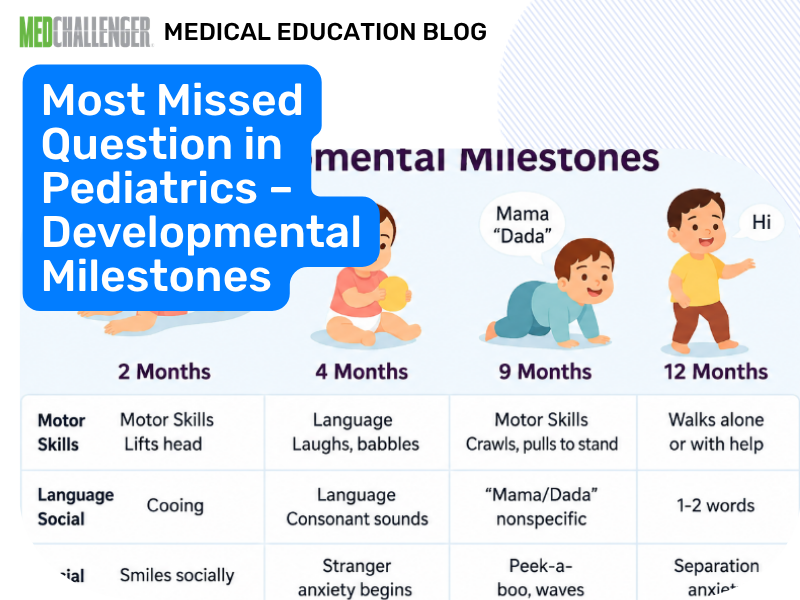
Correctly clustering milestones (gross motor + language + fine motor) is the fastest way to answer board-style “what age is this infant?” questions.
Question – Milestone clustering
An infant is starting to roll over, coo, and laugh out loud, but cannot sit or use a raking grasp. What is the most likely age of this baby?
Answer Options:
A. 2 months
B. 4 months
C. 6 months
D. 9 months
E. 12 months
The database-keyed answer (4 months) is consistent with current, exam-relevant developmental milestone references, but the provided remediation is overly rigid about what “belongs” at exactly 6 months (particularly fine-motor timing). Current milestone frameworks (e.g., CDC 2022 milestone updates and AAP Bright Futures developmental surveillance expectations) emphasize ranges and “most children by” ages, not single fixed cutoffs.
That said, the cluster here—starting to roll, cooing, and laughing out loud—most strongly matches the ~4-month developmental window. The negative qualifiers (“cannot sit” and “cannot use a raking grasp”) mainly function to exclude older ages (6+ months), when independent sitting and more purposeful grasping are more likely to be present.
Validated correct option: B. 4 months (supported by CDC developmental milestone groupings and AAP developmental surveillance norms within preventive care guidance).
Why This Pediatric Medicine Question Is Often Missed
- Test-takers anchor on a single milestone (e.g., “roll over”) instead of triangulating gross motor + language + fine motor.
- Confusion between “emerges at” vs “most children can do by” milestone phrasing.
- Over-reliance on rigid month-to-month lists rather than age ranges used in modern surveillance (CDC/AAP).
What the Distractors Indicate
| Option |
What It Tests / Implies |
Why It’s Wrong Here |
| 2 months |
Early social smile, improved head control |
Rolling + laughing out loud is typically later than 2 months; cooing may start near this time but the *cluster* is older. |
| 4 months |
Early rolling, laughter, vocalizing |
Best match for combined milestones; absence of sitting and mature grasp supports this. |
| 6 months |
Sitting with minimal support/independently (varies), babbling, more deliberate grasping |
The stem’s “starting to roll” is generally earlier; many 6-month-olds have progressed beyond early rolling and show more advanced fine motor. |
| 9 months |
Crawling/pulling to stand, pincer development emerging, stranger anxiety |
Too advanced; rolling/cooing/laughing are well-established earlier. |
| 12 months |
Independent walking (variable), single words, mature pincer, pointing |
Far too advanced for the described skill set. |
High-Yield Pearl for Exam Prep
When a stem lists multiple milestone domains, pick the age that best fits the overall cluster, not the most memorable single skill.
Core Learning Objectives
- Identify the most likely age for infants based on combined gross motor and social/language milestones.
- Avoid common board traps by distinguishing early emergence milestones from later consolidating milestones (e.g., sitting, grasp patterns).
The Exam “Test Trick” at Play
The question uses negative milestones (“cannot sit,” “cannot use a raking grasp”) to push you away from older ages, while the positives (rolling + cooing + laughing) define the developmental window. Boards reward pattern recognition across domains, not perfect recall of one-month increments.
Additional Practice Questions and Remediation for Developmental Milestones (Infancy)
Pediatric Medicine Practice Question 1 - Infant smiles
A term infant smiles responsively and briefly lifts the head when prone but does not laugh yet. Most likely age?
- A. 2 months
- B. 4 months
- C. 6 months
- D. 9 months
- E. 12 months
Pediatric Medicine Practice Question 2 - Roll + laugh
An infant laughs, brings hands to midline, and rolls from prone to supine. Most likely age?
- A. 2 months
- B. 4 months
- C. 6 months
- D. 9 months
- E. 12 months
Pediatric Medicine Practice Question 3 - Sits and babbles
A 6-month-old well-child check: which finding is most expected?
- A. No vocalizations except crying
- B. Babbles and sits with support or briefly without support
- C. Uses 2-word phrases
- D. Walks without assistance
- E. Copies a circle
Pediatric Medicine Practice Question 4 - Fine motor progression
Which fine motor skill is most consistent with ~9–12 months rather than 4–6 months?
- A. Hands to midline
- B. Palmar grasp of a rattle
- C. Raking grasp to pick up small objects
- D. Immature-to-mature pincer grasp emerging
- E. Swats at objects
Pediatric Medicine Practice Question 5 - Pincer grasp
An infant coos and laughs but cannot sit independently and does not have a pincer grasp. Best age?
- A. 2 months
- B. 4 months
- C. 9 months
- D. 12 months
- E. 18 months
Mini Case Discussion Prompt
How would your age estimate change if the infant could sit unsupported but still only cooed (no babbling), and what differential diagnoses would that milestone dissociation raise on a pediatrics board exam?
Mini FAQ
Q1: On boards, should I treat milestones as exact month cutoffs?
A: No—ABP-style questions usually reward recognizing typical clusters and ranges, consistent with CDC milestone framing and AAP developmental surveillance.
Q2: Why do questions include “cannot do X yet”?
A: ABP-style stems use negatives to exclude older ages (e.g., independent sitting, pincer grasp) when the positive milestones suggest a younger infant.
Q3: Is “cooing” strictly a 3-month milestone?
A: It’s an early language milestone that can appear around 2–3 months; exam writers often accept it as present by ~3–4 months, so you should use the whole cluster.
Q4: What’s the safest way to answer milestone-age questions quickly?
A: Pick the age that best fits gross motor + social/language + fine motor, then sanity-check by excluding ages that would almost certainly have later milestones (e.g., sitting, pincer, stranger anxiety).
Find this and other Pediatric Medicine exam prep questions in Med-Challenger Pediatric Medicine Exam Review with CME
Try for free and save. Ace your exams and meet your CME/MOC requirements for just $35 a month!
/PEDS%20CHALLENGER.png?width=250&height=218&name=PEDS%20CHALLENGER.png)
No matter your program, no matter the size, Med-Challenger for Groups and Institutions can better prepare your program or group, fulfill industry requirements, and increase test scores.
For personal medical education that includes board's prep, MOC, and CME requirements, Med-Challenger has you covered in Family Medicine, Emergency Medicine, Internal Medicine, Pediatrics, Pediatric Emergency Medicine, OBGYN, Physician Assistants, and Nurse Practitioners.
Never miss a thing. Subscribe to our blog and save!