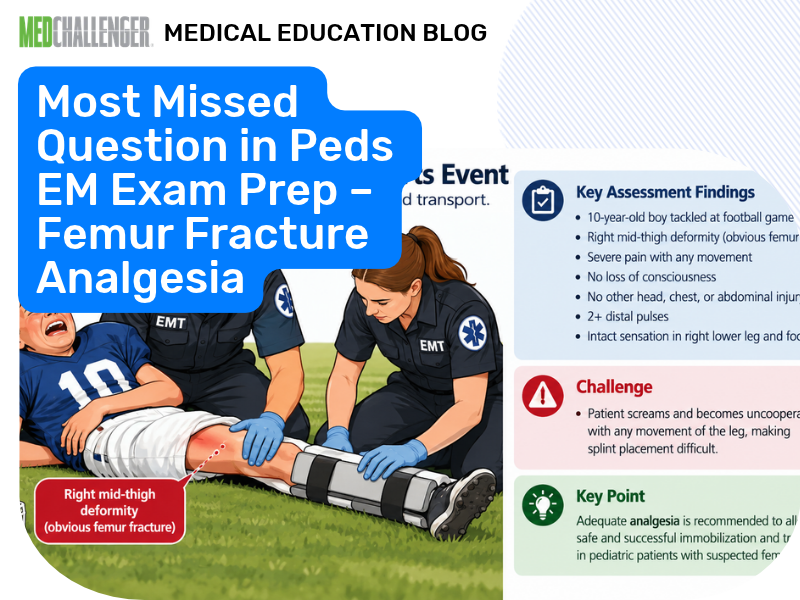
In a tiered BLS/ALS EMS system, severe femur-fracture pain that prevents splinting should trigger ALS/paramedic response for analgesia, not forced restraint or transport without immobilization.
Question – EMS analgesia decision
As a medical control physician in a tiered-response EMS system, EMTs responded to call at a youth football game where a 10 yo boy was tackled, and now has a right mid-thigh deformity with obvious femur fracture and is in severe pain. There was no loss of consciousness, and he has no other head, chest or abdominal injury on assessment. He has 2+ distal pulses and intact sensation in his right lower leg and foot. EMTs are attempting to immobilize the right leg in a splint, but the patient screams and becomes uncooperative with any movement of the leg.
EMTs on scene call online medical control to ask what to do. Your next best response is to:
Answer Options:
A. Advise the EMTs to transport the child without placing the leg in a splint
B. Give a verbal order to the EMT to give Morphine IV for pain to facilitate splint placement
C. Recommend the EMTs call their regional Paramedic for pharmacological intervention
D. Recommend the EMTs have coaches hold patient down while they splint the child’s leg
Severe pain is not a “comfort issue” on boards—untreated pain can directly interfere with required care (splinting/traction), increase movement at the fracture site, and risk worsening bleeding, swelling, and neurovascular compromise. The key testable point is matching the needed intervention to the provider level and scope in a tiered-response system.
Option C is best because EMT-BLS crews commonly cannot initiate IV access or administer IV opioids under the NASEMSO National EMS Scope of Practice Model (2019) framework (exact permissions vary by state/agency). Calling for ALS/paramedic response (or rendezvous) is the exam-reliable move when analgesia beyond BLS scope is required to enable immobilization.
Why this shows up as a miss: learners often choose “give morphine” because it is clinically sensible in the ED. But prehospital medical control must stay within protocol + scope: you can’t order a BLS EMT to perform ALS-only skills, and restraining a terrified child to splint without analgesia is both unsafe and contrary to pediatric pain-management standards emphasized by the American Academy of Pediatrics (within the last decade) in EMS-focused guidance.
Why This Pediatric Emergency Medicine Question Is Often Missed
- Test-takers answer as if they are in an ED with full nursing/medication capability, not a tiered BLS/ALS field model.
- Confusion between “EMT” vs “paramedic” capabilities across regions; boards usually test the classic national model.
- Underestimation of how essential analgesia is for successful splinting/immobilization.
What the Distractors Indicate
| Option |
What It Tests / Implies |
Why It’s Wrong Here |
| Advise the EMTs to transport the child without placing the leg in a splint |
“Minimize scene time; just go” |
Transporting an unstable, unsplinted femur fracture increases movement/pain and may worsen bleeding and swelling; immobilization is indicated when feasible. |
| Give a verbal order to the EMT to give Morphine IV for pain to facilitate splint placement |
Using online medical control to authorize IV opioid |
In most tiered systems, BLS EMTs cannot start IVs or give IV morphine (scope/protocol issue per NASEMSO model and common state protocols). |
| Recommend the EMTs call their regional Paramedic for pharmacological intervention |
Recognizing need for ALS analgesia and appropriate escalation |
Correct: request paramedic/ALS intervention so pain control can allow safe immobilization (and consider traction splinting when appropriate per protocol). |
| Recommend the EMTs have coaches hold patient down while they splint the child’s leg |
Physical restraint to complete a procedure |
Unsafe/ethically problematic; increases risk of iatrogenic injury and treats the patient’s pain/anxiety as a behavioral problem rather than a medical one. |
High-Yield Pearl for Exam Prep
When pain prevents necessary immobilization in a child and the responding crew is BLS, the board-safe answer is: request ALS for analgesia, not restraint or “just transport.”
Core Learning Objectives
- Identify when pediatric extremity trauma pain requires escalation from BLS to ALS to enable safe immobilization.
- Apply scope-of-practice principles to online medical control decisions in tiered EMS systems.
The Exam “Test Trick” at Play
The stem tempts you to practice ED medicine (“just give morphine”), but the question is actually about prehospital system design and scope: BLS providers may recognize the need for analgesia yet be unable to deliver IV opioids. The correct action is operational—activate ALS resources—while still prioritizing humane, effective pain control.
Additional Peds EM Practice Questions and Remediation for Prehospital Pediatric Pain & Immobilization
Pediatric Emergency Medicine Practice Question 1 - BLS vs ALS escalation
A 12-year-old with an obvious displaced forearm fracture is crying and refuses splinting. BLS EMTs have intact distal pulses and no other injuries. Best online medical control instruction?
- A. Tell them to restrain the child to complete splinting
- B. Request ALS/paramedic for analgesia per protocol and continue nonpharmacologic comfort measures
- C. Transport without splinting to save time
- D. Attempt procedural sedation with midazolam IM
- E. Have a parent “hold the arm straight” during transport
Pediatric Emergency Medicine Practice Question 2 - Scope-of-practice recognition
In a tiered system, an EMT asks for permission to start an IV and give fentanyl for a femur fracture. Best response?
- A. Approve; online medical control can override scope limits
- B. Decline and request ALS/paramedic response for medication administration
- C. Tell them to give oral ibuprofen and proceed with traction splinting
- D. Tell them to give ketamine IM, then splint
- E. Tell them to apply no immobilization until arrival at ED
Pediatric Emergency Medicine Practice Question 3 - Immobilization principle
Which injury most strongly supports attempting immobilization before transport when feasible?
- A. Isolated ankle sprain with mild pain
- B. Displaced mid-shaft femur fracture with severe pain
- C. Minor scalp laceration
- D. Viral croup without stridor at rest
- E. Isolated finger contusion
Pediatric Emergency Medicine Practice Question 4 - Nonpharmacologic measures while awaiting ALS
While awaiting paramedic intercept for analgesia, which action is most appropriate?
- A. Forcefully straighten the leg to anatomic position
- B. Gentle manual stabilization in the position found, reassure, and minimize movement
- C. Ignore the child’s distress to avoid “reinforcing” crying
- D. Apply traction with untrained bystanders
- E. Encourage the child to stand to “test” the leg
Pediatric Emergency Medicine Practice Question 5 - Board-style operational endpoint
A 9-year-old with a suspected femur fracture has normal distal neurovascular exam but severe pain. BLS can’t splint due to pain. Best “system” endpoint?
- A. Cancel ALS to reduce cost; proceed BLS-only
- B. Activate ALS response for analgesia and coordinate intercept while continuing immobilization attempts within tolerance
- C. Direct the coaches to assist with restraint
- D. Delay transport indefinitely until child “calms down”
- E. Tell family to drive to ED
Mini Case Discussion Prompt
How would your medical-control advice change if the responding unit were an ALS paramedic crew already on scene versus a BLS-only crew with a 20-minute ALS intercept ETA?
Mini-FAQ
Q1: Why isn’t “give IV morphine” the best answer if it’s clinically appropriate?
A: Because boards test prehospital scope-of-practice: in many tiered systems, BLS EMTs cannot start IVs or administer IV opioids (NASEMSO Scope of Practice Model 2019 is the common reference point).
Q2: Is transporting without a splint ever acceptable?
A: The ABP/EM-style expectation is that fractures should be immobilized when feasible; if pain prevents it, you address pain (often via ALS) rather than accept avoidable motion and suffering.
Q3: Is physical restraint ever appropriate for splinting a child?
A: Rarely and only in extreme situations (e.g., immediate life threats); for isolated femur fracture pain, restraint is a red-flag answer because it ignores analgesia/anxiolysis principles emphasized in AAP EMS-focused pain guidance.
Q4: Could an EMT give intranasal analgesia in some places?
A: Yes in some jurisdictions/protocols, but exam questions usually assume the standard tiered model where opioid/advanced analgesia is ALS-level unless the stem specifies otherwise.
Find this and other Pediatric Emergency Medicine exam prep questions in Med-Challenger Pediatric Emergency Medicine 3rd Edition Exam Review with CME
Try for free and save. Ace your exams and meet your CME/MOC requirements.