Quick clinical clue question on suspected infective endocarditis—focuses on murmur changes, peripheral stigmata, and how Duke criteria guide diagnostic certainty in febrile patients.
Findings are most consistent with infective endocarditis. Obtain blood cultures promptly, arrange echocardiography (TTE → TEE if high suspicion), and consult ID/cardiology while considering empiric IV antibiotics.
A 54-year-old man presents to his physician’s office with the complaint of fever of 2 weeks duration. His temperature has varied between 101° and 103°. He has had no chills, cough, or urinary symptoms. Over the past few days, he has had painful “lumps” on the toes of his feet.
Two months ago, the patient underwent a diagnostic left heart catheterization without acute intervention. The patient’s past history was otherwise uneventful. He exercises regularly, does not smoke and drinks 5-6 glasses of wine a week.
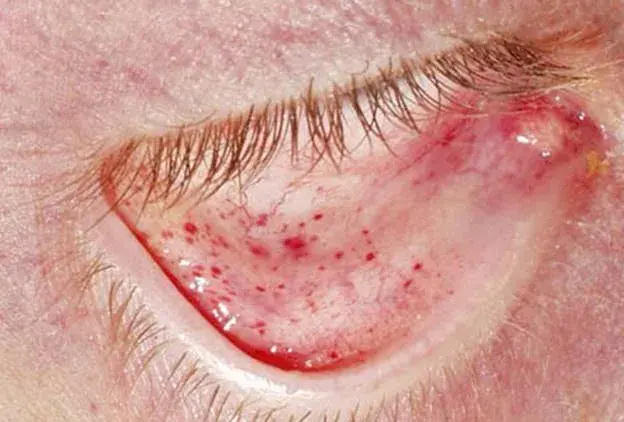
Physical examination reveals a patient who appears mildly ill. Temperature is 102° F, Blood Pressure is 132/80 in the right arm, Pulse is 96 and regular, and Respirations 16/minute. Examination of the skin reveals a very tender nodule on the flexor surface of distal interphalangeal (DIP) joint of the 3rd finger and cyanotic changes at the tips of three fingers (Fig 1). The lesion is papular and is very tender. There are a moderate number of petechiae along the inner surface of the conjunctiva of the lower lid of the right eye (Fig 2).
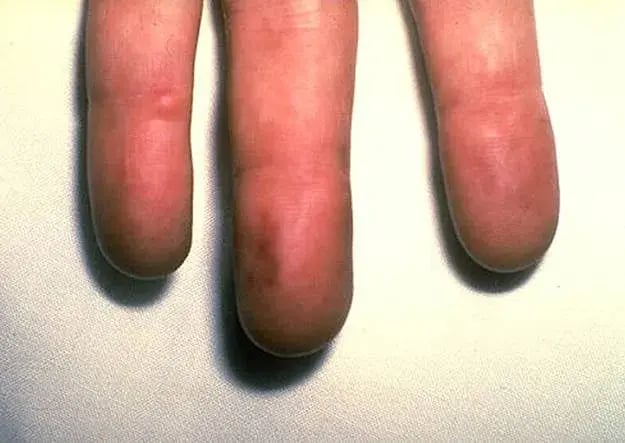 Figure 1. Osler Node
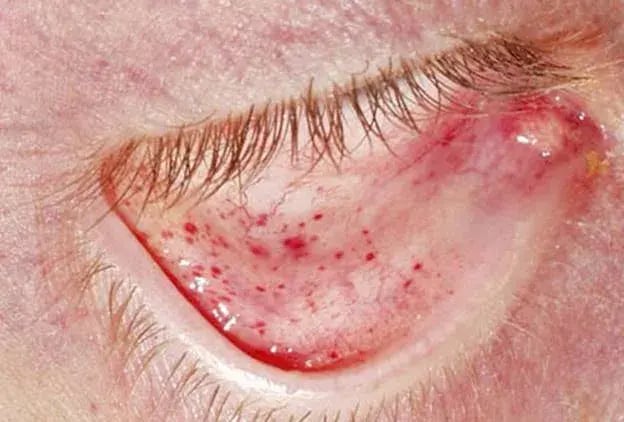 Figure 2. Conjunctival Petechiae
Examination of the heart reveals a Grade III holosystolic murmur at the apex. It is noted to be louder than previously recorded. The remainder of the physical examination is normal.
Which of the following essentially confirm a diagnosis of bacterial endocarditis in this febrile patient?
Answer Options:
- Worsening of a pre-existing heart murmur and conjunctival petechiae
- Osler nodes and fever
- Osler nodes and vascular emboli
- Fever and vascular emboli
The correct answer is #1.
Why This Question Is Often Missed
– Learners focus on “classic” findings (Osler nodes, Janeway lesions) and overlook that a new or changed murmur is a major Duke criterion, whereas Osler nodes are only minor.
– Conjunctival petechiae are subtle and often mistaken for nonspecific irritation, yet they count as a vascular (minor) criterion.
What the Distractors Indicate
| Option |
What It Tests / Implies |
Why It’s Wrong Here |
| Osler nodes and fever |
Immunologic phenomena + general sign |
Both are Duke minor criteria – two minors alone don’t confirm definite IE. |
| Osler nodes and vascular emboli |
Immunologic + vascular phenomena |
Two minor criteria; still insufficient for “definite” endocarditis. |
| Fever and vascular emboli |
Fever + vascular phenomena |
Again, two minor criteria without any major criterion. |
| Worsening of a pre-existing murmur and conjunctival petechiae |
New regurgitation (major) + vascular phenomenon (minor) |
Only combination here with ≥1 major criterion → confirms definite IE. |
High-Yield Pearl
A changing or new regurgitant murmur is a major Duke criterion—pair it with any vascular or immunologic sign, and you’ve clinched the diagnosis.
Core Learning Objectives
- Apply the Modified Duke Criteria to distinguish major versus minor findings in suspected infective endocarditis.
- Differentiate immunologic (e.g., Osler nodes) from vascular phenomena (e.g., conjunctival petechiae, Janeway lesions) and know their weight in the diagnostic algorithm.
The “Test Trick” at Play
This item hinges on knowing that only new valve regurgitation (a major criterion) combined with a single minor criterion is enough for a definite IE diagnosis—many distractors use two minors (Osler, fever, emboli) which are tempting but insufficient.
Additional IM Practice Questions and Remediation
ABIM Exam Practice Question 1
A 58-year-old IV drug user has had 2 weeks of fever, blood cultures positive for S. aureus, and a newly detected holosystolic murmur at the apex. Which combination meets definite IE by Duke criteria?
A. Positive blood cultures + new regurgitant murmur
B. Positive blood cultures + splinter hemorrhages
C. Fever + Janeway lesions
D. Osler nodes + Janeway lesions
ABIM Exam Practice Question 2
A 62-year-old with suspected endocarditis has tender nodules on fingertips and painless, flat erythematous macules on palms and soles. Which pairing correctly classifies them?
A. Janeway lesions = immunologic; Osler nodes = vascular
B. Osler nodes = immunologic; Janeway lesions = vascular
C. Janeway lesions = immunologic; splinter hemorrhages = vascular
D. Splinter hemorrhages = immunologic; Janeway lesions = vascular
ABIM Exam Practice Question 3
Which of the following combinations represents one major and one minor Duke criterion?
A. New regurgitant murmur + Osler nodes
B. New regurgitant murmur + conjunctival petechiae
C. Fever + Janeway lesions
D. Positive echo showing vegetation + Osler nodes
Mini Case Discussion Prompt
Discuss how immunologic phenomena (Osler nodes, Roth spots) versus vascular phenomena (Janeway lesions, petechiae) reflect different pathophysiologic mechanisms in infective endocarditis, and how recognizing each influences both diagnosis and management.
This question appears in Med-Challenger Internal Medicine Review with CME
Try for free and save. Ace your exams and meet your CME/MOC requirements for just $35 a month!