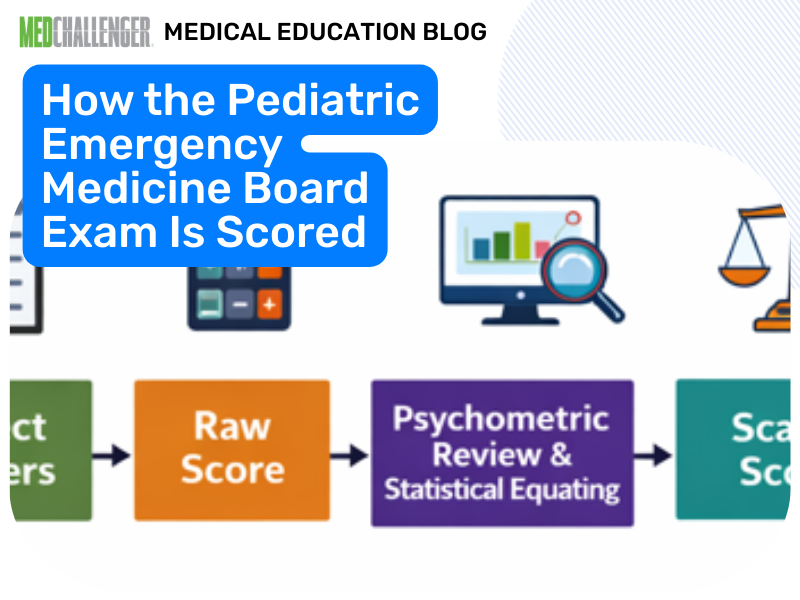
Physicians preparing for the Pediatric Emergency Medicine (PEM) board exam often want to understand how their performance on the test will be evaluated. While candidates typically focus most of their energy on studying clinical material, understanding how the exam is scored can help clarify what it means to pass the certification exam.
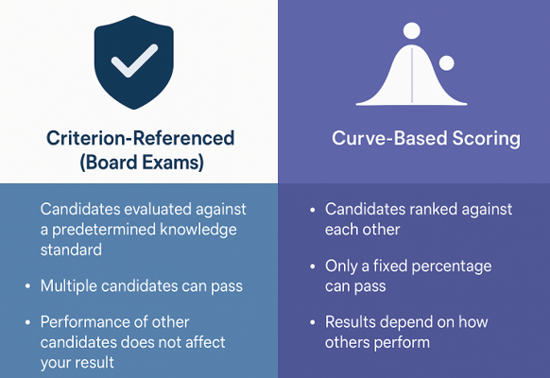
The Pediatric Emergency Medicine certification exam is designed to determine whether physicians possess the knowledge expected for safe and independent subspecialty practice. Rather than ranking candidates against one another, the exam uses a criterion-referenced scoring system, meaning candidates are evaluated against a predetermined standard of knowledge.
Understanding how the Pediatric Emergency Medicine board exam is scored helps candidates interpret their results and understand how pass–fail decisions are determined. For a full overview of the certification process, see the Pediatric Emergency Medicine Board Exam Guide.
Criterion-Referenced Scoring on the PEM Board Exam
The pediatric emergency medicine certification exam uses a criterion-referenced scoring model. In this type of system, a candidate’s performance is evaluated against a defined level of competence rather than compared with the performance of other test-takers.
This means that passing the exam depends on demonstrating sufficient knowledge of pediatric emergency medicine—not on achieving a certain percentile relative to other candidates.
Criterion-referenced scoring is commonly used in professional certification exams because it focuses on determining whether candidates meet the knowledge standard required for safe clinical practice.
For the PEM boards, this standard represents the level of knowledge expected from a physician who has successfully completed accredited pediatric emergency medicine fellowship training.
👉 What to Expect on the Pediatric Emergency Medicine Board Exam
How the Passing Standard Is Determined
The passing standard for the pediatric emergency medicine board exam is established through a formal standard-setting process conducted before the exam is administered.
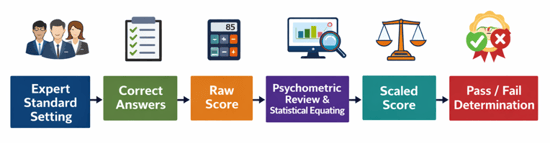
During this process, panels of experienced pediatric emergency medicine physicians review exam questions and evaluate how a minimally qualified candidate should perform on each item. These physicians consider the level of knowledge and clinical reasoning expected of a physician who has completed fellowship training and is ready for independent practice.
Using these expert judgments, the certification board determines the minimum level of performance required to pass the exam.
This approach helps ensure that the passing standard reflects real clinical expectations rather than arbitrary numerical thresholds.
Scaled Scores and Exam Results
Although the exam is scored based on a predetermined passing standard, candidates typically receive their results in the form of a scaled score.
Scaled scoring helps ensure fairness across different versions of the exam. Because each exam administration may contain slightly different questions, statistical methods are used to adjust scores so that results remain comparable across exam forms.
This process ensures that candidates are evaluated consistently regardless of which specific version of the exam they receive.
Scaled scores therefore represent a standardized measure of performance rather than a simple percentage of questions answered correctly.
👉 Creating a Study Plan for the Pediatric Emergency Medicine Boards
What Determines a Passing Result?
Ultimately, passing the pediatric emergency medicine board exam depends on whether a candidate’s scaled score meets or exceeds the predetermined passing standard.
If a candidate’s score meets this threshold, the physician is considered to have demonstrated the knowledge required for subspecialty certification.
If the score falls below the standard, the candidate does not pass the exam and must retake the examination at a future administration.
Importantly, because the exam is criterion-referenced, the number of other candidates who pass or fail does not influence an individual candidate’s result.
Why the PEM Board Uses Criterion-Based Scoring
Professional medical certification exams aim to ensure that physicians possess the knowledge required for safe and effective patient care.
A criterion-referenced scoring system supports this goal by focusing on competence rather than competition. Every candidate who meets the required standard can pass the exam, and the performance of other test-takers does not affect individual results.
This approach ensures that certification decisions reflect whether physicians have achieved the level of knowledge expected of pediatric emergency medicine subspecialists.
How Candidates Should Interpret Their Exam Results
After completing the pediatric emergency medicine board exam, candidates receive official score reports from the certifying board.
These reports indicate whether the candidate passed or did not pass the exam and typically include a scaled score reflecting overall performance.
Some score reports may also provide general feedback about performance in broad content areas. This information can help candidates identify areas for improvement if they need to retake the exam.
Frequently Asked Questions
Is the pediatric emergency medicine board exam graded on a curve?
No. The exam uses a criterion-referenced scoring system, meaning candidates are evaluated against a predetermined standard rather than compared with other test-takers.
What score is required to pass the PEM board exam?
The exact numerical passing score is determined through a standard-setting process conducted by the certification board. Candidates must achieve a scaled score that meets or exceeds this passing standard.
What is a scaled score?
A scaled score is a standardized score used to ensure fairness across different versions of an exam. It accounts for minor differences in exam difficulty between test forms.
Does the performance of other candidates affect my score?
No. Because the exam uses criterion-referenced scoring, your result depends only on whether your performance meets the required standard.
Next Step: Registering for the Pediatric Emergency Medicine Board Exam
After understanding how the exam is scored, the next step for candidates is learning how to apply for and schedule the exam.
How to Register for the Pediatric Emergency Medicine Board Exam explains the application process, required documentation, and important deadlines candidates should know before scheduling the test.