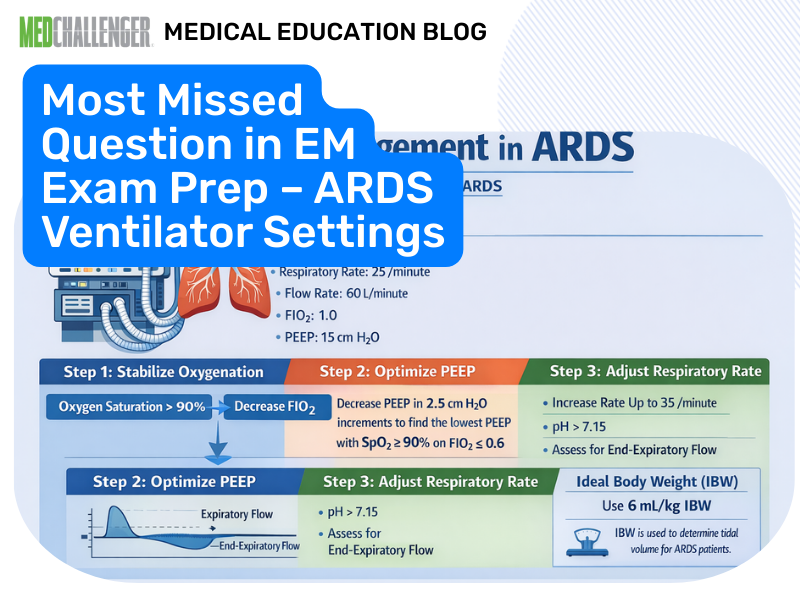
ARDS board questions reliably reward recognition of low tidal volume ventilation (~6 mL/kg predicted/ideal body weight) with plateau pressure limitation as the intervention linked to improved mortality.
Question - Ventilator Setting
You intubate a 30-year-old woman for acute respiratory distress syndrome (ARDS). Which of the following respirator settings is associated with decreased mortality in patients with ARDS?
Answer Options:
A. Plateau pressure > 30 cm H2O
B. Positive end-expiratory pressure (PEEP) of 10-15 H2O
C. Peak inspiratory pressure > 30 cm H2O
D. Tidal volume 6 to 7 mL/kg/ideal body weight (IBW)
Low tidal volume ventilation (classically 6 mL/kg predicted/ideal body weight) is the most consistently guideline-backed ventilator strategy associated with improved mortality in ARDS, along with limiting plateau pressure to ≤30 cm H₂O (ATS/ESICM/SCCM 2017). PEEP is generally used in ARDS and titrated to oxygenation and recruitability (often via PEEP/FiO₂ tables); it is not accurate to teach “little or no PEEP” as a mortality-improving strategy.
Why This Emergency Medicine Question Is Often Missed
- Test-takers confuse peak inspiratory pressure with plateau pressure (ARDS targets plateau, not peak).
- Some learners memorize a single “PEEP number,” but PEEP strategy is individualized and the option provided is not a uniquely mortality-proven setting.
- “Lung-protective ventilation” is often remembered vaguely; boards expect the numeric tidal volume target based on IBW/PBW.
What the Distractors Indicate
| Option |
What It Tests / Implies |
Why It’s Wrong Here |
| A. Plateau pressure > 30 cm H₂O |
Understanding of plateau pressure limits |
Plateau pressures **>30** increase risk of ventilator-induced lung injury; guidelines emphasize **≤30 cm H₂O**. |
| B. PEEP 10–15 cm H₂O |
PEEP selection in ARDS |
PEEP is not a single fixed mortality setting; ARDS management uses **PEEP/FiO₂ titration** (and often higher PEEP in more severe ARDS), not “10–15” as a universal mortality-improving choice. |
| C. Peak inspiratory pressure > 30 cm H₂O |
Confusion between peak vs plateau pressure |
Peak pressure reflects airway resistance + compliance; targeting a *high* peak pressure is not protective and is not the mortality-linked parameter. |
| D. Tidal volume 6–7 mL/kg IBW |
Lung-protective low VT ventilation |
This is the best-supported mortality-reducing setting (conceptually **~6 mL/kg PBW/IBW**, within 4–8) in ARDS. |
High-Yield Pearl for ABEM Exam Prep
In ARDS, the mortality-associated ventilator strategy is low tidal volume (~6 mL/kg PBW/IBW) while keeping plateau pressure ≤30 cm H₂O.
Core Learning Objectives
1. Identify the ventilator parameter in ARDS with the strongest association with reduced mortality: low tidal volume based on predicted/ideal body weight.
2. Distinguish plateau pressure (alveolar distending pressure; target ≤30) from peak inspiratory pressure (includes airway resistance) in ARDS test questions.
The Exam Trick at Play
This item exploits two common board traps: (1) offering “high pressure” options that sound like they might improve ventilation but actually worsen VILI risk, and (2) offering a plausible PEEP range even though PEEP is titrated and not the single most test-reliable mortality association compared with low VT based on PBW/IBW.
Additional Practice Questions & Remediation for ARDS Ventilation
Emergency Medicine Practice Question 1 — PBW dosing
A 68-year-old man meets Berlin criteria for ARDS. Which initial tidal volume is most appropriate to reduce ventilator-induced lung injury?
- A. 10–12 mL/kg actual body weight
- B. 6 mL/kg predicted (ideal) body weight
- C. 8–10 mL/kg ideal body weight
- D. 4 mL/kg actual body weight for all patients
- E. 12–15 mL/kg ideal body weight
Emergency Medicine Practice Question 2 — Choosing the “most mortality-linked” setting
Which ventilator change has the best evidence for mortality reduction in ARDS?
- A. Increase tidal volume to normalize PaCO₂
- B. Avoid permissive hypercapnia at all costs
- C. Reduce tidal volume to ~6 mL/kg predicted body weight
- D. Use zero PEEP to prevent barotrauma
- E. Increase FiO₂ to 1.0 indefinitely
Emergency Medicine Practice Question 3 — IBW vs actual weight
A 5'2" (157 cm) woman with obesity is ventilated for ARDS. To set lung-protective ventilation, tidal volume should be calculated using:
- A. Actual body weight
- B. Predicted/ideal body weight based on height and sex
- C. BMI category
- D. Lean body mass measured by bioimpedance
- E. Body surface area
Mini Case Discussion Prompt
How would your ventilator adjustments differ between (1) ARDS with severe hypoxemia requiring escalating PEEP/FiO₂ and (2) obstructive physiology with high peak pressures but normal plateau pressures?
Mini-FAQ
Q1: Why do boards emphasize tidal volume in ARDS?
A: Because the ABIM/ABEM-style expectation is recognition that low VT based on predicted/ideal body weight is the most consistently demonstrated mortality-reducing ventilator strategy in ARDS.
Q2: Why is plateau pressure more important than peak pressure for lung injury?
A: Plateau pressure best reflects alveolar distending pressure (static compliance), which is directly linked to volutrauma/barotrauma risk; peak pressure is confounded by airway resistance.
Q3: Is “PEEP 10–15” always correct for ARDS?
A: No—exam writers more often test that PEEP is titrated (e.g., PEEP/FiO₂ tables) and that “no/low PEEP” is not a general ARDS mortality strategy.
Q4: Do you have to use volume-control to get the mortality benefit?
A: No—the board-relevant principle is achieving low VT and safe plateau pressures; mode (VC vs PC) is secondary to meeting lung-protective targets.
Find this and other Emergency Medicine exam prep questions in Med-Challenger Emergency Medicine Review with CME
Try for free and save. Ace your exams and meet your CME/MOC requirements for just $35 a month!